


Director of the Utopia Festival for Science Fiction and Future Story-telling. As the Promethean Consultancy, program curator, PMO, artistic consultant and producer, writer and speaker on topics of technology and society, science fiction and the future.
Elon Musk. Itamar Ben Gvir. Yahya Sinwar. As an anxious person who lives in Tel-Aviv, I spend day and night overthinking everything, especially the future. I toss and turn every night with intrusive thoughts. It’s extremely hard to avoid these people, their friends and followers, the ideas they promote and their influence on the world around me. But equally important, it’s hard to ignore their impact on me, my loved ones, my friends and my immediate surroundings.
Elon Musk is the wealthiest man on Earth, for a while Grand Vizier to the President of the United States, not the charlatan we need, but the one we deserve, it seems. Itamar Ben Gvir, a convicted felon charged with supporting a terrorist organization, now National Security Minister in the Israeli government. Yahya Sinwar is no more, dead, assassinated. But, while he was still with us, Ben Gvir’s terrorism offence and conviction would have been an embarrassment, mere child’s play in comparison to his actions. Why did I group these men into one list? For me, all three are (or were) doing their best to bring forth the Messiah. Their social, cultural, financial and religious backgrounds are as different as Heaven from Earth, and Mars. They are, however, all working toward the same goal. They are “The Eternals”. For them, our present existence is only a transitional phase, a necessary evil on the way to the messianic era, the Utopia that could be and should be, here and now. It’s just around the corner, within our lifetimes.
Forever Beyond the Horizon
Utopia has always been, and will always be, beyond our reach. As Uruguayan author Eduardo Galeano says, “always beyond the horizon”. It has to be, by definition, a half-forgotten daydream, a vague memory of a story you once heard, maybe. Not a tangible reality, not a coherent plan of action, but not pure fiction either. It might have happened. It well might happen, one day.
Look at the efforts taken by Sir Thomas More, the author of the original Utopia (1516), to distance himself from his own manuscript. The book was written as a documentation of a letter, the summary of a conversation More had with Raphael Hythloday, a mysterious world traveller More met while visiting a friend in Antwerp. Raphael Hythloday had just returned from a bold voyage to “the new world”, there he met the Utopians, on an island at the heart of Atlantic ocean. He was greatly impressed by their way of life and customs and reported what he had learned. What part of this is memory? What part is fiction or a hidden wish? And whose? And just as Utopia itself is a Greek pun, “the perfect place” that is also “nowhere”, Hythloday’s name is also a play on words, meaning “speaker of nonsense” in Greek, making it clear none of it was true. Or was it?
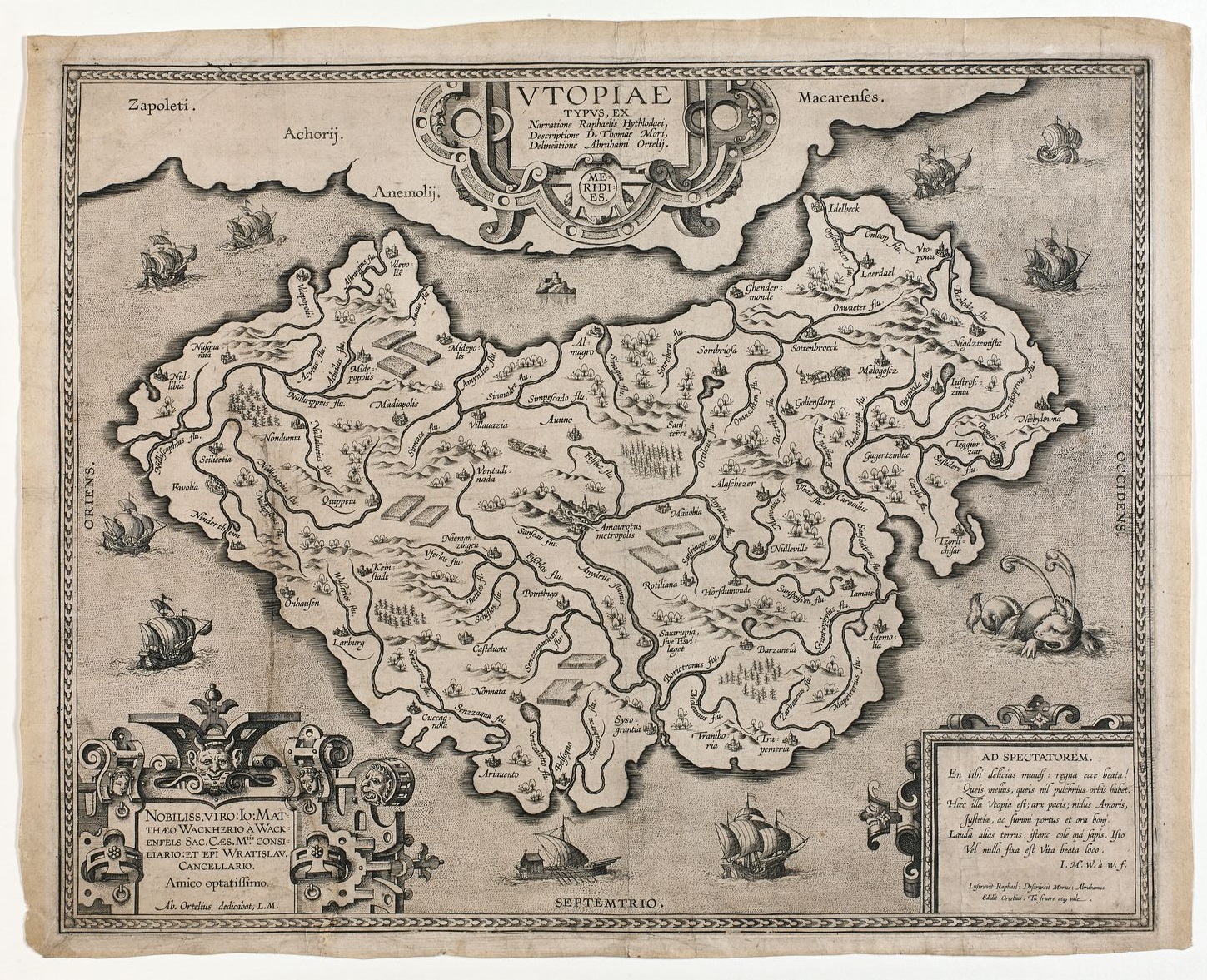
Map of Utopia as imagined by Antwerp cartographer Abraham Ortelius from Sir Thomas More’s famous text, circa 1595 | The original map, engraved in copper, is presented at the Plantin-Moretus Museum in Antwerp, thanks to the King Bedouin Foundation and the Charles Vreeken Fund.
Legendary Utopias existed long before Sir Thomas coined the term. Plato’s Atlantis is a utopian society, and notice how Plato, when speaking about Atlantis, distances it from himself and the reality of his time, in similar manner. Plato claims the knowledge of Atlantis reached him as stories passed down through the generations by one of his ancestors, the statesman Solon (who lived 200 years prior). Solon himself heard the story from an Egyptian priest who described an advanced culture on a distant island ‘beyond the Pillars of Hercules’ (the Strait of Gibraltar), which had existed 9,000 years earlier (according to the date of their supposed conversation).
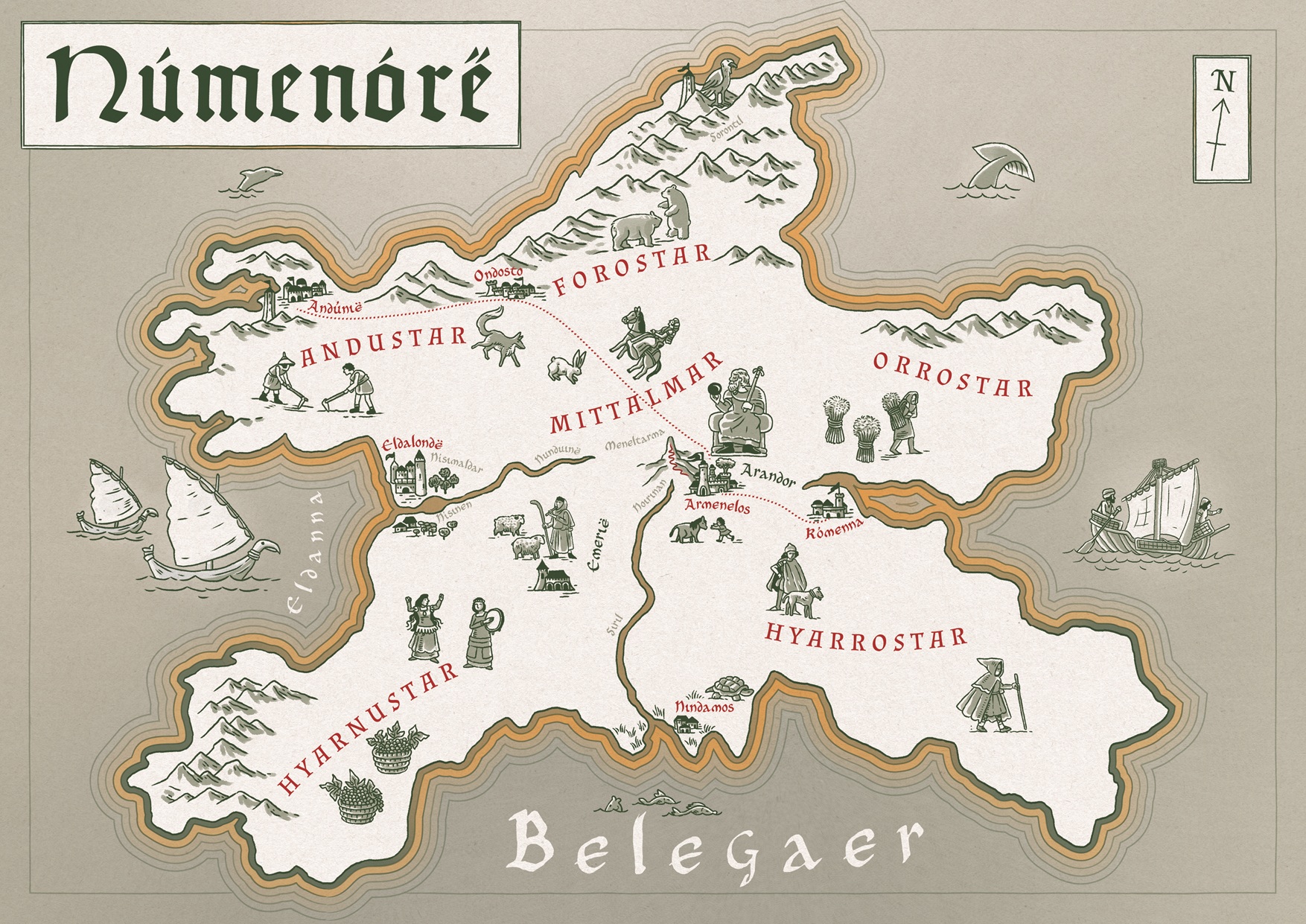
A map of Númenórë, a fictional island kingdom in the world created by J.R.R. Tolkien, specifically The Lord of the Rings and The Silmarillion. The island-kingdom was destroyed and sunk into the sea, henceforth it was called in the High Elvish language of Quenya, Atalantë, which means “The Downfallen”, a wink by Tolkien to the myth of Atlantis. Map design: The Tipsy Racoon.
The grand Israeli monarchy of King David and Solomon is also identified by many Biblical scholars as a legend with Utopian elements, conceived already during Biblical times, specifically during the reign of King Josiah (7th century BCE, at least two centuries after the supposed collapse of the monarchy). The mythology’s purpose was to give a glorious common past to two distinct Canaanite groups: Israelites from the northern kingdom of Samaria, destroyed by the Assyrian Empire, arriving en masse as refugees to their neighbours-distant-relatives in the Southern kingdom of Judah.
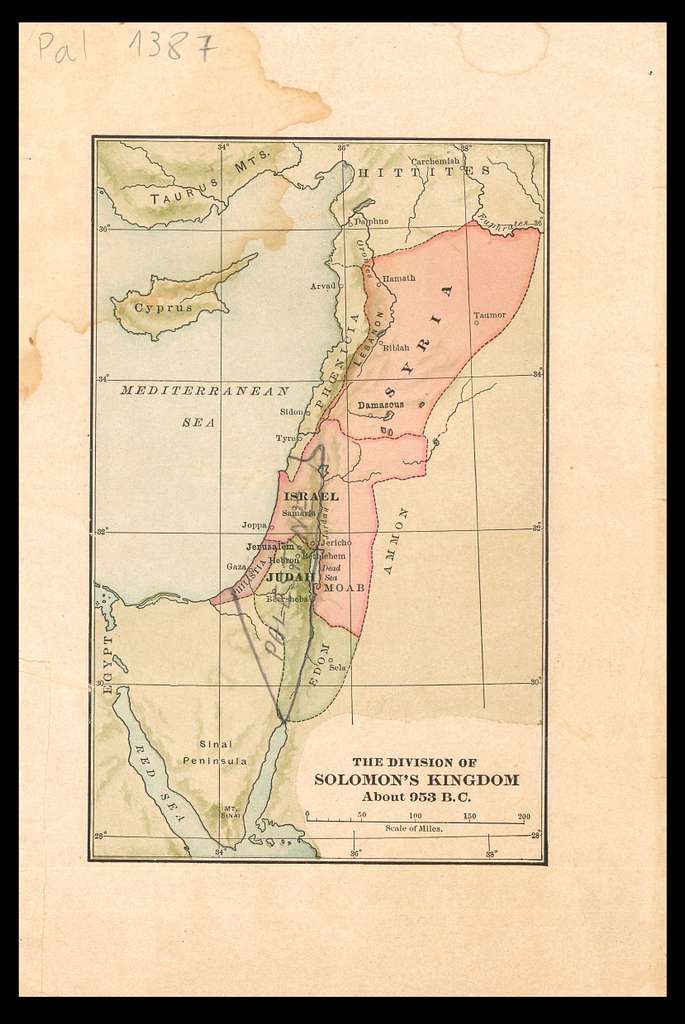
The mythical united kingdom of greater Israel under the reign of Kings David and Solomon, prior to its division to the Northern Kingdom of Israel and Southern Kingdom of Judeah. Source: Wikipedia.
A great example of Utopias in Judaism and Hebrew culture are the “cities of refuge”, part of the planned infrastructure for the Hebrew “state-to-be” (the OG, conceived in Exodus under the leadership of Moses and Joshua, which was, then, still to come). The Bible (in The Old Testament books of Numbers and Deuteronomy) contains clear instructions for the establishment and purpose of the cities of refuge, in terms of city-planning but, more importantly, in their social, legal and ritualistic-religious role and meaning. These cities are sanctuaries for supposed criminals, where they can exist in a liminal state similar to the modern “accused, but not convicted”, while the wheels of justice turn slowly (in order to prevent the swift and brutal ‘justice’ of an inflamed mob and the ancient custom of blood vengeance). More than a thousand years later, the Talmudic scholars in the Jewish communities in Mesopotamia, living in exile under different Persian rulers, thoroughly explored the issue in all it’s complexity: urban planning, road signage and, of course, legal arguments about accusation and guilt, unintentional vs. deliberate, communal responsibility, justice and revenge. At the heart of it all, cities that are non-existent, cities that supposedly existed in the distant past and might exist again in the far-off future. A precise codification of the laws and regulations of a non-place, a “perfect place” – yet one that sustains a real society where very tangible events happen, such as accidental death or premeditated murder; a place that does not truly exist, whose existence drifts between a legend from the distant past and a dream, aspiration, a vision for the future.
The Journey To Utopia
Obviously, the journey to Utopia, which exists outside the familiar geographical and political landscapes, holds its own significance.
In Charlotte Perkin Gilman’s Herland (1915), the feminist Utopia is discovered by three young researches who embark on a journey to one of the last unexplored regions on Earth. They follow a rumour about a hidden land deep in the mountains, populated solely by women. In 1966, Marvel Comics first introduced The Black Panther (by Stan Lee and Jack Kirby), a black superhero from Wakanda, an African society far more progressive than any Western world nation, then and now, in every aspect – socially, economically, scientifically, and technologically. But a nation hidden from the eyes of outsiders.
Let’s not forget Herzl’s Utopia, of course. In his novel, the visionary of the state of Israel writes about a young educated, but discouraged, Viennese man (perhaps with some similarity to Herzl himself), who decides to accompany a Prussian aristocrat on a long journey and stay on a remote island. The year is 1902, and on the way to their island of solitude they stop in the Ottoman Empire region of Palestine. They visit Jaffa and Jerusalem and witness the shaky and unimpressive beginnings of Zionism. Twenty years later they return for a visit and pass by the same, sad, supposedly “Promised Land” (the same from the thousands years old legendary Utopias of the Kingdoms of David and Solomon, myth upon myth, again and again utilized for political purpose), and are surprised to see a vibrant culture, a progressive society and economy, revolutionary technological innovations, peace, equality, harmony, a true Utopia. This is Herzl’s Tel-Aviv. The name of the novel Altneuland, literally “Old-New Land”, was originally translated to Hebrew by Nachum Sokolov as Tel-Aviv, which has a poet flair in Hebrew and is also a Biblical reference, and in 1909 became the namesake for the first Hebrew city of the Jewish-Israeli new era. Tel-Aviv is itself of course also a legend, a fantastic vision for a possible future, beyond the event horizon. But the story isn’t set hundreds of years into the future like Star Trek, or tens of thousands of years ahead like in Asimov’s Foundation series or Frank Herbert’s Dune. Only twenty short years separate the “present” reality (1902) from the proposed Utopia.
Herzl’s vision for the future is as progressive as it is myopic, magnificent as it is exclusionary, concrete and ethereal, the most a 42-year-old European secular Jewish intellectual, journalist and playwright thrust into nation-building, could come up with.
Full-civil and political rights to all who live in the land, women and men, local Arabs, immigrant Jews, all religious practices and denominations accepted. Herzl envisions the Jewish Holy Temple rebuilt in Jerusalem, but doesn’t go into great detail on what exactly goes on there (chances are he didn’t really know, nor care) – but he does care enough to mention it is built in a new location, adjacent to the former, so as to not disturb the mosque and holy site for Islam. Jerusalem is also an international capital of peace and scientific exploration (think Geneva), where the Great Halls of Peace hold international summits and scientific conferences. Herzl’s Utopia does not diminish or dismisses the local Arab population but does see the Jewish-European immigration as a force of progress – industrial, cultural, political. While claiming a nation-state for the Jewish people, he even leapfrogs the nation-state itself, understanding the flaws inherent to the model, but doesn’t make it quite clear on how to resolve them or what’s exactly the governing model of this new land, aside of the obvious but unexplained peace, equality, harmony and indeed, democracy. How does that work in a multi-ethnic, multi-cultural, multi-religious, environment? Maybe because society is dominantly secular, with religion delegated to a layer of cultural practice. Maybe because everyone speaks German?
All to say, Herzl’s vision for a Zionist Utopia was singular, stood next to various other models and ideologies, and suffice to say that Herzl’s Utopia has far from materialized, while other forms of Zionism took shape. But Herzl does begin and end his Utopian novel in supposedly benign but inspirational words. “If you will it, it is no dream”.
This might sound obvious, but… Beware! Danger! Any attempt to enforce a Utopian worldview, not as a vision to aspire to, not as an idea to debate, not as a living, breathing model that evolves and changes over time, but as a complete, final and absolute state of being, has failed. Any attempt to see Utopia as a pragmatic, dogmatic and perfect plan to be executed quickly and completely, has repeatedly led to some of the greatest travesties and horrors in history. The reign of terror during the French revolution, mass starvation in the Soviet Union, infanticide by parents under China’s one-child policy, ethnic cleansing, forced-migration, mass graves, gas chambers, death camps and crematoriums, all in the name of some form or another of Utopia.
So, how to change the world, after all?
Impact
– Gavin Belson, CEO of fictional tech giant Hooli, from the television series Silicon Valley (Season 2, Episode 1, Datageddon).
Many words have been corrupted over the last two decades. One after the other, innovation, democratization, community, transparency, and empowerment have all been thrown into the gutter. Let’s add “impact” to the pile. Impact investing was first introduced by the Rockefeller Foundation in 2007, meaning investments intended not only to generate financial returns but to have social or environmental value. The field flourished, and the past decade and a half has been an era of impact.
Launching a startup isn’t what it used to be. Good ideas are everywhere; funding can be found by those who seek it. As always, everything depends on execution, but now the goal isn’t just making x20 the investment. That’s a given. How does a startup make the world better? Obviously, we all aspire for a better world, but how does “Uber for dentists, on the Blockchain” or “Airbnb for Dogs, with AI” establish not only user generation and retention, but “impact”? How does a startup contribute not only to the neighbourhood, city, community it serves, local-global, but also to the environment, society, governance, and humanity in general? After all, we’re responsible institutions, moral people, we’re not just doing business. We make the world a better place.
Sounds great. In principle. Beautiful. Exciting, even! But, of course, execution is key. To initiate, develop, launch and run a business is quite challenging from the get-go. How do you make sure the startup you’re steering not only functions and expands, pleases clients, retains its employees, satisfies investors, shareholders and, hopefully, your parents, but also contributes to society, the environment and humanity? How do you even measure something like that? Easy peasy. We all recognize, feel and know instinctively what is good, what contributes to and benefits society, the environment and humanity. Add some ESG, a bit of SDG, a few impressive presentations that include democratization and transparency, waving hands about empowering marginalized populations, and PR about the outreach program to help opioid-addicted polar bears, their world collapsed when the only car factory in Greenland shut down. Voila, impact!
(The writer is a hopeless cynic but is also self-aware and cares about change. There are many important and worthy funds, companies and startups in the impact field, that really make an impact. To paraphrase comedian Steven Wright’s line about lawyers, 99% of impact ventures give the rest a bad name).
An Unfair Competition – Your Local Pub vs Eternity!
Something else happened in the past two centuries, and even more precisely, the past 4 decades, one of the strangest social phenomena of our times: the dramatic jump in socio-economic inequality (in which society? Aside from exceptional cases, you’ll find this everywhere). Specifically – there are now more multi-millionaires and multi-billionaires than at any other time in modern history. In fact, the metrics themselves need constant revision, such as the redefinition of the upper 10th percentile. Are you considered super-rich with assets starting at 10 million dollars? Thirty million? A hundred million? Since the beginning of the decade, a new category of super-billionaires has emerged, with assets and wealth exceeding fifty billion dollars (24 people fall into this category according to the Wall Street Journal, as of early 2025).
If economic inequality is something we aim to reduce, then we are steadily and consistently moving backwards. Donald Trump recently praised the American gilded age of the late 19th century, a period of time when a tiny number of tycoons, industrialist aristocrats, robber barons, controlled massive monopolies, bought and sold politicians, and charged rents at their pleasure (Rockefeller, Carnegie, J.P. Morgan, Vanderbilt, and others). Yanis Varoufakis, Greek economist and thought-leader, believes we have gone even further back in time and calls the current era “techno-feudalism” (in his 2023 book Technofeudalism: What Killed Capitalism).
I used the term “strange” earlier because this creates psychological and social phenomena for which I have no other word. Effective Altruism, a philosophical-social-activist movement that has grown and gained popularity in the past decade, is one of those phenomena.
Imagine a scenario. You were lucky. You’re employee number fifty at Google, Facebook, Amazon, Apple, or a similar company. Congratulations. You’re 35 years old, maybe 40, and you’re most likely a multi-millionaire. You’ve bought every possible gift for every family member, both close and distant, partied with friends and have trust funds for your kids. Now it’s time to do something for the greater good. There’s a certain expectation for public involvement and philanthropy. The Rockefeller family donated the land on which the United Nations buildings were constructed in New York City. Carnegie established, among other things, a concert hall, a research institute, and a university. What about you? Fine, you’re not that filthy rich. No need to be dramatic. But you’ll save your local bar, the independent book shop, the city newspaper – now what?
One possible answer for you could be Effective Altruism (EA). Obviously, you could continue making donations to nonprofits, funds, institutes, get into political campaigns, or even people who just feel “right”. Then, after a few years, financial irregularities are revealed at the nonprofit. The politician? A scandal. It suddenly becomes work, sorting and filtering all the requests coming from everywhere. It’s hard to tell what genuinely would do good, what really would make an impact. Now you’re starting to doubt old decisions you made. Was funding that small book shop the right call? You revive a business against market forces, maybe you should have let the bookstore tank, and let business evolution do its thing. We’re not communists, after all. What would be an efficient, effective, and proper use of your influence, time, wealth and capital?
Effective altruism offers a philosophical and practical framework that has been embraced by many wealthy individuals in Silicon Valley for philanthropic giving. The goal is to do good and make sure that this good is objective and measurable. Let’s take the math, engineering, economical and business management skills, the very ones on which the Valley was built, and apply them to create maximum impact. Make a difference. Work for the greater good. A mainstream, human, global, scientific, objective, measurable and undeniable good. After all, nothing bad ever happened when mathematicians, engineers, and economists tried to figure out the answer to the most fundamental question in philosophy – what is good?
It’s not a new invention. It’s the same familiar Utilitarianism and the questions remain the same. With defining the metrics, the issue of timeframe arises. What will produce the most ‘good’, in the here and now? Maybe something else will do much more ‘good,’ for more people, down the line?
And here the confusion begins for most people. Understandably so. It is quite confusing. The average person can’t deal with such dilemmas intended for governments or kings. But what can you do when luck, life, fate or maybe unique personal talent and wise, accurate choices have brought you unexpected wealth (or maybe an inheritance? Always an option). How will you make the best use of this gift, this opportunity, for all of humanity? It’s a dilemma that would confuse most of us. Especially sci-fi buffs! After the friendly bar, the small bookshop, the local paper, what about more schools? More school programs? More Auschwitz tours? AIDS vaccines? Eradicating the West Nile Virus? But, really, these are minor issues. What about the big, existential problems? After all, the entire of humanity is in danger – asteroids, pandemics, artificial intelligence and nuclear weapons, which can combine to make an even greater calamity, and let us not forget – alien invasion. Given the chance to take part in preventing the apocalypse, wouldn’t you take it? And why only see the bad stuff when there’s so much potential for so much good? There’s hope in groundbreaking scientific research, at the bleeding edge of technological innovation. Science fiction? Star Trek! Not just the eradication of disease, poverty, and hunger, all almost within our reach. If we invest wisely, we could eliminate every existential threat and secure the future of humanity and its expansion into digital and galactic space – break through the boundaries of thought and consciousness, of the solar system and the entire galaxy, and finally, at last, put an end to pain, suffering, and death itself. One step away from divinity! Apotheosis, here we come!
Wouldn’t you throw in a fiver (of millions/billions, USD/EUR/GBP/RMB, Bitcoin) for another step, maybe the final important step, toward eternity? Utopia is within our grasp. Individual good, the community, the neighbourhood, the guys or the fam or all of society here and now, how could these compare to timeframes of hundreds or hundreds of thousands of years? The very thought of eternity, realizing an Earthly Utopia, can and will drive people mad and lead to horrific, monstrous, unimaginable acts that happen around us constantly.
Sam Bankman-Fried
Sam Bankman-Fried (SBF) was one of the leading voices and influential investors in the Effective Altruism community. He believed that, by gathering more and more wealth, along with political power, he would be able to give back to society and the environment and lead us to a better world. Bankman-Fried was a crypto prodigy, and one of the key lobbyists for the industry. He testified before congress on the subject several times, as he donated tens of millions to politicians in both major US parties. Bankman-Fried managed the cryptocurrency exchange FTX from a luxury residence in the Bahamas and it earned him billions. Too bad it was a massive Ponzi scheme that got him charged and convicted of corruption and fraud. On March 28, 2024, at the age of thirty-two, he began serving a 25-year prison sentence.
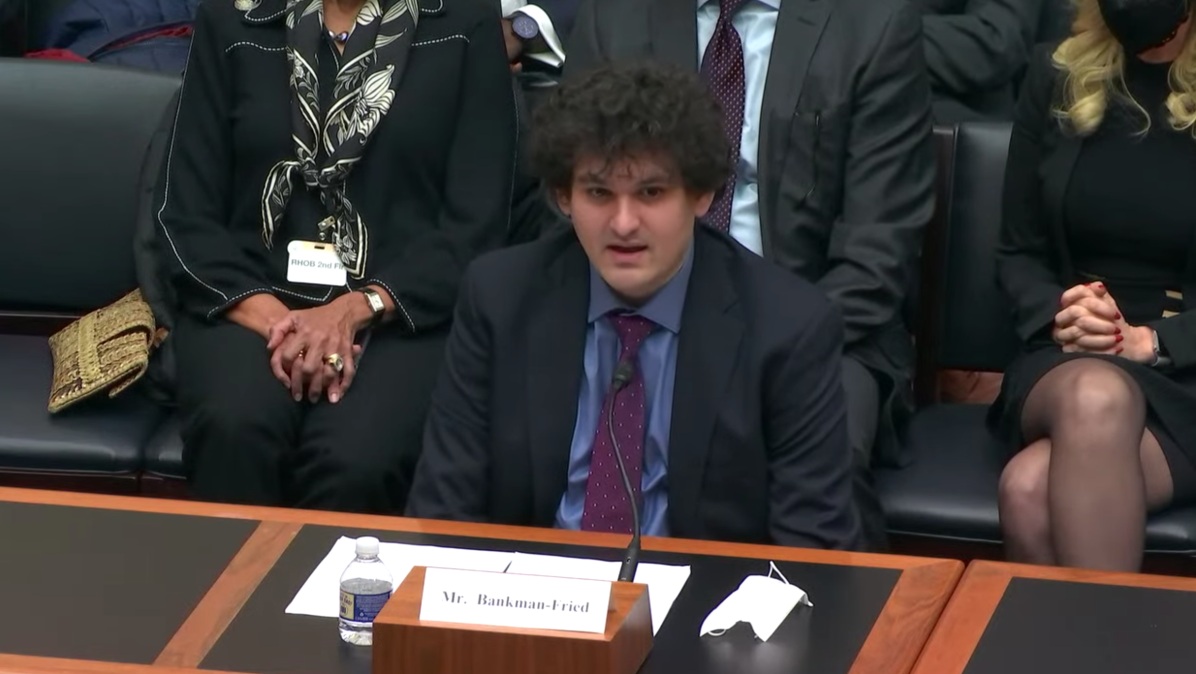
Sam Bankman-Fried (SBF) testifying before the US congress, 2021
Simone and Malcolm Collins
The Effective Altruism power couple, a pair of eccentric millionaires from the finance and tech industries. They’re thirty-six or thirty-seven, married over a decade and have four children, but aspire to 7-13. According to their highly scientific and most objective view, successful people (based on “reliable” measures like IQ and genetic testing) should reproduce, and as much as possible. They also seek to prevent dysgenics, the gradual deterioration of the human genome due to the preservation of unwanted genetic traits – behaviours and genes that can and should be eliminated from the gene pool. The couple has recently announced the launch of the HardEA initiative to promote “real” Effective Altruism, arguing that too much of the original movement’s activity is, in their view, virtue signalling rather than genuinely effective. They believe that too much of the philanthropy by the world’s wealthy is inefficiently devoted to causes with little impact, such as climate change (a worthy goal in itself, but already adequately addressed by governments and other institutions), while critical threats like population collapse due to insufficient reproduction and dysgenics receive no attention at all. They’re on it. They’re atheists, or “techno-Puritans” by their own definition. They draw significant inspiration from the Judeo-Christian tradition and consider their actions driven by divine inspiration. In raising and educating their children, the Collins’ rely on corporal punishment. Simone clarifies that, like everything in their lives, this practice is based on scientific research, but she admits the inspiration came from observing tigers in the wild.

Simone and Malcolm Collins | Source: Wikipedia
Multi-Billionaires See Things Differently
Impact investments or Effective Altruism are concerns for regular multi-millionaires. Multi-billionaires think differently, and who, aside from Elon Musk, (though I must admit, a freak among freaks) should represent this niche but important sector of population? In 2015, Musk spoke at an Effective Altruism conference and later claimed that the philosophy aligns with his work. But, honestly, This is beneath him. The six companies he founded, or runs, are supposedly aimed at serving public causes, ranging from the tangible to the fantastical: revolutionary changes in transportation, man-machine interfaces, artificial intelligence development, all the way to the colonization of Mars. Under Muskite leadership humanity will become digital and galactic, settle on other planets, merge with machines, and secure its eternal survival. Investing in Musk’s venture, working there in software development, policy consultancy, party planning or cleaning the floors of his office – all of that is powerful impact! It doesn’t get more altruistic than that. Leaders lead by example and Musk is fully invested in the population collapse disaster; At the moment of writing Musk is reported to have 14 offspring, but that number seems to change daily.
Why do all this? For the sake of us all, of course, for all of humanity, unwavering and resolute, eyes on the prize: eternity, in our lifetime (or, at least, one specific person’s lifetime). A future of abundance, downloading backups of ourselves as we trek through the stars, a majestic goal, one that legitimizes, condones and might require many earthly sacrifices.
When Tesla’s (and others’) autonomous vehicles endanger, injure, or kill people, whether passengers inside or pedestrians outside, the argument is that, in the long run, these cars will be much safer than ones driven by humans, and, therefore, it is important to continue the development process. Not only is it a worthy goal, it is a moral obligation. Raising questions? doubts? Any issue that could delay or impede the process would be a crime against humanity. From taking care of working conditions at Tesla factories (there is a trail of evidence of every possible form of abuse, from sexual harassment to racial discrimination and, of course, the crushing of labor union efforts) to the livelihoods of drivers; taxis, deliveries, and, obviously, trucks (one of the strongest labor unions in the US). Regulation, bureaucracy, democracy; the needs of those desperately trying to minimize the harm to their livelihoods, lifestyles, and lives, all of these do not hold any weight against eternity; the countless future human lives, that may not have been born yet, but will be spared immense suffering and pain, in the future.
Shutting down Tesla factories during the CoVid lockdowns was a personal disaster for Musk, (allegedly) not for financial reasons, but out of great pain and concern for all of humanity. Every second that Tesla cars are not being developed, built and sold is a future moment where countless unborn humans live and die in immense suffering.
This weak and disturbing claim could have been a little more credible if it hadn’t come from the wealthiest man alive, whose fortune is based on public money, selling stock of Tesla, and Tesla cars. But this idea could only come from him. We don’t know what “really” goes through someone’s mind or heart. Are the public statements just one big act of hypocrisy, with the real goal being nothing more than riches and self-glorification? Since the big plan for humanity inevitably involves self-enrichment and self-glorification for that one person, does it really matter?
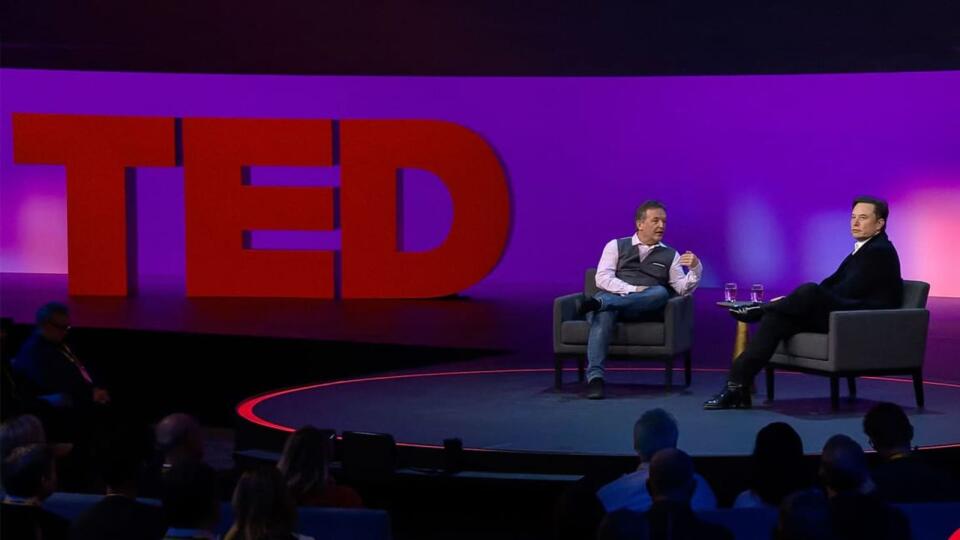
Chris Anderson, director of TED, interviewing Elon Musk | Image: TED
And that is the fall of Effective Altruism, the hubris of impact. It’s not only the baseless assumption that economic and engineering tools are relevant to every field or situation. The hubris is the overwhelming arrogance in trying to formulate a mathematical equation for predicting the ultimate good, for all of humanity. Supporting the bookshop, the local paper or the neighbourhood pub – that’s great (feel free to register and join us at Utopia), but “objective metrics”, and seemingly good intentions, that along the way makes the rich even richer, could lead to Nazi eugenics, techno-feudalism, and a brave new world. Materialistic sacrifices (of others) for the sake of eternity. A future of abundance, of digital personality downloads and space travel, is a majestic goal that requires many earthly means.
The Coming Messianic Days
Corporeal sacrifice with the promise of eternal bliss. Why does that ring a bell? A future that is all good, heaven on Earth, a divinely inspired goal that requires earthly sacrifice. Sounds very familiar. In fact, I’ll repeat a part of a previous paragraph: “Regulation, bureaucracy, democracy; the needs of those desperately trying to minimize the harm to their livelihoods, lifestyles, and lives, all of these do not hold any weight against eternity”. It’s the same Messianic fervor, new coat of paint on that old car. It’s been to an empowerment workshop, an organizational consultant, is on Ozempic, is AI-infused and the new logo cost half a million dollars, but to the discerning eye, it’s easy to tell.
Yahya Sinwar, Itamar Ben Gvir and Elon Musk’s lives couldn’t be more different, but they’re talking about the same thing. The legendary literature they rely on is completely distinct, but their followers speak clearly and unapologetically about the end of days, the rupture, the singularity. they do so with hutzpah and nonchalance, in the name of thousands and millions who do not exist. They justify their actions in the here and now, as monstrous as they may be, in the name of people who who do not exist. Some of them represent the dead – not those who die every day in their crusades and jihads, but thousands and thousands of deaths, some historical, most mythological, which we are expected to believe are meaningful and holy. Some represent the non-existent, the yet unborn. Billions upon billions, whom they claim to act for, in the name of a promised future. The represented are too many to count. They have a glorious past and a bright future, but they make us, the ones who are currently in existence, feel insignificant. We, who exist here and now, don’t matter. We’re irrelevant. Sinwar, Ben Gvir, Musk, are playing the long game. You can’t beat eternity.

Protests directed at Elon Musk following his support of Donald Trump and association with radical right-wing, Fascist and Neo-Nazi public figures and groups, including making a “Roman salute” to a cheering crowd following the 2025 presidential inauguration | Image credit: politicalbeauty_X.com
We, Who Are Condemned To Exist
We mustn’t get confused ourselves, we, who are anchored to the present. The past and the future(s) are with us at all times. We grant the dead the respect we seek ourselves, and hope to deliver a better world to those who follow us. To us who are, in the here and now, who are doomed to exist, the dilemmas are complex and horrifying, grotesque and absurd, worthy of a Greek tragedy or a Kafkaesque novel, or maybe a good science fiction story or film. For those who exist in the present, the dilemmas are chilling, overwhelming, heartbreaking, yet necessary and… mundane. It’s the distressing decisions made, at least in theory, day by day, through government policy and regulation, by healthcare professionals, police officers, teachers, investors, grocery clerks. But Elon Musk, Bezalel Smotrich, Jim Jones, Abu Bakr al-Baghdadi – they’re not here, not really. They have gone through apotheosis, they are eternal, constantly living in the glorious past or in the bright future. Fate clearly emerges from the code, be it algorithmic or divine. There is no complexity, zero doubts, dilemmas or anxieties.
The eternals do not toss and turn in their bed at night. They don’t have intrusive thoughts or problems with anxiety. They sleep well at night.
Beware of the eternals. They’re not afraid to make the required sacrifices, but by whom?