


Scholar of Spanish and Latin American literature. His fields of expertise are Spanish Golden Age literature and contemporary Latin American literature.
New Women’s Creative Work in Latin America
In the late 20th century and early 21st century, social changes in Latin America – like the rise of feminism and reevaluation of cultural canon – contributed to the rise of female creative work on the continent. While there was abundant woman-made art in the 20th century and even before that, the beginning of the current century saw the rise of a new generation of female creators who offer original, bold, quality art in a variety of types and styles.
Suddenly, female novelists and directors take the cultural center stage, signing with publishers and studios, win awards, get translated to many languages and reach a massive audience in South America, the United States, Europe and other regions. The main themes of their works include the female experience in a male world, gender-based violence and misogyny, family and parenting, the legacy of dictatorships and military regimes.
Two standout Argentine creators in this context are director Laura Casabé (b. 1982) and novelist Mariana Enriquez (b. 1973). Casabé is a director, writer, and camera operator who studied film at the Universidad de Buenos Aires and directed narrative and documentary films that won awards in international festivals. Enriquez is a novelist and journalist considered the leading voice of new writing in Latin America. Her works are in constant dialogue with the horror genre and reprocess it. Her books have won prestigious awards and have been translated into dozens of languages.
The marvelous combination of Casabé’s cinema and Enriquez’s literature gave us this year’s The Virgin of the Quarry Lake (special screening at Utopia 2025). This film signifies the beginning of a new age in the history of social horror in Latin America.
The Virgin of the Quarry Lake: Defining Characteristics
The film, The Virgin of the Quarry Lake is based at the very least on two stories by Enriquez: The Shopping Cart (El carrito) and The Virgin of the Quarry Lake (La virgen de la Tosquera). Both were published in her first short-story collection, The Dangers of Smoking in Bed (Los peligros de fumar en la cama, 2009).
The Shopping Cart tells the story of a neighborhood in Buenos Aires visited by a beggar with a shopping cart full of items from the “villa,” a nickname for poverty-and crime-stricken neighborhoods in the Argentine capital. The neighborhood residents are cruel toward the beggar, hitting him and humiliating him, and he runs away and leaves the cart behind. As time goes by, the inhabitants begin to suffer from poverty, crime, madness, and suicide. The neighborhood that was normal turned also into an impoverished neighborhood, a villa. The residents think that the beggar cursed the neighborhood and “infected” it with poverty as a divine punishment for the ill treatment he received. However, this supernatural possibility is in contrast with a realistic explanation: poverty in Argentina is devouring every decent patch of land, and the neighborhood could have deteriorated even without any magical curse, just like in many other cases. Entire neighborhoods in Buenos Aires have fallen into a similar state following economic crises which struck Argentina.
The Virgin of the Quarry Lake is a story told in first person plural, we. The narrators are a group of girls who hate Silvia for “stealing” Diego. In one of their visits to the quarry lake, Diego and Silvia prank the group of girls, putting them on and humiliating them. In response, one of the girls named Natalia goes to the Virgin statue at the edge of the lake and asks her for something. The story doesn’t say what she asks for, but the film does. In the end, a pack of huge black dogs appears at the edge of the lake, and it is implied that they bite Diego and Silvia to death. Natalia says they are not the lake owner’s dogs but the dogs she has summoned, and that the Virgin statue at the edge of the lake is not of a regular virgin but one of a naked red lady, one of the dark saints in Latin American folklore. The supernatural interpretation is that Natalia has summoned dark forces to take revenge on Diego and Silvia, but it is again contrasted with a realistic explanation: the bus driver warned the girls that there are very dangerous stray dogs in the area.
The Virgin of the Quarry Lake, Casabé’s cinematic adaptation to Enriquez’s stories, is based quite faithfully on these two stories. The events in The Shopping Cart make up the secondary plot line in the film, and the events of The Virgin of the Quarry Lake comprise the main plot line. While there are many differences between the film and the stories, they are negligible and serve the narrative and artistic needs of the film. Casabé’s film faithfully reflects the spirit of Enriquez’s writing, the fantastical horror genre that defines it, and the poignant social commentary at the heart of her stories.
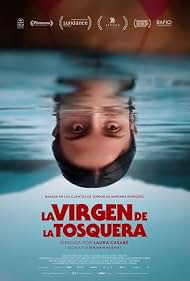
Poster of the The Virgin of the Quarry Lake
Fantastical Horror
The basic trait of fantastical horror is ambiguity: you can never be certain whether the scary events taking place are supernatural or just strange and unusual but real. Both the stories and the film impressively preserve the fantastical doubt with the viewers and readers, a doubt that swings between the two opposite interpretations without a clear choice. Did the beggar really put a curse on the neighborhood residents or did it drown in poverty due to the reality in Argentina? Did Natalia really summon the dark forces in the form of dogs or is it a strange coincidence? The supernatural horror is more explicitly present in the film than in the stories, but there is no conclusive proof that it is sorcery or dark magic. However, there is not doubt in the power of superstitions, everyday violence, real-life crime, and the human factor, which might be the real danger, much more than supernatural darkness.
Social Horror in Latin America
“The marvelous real” and magical realism are two literary movements that emerged in Latin America in the first half of the 20th century. They both share the mix of realism and supernatural elements. The main distinction is in the supernatural aspect – in “the marvelous real,” it is embedded within the local Latin American reality, with its people, culture, and beliefs.
It’s clear from the two mentioned stories and the rest of Enriquez’s oeuvre, that she is a literary heir to “the marvelous real”: the supernatural or seemingly supernatural elements in her writing are firmly planted in Latin American reality and draw from it. The dark forces she depicts in her stories are not universal but local. For example, the folk saints mentioned in her stories are Latin American and even decidedly Argentine, like San La Muerte (“holy death” or “death saint”) or Gauchito Gil. In the stories and in the film, the girls find a statue of a local virgin: it is not the standard statue of the Virgin Mary/Maria, but a naked red woman – a local, sexual and bleak version of Maria.
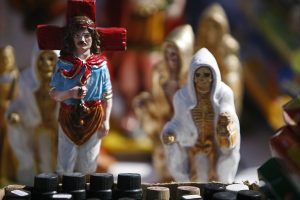
Statues of San La Muerte and Gauchito Gil, Wikipedia
In Casabé’s film and Enriquez’s stories, the possibility of supernatural horror exists alongside a local Argentine context, realistic and no less disturbing: the poverty, violence, alienation, and lack of solidarity. In both stories and in the film, the horror genre contains poignant social commentary: in The Shopping Cart, the neighborhood residents blame the beggar for the myriad of troubles that befall them, but they are the guilty ones: they treat both him and each other maliciously. When poverty strikes, they steal from one another, rob their neighbors at gunpoint, murder, and even turn to cannibalism. In The Virgin of the Quarry Lake, the girls’ hatred of Silvia drives them mad, prompting them to look for ways to harm her even without the help of dark forces. The entire story is told from the point of view of the “bad guys”, or the “bad girls” in this case: Silvia can be described not as the antagonist but as a victim of evil-scheming girls. The film focuses on Natalia’s human evil and depicts her gradual transformation into a violent, malicious, and vindictive person.
These matters unfold in an important social and historical context: the severe economic crisis Argentina went through in 2001. People lost their entire fortune overnight; banks locked accounts and closed down; entire families were kicked out on the street, and fell into crime, drugs, madness, and death. At the same time, an extreme disintegration of the social fabric took place: the economic crisis created a state of “dog eat dog”.
That is the exact situation depicted in Casabé’s film and Enriquez’s stories, and it is the profound message of the social horror genre – scathing social commentary that can be felt in the film, in the two stories on which it’s based, and in other stories by Enriquez. Perhaps there are demons in the world, not to say satanic elements, and perhaps not. However, there is no doubt that human beings hold within them the seeds of evil and destruction.