

Lavie is an Israeli author and playwright, game designer and entrepreneur. His play “Nephilim” (created with Yonatan Levi) premiered at The Israel Arts Festival in Jerusalem. “The Divine”, a graphic novel (created with illustrators Asaf and Tomer Hanuka) became a New York Times bestseller, was a Hugo Award Nominee and won the International Manga Award and.
In March 2023, an open letter was published by tens of thousands of scientists and technology professionals, all calling to halt all research around the world aimed at advancing the development of artificial intelligence in any form. In the letter, the scientists and technology professionals presented their arguments against the development of AI systems, such as Chat-GPT, Dall-E, and others. In response, we at Utopia editorial decided to present our arguments as well, on behalf of the written word, the economy, regulation, and human creativity. And this time: human creativity.
The open letter calling for a pause to all AI experiments was signed by 33,709 names [December 2023]. You’ll not find my name among them, even though I did contemplate in the early days, truly, possibly adding it. I’m very modest. My voice probably wouldn’t have tipped the scales, but for a moment it felt like it was the right thing to do, for anyone with any connection to the field. Like liking the most “accurate” post. It’s not just “everybody”. The letter is signed, among others, by Yoshua Bengio, one of the leading researchers in artificial intelligence, Steve Wozniak, co-founder of Apple, and a lineup of key figures in the field such as Stuart Russell, Andrew Yang, and Emad Mostaque. Even a few celebrities with well-known names, like Elon Musk and Professor Yuval Noah Harari.
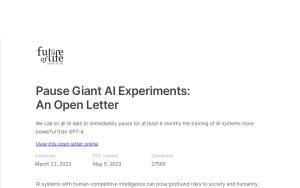
Future of Life Institute, Pause Giant AI Experiments: An Open Letter
So why not join? First, I’m not the only one who refused the trend. Surprisingly enough, Eliezer Yudkowsky, one of the most consistent and dominant voices supporting the absolute halt of AI development, did not sign the letter either. Like him, several other key figures are missing in this fight, those who are constantly warning us about the risks that artificial intelligence might bring.
But it’s not necessary to be on the doom and gloom side like Yudkowsky to feel that this letter may say many true things on paper, but in a certain sense, exists only there. Like a work of fantasy. In fact, not only have most of the people who signed it continued to take part, full force, in developing AI models, but some have even initiated projects themselves. Elon Musk, for instance, announced the launch of a new AI startup (xAI) not long after he signed. The right hand signs the declaration, the left hand tweets the opposite agenda.
The letter serves as a sort of “prisoner’s dilemma”: everyone signed on to it is demanding that all the others, the tens of thousands of researchers, policy-makers, venture capitalists and tech-entrepreneurs, all over the world, stop developing their models in exchange for them also, whether big or small, to stop doing so in their own lab, at once.
The threat is clear: “although I truly believe from the bottom of my heart, that there is a risk in developing AI models, as I declare in this open letter, I want to emphasize that unless my demands are met by everyone in the field, I, myself, will continue to do exactly that, in full force”.
This is the clearest indication of the profoundly disconnected mindset that emerges from the letter. Unlike nuclear weapons, for example, or other complex technological developments, artificial intelligence already exists in a completely decentralized world. One in which, alongside giants like OpenAI or Google, there are open-source models, small independent initiatives, and code written in shared office space on the outskirts of cities in India, France, the United States, and Israel.
This Isn’t Romance – It’s Reality.
Therefore, the call to pause AI development and subject it and its outputs, immediately, to draconian regulation, even if done with good intentions, is a call to put human motivation on hold, and in practice, to further empower the already powerful players in the field. After all, who will set the tone for regulatory decisions? Follow the money to the major corporations, of course, which will block smaller players.
But, even though I chose not to sign the letter, the letter is still valuable, just like a good piece of science fiction shining a spotlight on a fundamental issue that might not have been taken seriously enough otherwise: the risks of developing artificial intelligence. Some of these risks are very real today. But, like many science fiction works, this letter, too, takes the world it creates as far as it can, and crosses over to pure fantasy, and there it lies. So for now, I’ll save my (precious) signature for other letters.
Maybe letters written one day by the machines themselves.