


Young is an architect who operates in the spaces between design, fiction and futures. He is founder of the urban futures think tank Tomorrows Thoughts' Today (TTT), exploring the possibilities of fantastic, perverse and imaginary urbanisms.
The most significant architectural spaces in the world are now entirely empty of people. Any tour through these sites to visit the landscapes and structures made for and by our machines must begin in a series of anonymous towns in the middle of Oregon, home to the largest cultural landscape in human history. Here, sitting at the confluence of cool air, cheap hydropower and tax incentives, the tech giants of Facebook, Google, Apple and Amazon have built their data centres. The chilly breeze that brushes our face has set in motion a storm of infrastructure. This is where the internet lives.
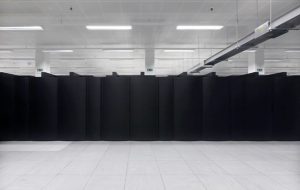
The UK Met Office’s Cray XC40 in Exeter is one of the most powerful supercomputers on the planet dedicated to weather and climate. Photo by: Tank Magazine
The buildings where we keep the world
These unremarkable streets and sprawling peripheries contain everything about who we are. Much of our dreams and fears, histories and futures are here, just behind an Oregon Thriftway, drenched in the stench of diner pancakes and simulation syrup. If we were to stroll through the screen and follow the fibre-optic tentacles across the planet, we would find ourselves in unfamiliar places like this, in the autonomous server farms, power plants, ports, factories and mines that produce the modern world.
One of these towns is Prineville, home to Facebook. This is a town that turns electricity into bits; its data centres are giant machines for organising our culture and archiving our lives. Every like, love letter, embarrassing photo and ironic update is stored in the purring technologies contained in its vast concrete boxes. This intricate portrait of human history is sitting somewhere along a winding two-lane road, near a parking lot, beside a tree, baking in the afternoon sun. We stroll through the hot aisles, breathing the air that is being warmed by our digital selves.
Facebook’s data centre, like many similar facilities, is essentially just row upon row of identical floor-to-ceiling server stacks, spinning and writing the lives of 2.27 billion global users. Each of the 4,000 servers in this hall has a blue LED that illuminates when it is accessed and a yellow flashing light that flickers with the writing of data. The server floor trembles like a forest of fireflies, a map of social-media territory, a spatialised internet, a field of flickering Facebookers all waving hello. As we exit each room on our tour, we diligently switch off the lights. There is no one left behind in the dark, it is a building of empty rooms, quietly humming away without us. Just one Facebook engineer is able to maintain 25,000 servers each day. We are surplus to the practical needs of the data centre. It is a landscape filled with our digital avatars, but strangely absent of people. Just a few wandering technicians stalk the aisles, babysitting the servers, watching the lights, waiting for something to do.
The Facebook data centre in Prineville is a prime example of one of the new typologies of the post-human: a building of extraordinary meaning that sits at the core of what it means to exist today, but turns its back on any expression of that significance. At first glance, there appears to be little architecture here, no grand monumental gesture; instead, this network of spaces so fundamental to our modern experience of the world seems to be conceived of little more than air-conditioning infrastructure. Architecture has always been defined by the prevailing means of production. Stonemasons once carved column capitals and modernist architects harnessed the prefabricated components made possible by industrialisation. These flickering buildings are more than just computational infrastructure, they are becoming the defining cultural constructions of our age. At a time when our collective history is digital, these blank forms are our generation’s great library, our cathedral, our cultural legacy.
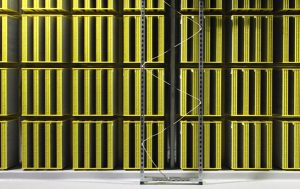
A typical server cabinet at Facebook uses 24,000 kilowatt-hours per year, four times the amount of the average family home. Thanks to the proximity of hydroelectric power plants near the Columbia River, energy is cheap in Prineville, about half the cost of elsewhere in the US. Photo by: Tank Magazine
Human exclusion zones
In order to understand and chronicle the emerging condition that the data centre embodies, we need to push open the pressurised doors and cross the lines of these human exclusion zones to trespass through the machine landscapes that run the world. The server farms, telecommunications networks, distribution warehouses, unmanned ports and industrialised agriculture that define the very nature of who we are today are at the same time places we can never visit. Instead they are occupied by processors and hard drives, logistics bots and mobile shelving units, autonomous cranes and container ships, robot vacuum cleaners and connected toasters, driverless tractors and taxis.
When early explorers were charting the “new world”, they would load up their ships and head off the map on expansive journeys with uncertain ends. They were pioneers plotting out uncharted lands and foreign territories, strange and unfamiliar although anything but empty. In “Machine Landscapes: Architectures of the Post Anthropocene”, the journal that I recently guest-edited, we mapped the less-trodden sites, architectures and infrastructures of a system not built for us, but whose form, materiality and purpose are configured to anticipate the logic of machine vision and habitation rather than our own. It is a compendium of conversations and encounters, travels and incursions in landscapes where we do not belong. It is a collection of spaces filled with autonomous natives, where we are each an intruder in an architecture that has left us behind.
The technological sublime
We begin to make sense of a new phenomenon by naming it and framing it through mechanisms we find familiar. To assimilate the unknowns of the natural world we first understood it through mythology and folklore. Gods pulled the sun across the sky and sea monsters crashed waves across ships. Then our objective, scientific eyes categorised nature, developing classes and species, and all fell into line. Machine landscapes are typologies without history. They are sites that force us to question all we know of architecture and we must again re-evaluate our own position in relationship to the spaces and systems around us. So many of these evidentiary artefacts of this emerging era suggest new typologies or call out the inefficiencies of architectural conventions based around our own bodies that until now have seemed satisfactory. We don’t have sufficient terminology to describe these conditions; they emerged in the shadows, out of sight, in territories where we are not allowed to wander. They occur at scales where the disciplinary language of architecture breaks down, where interiors are so vast that they become microclimates, where landscapes are so engineered they become circuit boards, where robots are so ubiquitous they become nature, where aisles through the server stacks are like partitions on a hard drive and buildings are so full of machines that they are better understood as urban-scale computers.
The default position of the architecture profession seems to be to try and reclaim this lost territory, to sneak back in and parasitically occupy these landscapes with ergonomic furniture, open-plan offices, green walls and raw-juice bars. The marquee architectures of technology are the corporate headquarters of BIG and Heatherwick Studio’s Googleplex, Foster + Partners’ Apple campus and NBBJ’s Amazon Spheres. These are not the star architects of the post-Anthropocene. They are just set-dressing the waiting rooms, distracting us with expressive displays while the machines program our planet, hidden behind windowless walls and anonymous forms. In these new landscapes, the poetics of human occupation are extraneous, the scale of the body is immaterial and we must explore new forms of productive engagement with the non-human world.
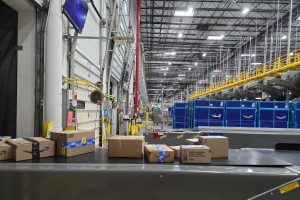
Amazon warehouse in Rockford, Ilinois, USA, Photo by: Kirkam
Ideology rarely evolves at the pace of our technology. As we turn our gaze toward the machine landscapes we need to radically embrace our uncomfortable place in a world where we are no longer at its centre. These sites, structures and spaces mark an end to human-centred design as we now chart an era of hard-drive-centred design, Lidar-centred design or autonomous-car-centred design.
The founding machine landscapes of the post-Anthropocene are already here, critical and fundamental, embedded in the ground of the Earth and the fabric of the planetary city. Their cooling fans spin, the electromagnetics hum, the LEDs flicker and it smells of rare earth. Machines are making the world and we are on the outside peering in, faces pressed to the glass windows of an empty control room.
First published on TANK Magazine. An edited extract from “Neo-Machine: Architecture Without People” by Liam Young, featured in “Machine Landscapes: Architectures of the Post-Anthropocene”, Architectural Design, Vol. 89:1, January-February 2019, guest-edited by Liam Young.