


Lives in Mitzpe Ramon, loves nature mountains and desert landscapes, photographer, musician, entrepreneur and social and environmental activist.

Ezra Orion, Slow Introduction, Intergalactic Sculpting, 1988
On the night of April 27, 1992, as part of the World Space Year events, the artist and humanist Ezra Orion launched into space the Super Obelisk I – a cathedral of light beams from six laser launchers of the Wagner network that were scattered thousands of kilometers apart in the northern half of the planet known to its inhabitants “Earth,” which belongs to a remote solar system at the edge of a galaxy known by them as the “Milky Way.”

Laser cannon, photograph by: Avraham Chai
The beam was launched simultaneously from its six sources for 55 minutes and 33 seconds. This is the time it takes for light to travel a billion kilometers. The beam of laser rays, projectiles of energy, lost about a quarter of its power by breaking out of the planet’s atmosphere. Within 5 hours, it abandoned the solar system on its way to empty space perpendicular to the galaxy’s plane.
The most significant distance between the two points was about 3,000 kilometers, the cross-sectional area of the work was approximately 3,000 square kilometers, and its volume was about 3Peta (1015) cubic kilometers.

Location of launch points on Google Earth
If there is a distinct characteristic for the development of Ezra Orion’s artistic thinking, it is the exponential leaps in the dimensions of his works. We can name the stages of this development by the signs that Orion himself gave them;
He began his work with human-size sculpting – small sculptures that can be placed in a museum or gallery. This type of sculpture was described by Orion as a “miniature sculpture that must pass through doors, must match the dimensions of the galleries that shape it. A sculpture controlled by an immeasurably violent volume, limited to small, low-ceilinged fields, suffocated by walls.”
Later, he left the galleries out into the open space in what he defined as an architectural sculpting, one that must, to his perception, extend over hundreds of meters and rise dozens of meters above the viewer, who remains inside it to be evoked by “experiences of high spiritual intensity.” Many of Orion’s sculptures that meet this definition, which he deemed secular cathedrals, are scattered throughout Israel.
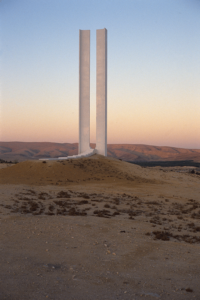
Identity, sculpture by Ezra Orion, Yeruham, 1990, photo: Avraham Chai
Orion called the next section tectonic sculpting. The desert layouts of the high Negev mountain, which surrounds the Ben-Gurion seminary where Orion lived since 1967, were the source of inspiration. The exposed rocks of the desert expanse reveal to the observer the secrets of the mighty tectonic forces that sculpt and shape Earth’s crust.

Annapurna, mountain ridge in the Himalayas, photo: Avraham Chai
Unlike the monumental approach, which erases or glorifies the power of human technology to overcome nature, or the assimilation approach that seeks to merge with and integrate into the overall existence, Orion formulated the dialogue approach as a synthesis between the two.
Orion does not seek to subjugate the desert setting or, alternatively, to use it as a disguise but to bring man, whose temporary, ephemeral existence is brief in geological time, to join and take part in the geological design processes spanning tens and hundreds of millions of years.
These sculptures are, in fact, launching pads for consciousness when the ancient consciousness of the stone slopes, which have the same vast geological time dimensions, stretch man’s ephemeral, passing consciousness and catapulting it to astronomical ranges. In 1988, Orion met with NASA personnel in Washington. He proposed that the robotic vehicle they send to Mars would assemble a line of stones and be the most distant ambassador of tectonic sculpting in the solar system.
Launch Pad for Consciousness, a short film by Ezri Kedar, 2015
Hence, the ingenious leap from using mass to produce launch pads for consciousness to using energy as a carrier of consciousness (or an idea as an expression of consciousness) seems almost natural.
In 1987, Orion began to develop intergalactic sculpting, using densely packed and focused light, i.e., laser beams, as raw material for sculptures of astronomical dimensions. A single laser beam was launched that same year from Tel Hai College, followed by another one in the summer of 1989 from the Jerusalem area.
The peak event occurred in 1992 with the launch of the five-beam.
This is how Orion describes his work:
This is a breakthrough in the art of sculpture from its history: from the materials that used its design prehistorically – into concealed entities of energy, of enormous dimensions, launched from powerful antennas, at the speed of light, into the intergalactic ranges, endless time ranges –––.”
Today, after about 18 human years, Orion’s energetic obelisk is already sailing at an astronomical distance of about 266 trillion kilometers from Earth. This is the greatest distance known to us that any product of human consciousness has ever reached, and since the obelisk moves at the speed of light, no other product of human consciousness will ever reach it.
It will take hundreds of years to break through the boundaries of the Milky Way galaxy; its lifespan is estimated to be about 37,000 Earth years before its energy dissipates, wears out, and will come to the end of its life.
Orion was able to produce sculptural objects on an astronomical scale. He built tools to launch human consciousness into unimaginable, superhuman, and inhuman ranges of distance and time. No human being, including the few individuals who actively launched the works into space, can perceive these works with their senses.
This is a man-made hyper-object. A man may conceive it, create it, give birth to it, grasp its idea, and make it a present, moving material in space. He can understand it numerically, quantitively, and mathematically, but he can’t even look at his own work he created.