


Researcher of the interface between theatre, performance, and Jewish religious tradition. Recently, he has also been exploring the connections between theatre, role-playing games, and fantasy.
In the following remarks, I ask to return to a specific moment in the history of Hebrew theater that, in my view, can serve as a key to understanding the problem of imagination in Israeli culture. In the current context of the Investigation committee on the failure of imagination, the moment to which I return is a sort of an investigation committee in itself, or more precisely, a public trial.
The year is 1926, the location is Palestine-Israel. A local theater troupe called the Eretz Israeli Theater (Hatai) performs The Dybbuk, a play by S. An-Sky, directed by Menachem Gnessin. Gnessin was one of the founders of the Habima Theater in Moscow and even played in the legendary production of The Dybbuk at Habima (1922), directed by the renowned Armenian director Yevgeny Vakhtangov, which brought the theater international renown. At some point, Gnessin left Habima, joined Miriam Bernstein-Cohen in Berlin in leading the Hatai group, and together they came to Israel. Here, he staged a version of An-sky’s play, which he explicitly stated was based on Vachtangov’s production. The name of the Habima production had already spread far and wide, but the group had not yet arrived in Tel Aviv, so the local audience had to make do with the Hatai production for the time being.
The Dybbuk was written by An-Sky after his ethnographic travels among Jewish communities in Russia between 1912 and 1914. An-Sky, an educated Jew who had distanced himself from Jewish tradition in his youth, sought in these journeys to collect and preserve the folk-traditional culture of Eastern European Jewry. Feeling that this culture was destined to disappear due to revolutions, pogroms, emigration waves, modernization, urbanization, and secularization processes, and believing that this culture contains important knowledge that must be preserved, An-Sky led an expedition among the Jewish towns (shtetls) in the Yishuv. They collected folklore, stories, traditions, melodies, and beliefs of the local communities. The expedition’s findings were presented in a special exhibition in St. Petersburg, and from the stories An-Sky heard on his travels, he also wrote The Dybbuk.
The plot of The Dybbuk revolves around Hanan, a young, poor yeshiva student who studies Kabbalah and practical mysticism. Hanan is in love with Leah, the daughter of a wealthy man, but when he discovers that she is to be married to another man who is richer than him, he tries his hand at magic in order to force God to give him Leah. Hanan dies during the attempt, but returns as a dybbuk—a dead spirit that enters Leah’s living body, possesses her, and is revealed from within her during her wedding ceremony. Leah-the-dybbuk screams in a man’s voice during the wedding, resists the marriage and disrupts the ceremony. She/he is taken to the local Hasidic rabbi so he would exorcise the dybbuk from Leah’s body. After a long and complicated debate and impressive ancient rituals, the rabbi finally succeeds in exorcising the dybbuk. However, Leah chooses to join Hanan in the afterlife and dies.
The Dybbuk was performed by Habima in a Hebrew translation by Bialik and, as mentioned, received great success. Vakhtangov’s direction emphasized the mystical, ritualistic, and mysterious elements of the play’s plot, using expressive and exaggerated theatricality: heavy makeup, stylized movement, and the majestic pronunciation of Hebrew as an ancient sacred language. Gnessin’s production, “Following Vakhtangov,” was also a hit with local audiences in Israel, but the play sparked a heated debate among critics—a debate that culminated in a public literary trial of The Dybbuk held in Tel Aviv by the Writers’ Association. (1)

Poster for the play The Dybbuk by S. An-sky | The National Library
Approximately five thousand people gathered in two evenings at the Beit Ha’am in Tel Aviv to watch the trial against An-Sky (who had passed away six years beforehand) and the Hatai Theater. Among the judges, defense attorneys, prosecutors, and witnesses in the trial were some of the key literary and intellectual figures of the Jewish community in the Jewish settlement in Israel at the time. The trial transcript provides a fascinating glimpse into the internal negotiations that took place in the community regarding cultural policy, as well as the tensions and profound questions that troubled the cultural personas at the time. (2) Of particular interest to us is the reference to the unrealistic and fantastical elements of the play.
The indictment against the play, which included no fewer than sixteen counts, claimed, among other things, that:
Most of the characters depicted in the play are not realistic types cut from Jewish-human existence […] but rather they are ethereal souls, mechanical creatures lacking solid and complete character traits, androgynous beings—some of them immature monstrosities and some of them creative freaks, passing before us like shadows.”
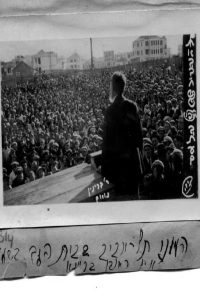
Reuven Brainin speaking before an audience at Beit Ha’am, 1926.
The claim that the characters are unrealistic touches on the basis of the anti-fantastic suspicion woven throughout the indictment. The characters are described as mere “shadows,” vague and unclear, lacking substance, as if the fact that they are not cut “from human-Jewish existence” prevents them from being real. Of particular note in this context is the description “androgynous,” which refers to the crossing of gender boundaries between masculinity and femininity performed by the Dybbuk, and perhaps also points to the queer discomfort raised by the fantasy of The Dybbuk: It seems that the requirement that the characters be grounded in reality also contains a desire for them to be anchored in a normative sexual, gender order.
The main problem with the unreality of The Dybbuk, according to the indictment, is that it corrupts both the audience and the actors. It:
provides the audience solely with entertaining stimulation of the senses of sight and hearing, but in no way can it serve as a decent educational tool and healthy spiritual nourishment for the people. Not only that, but it accustoms the viewer to superficial effects and momentary excitement on stage, thereby spoiling the taste of the audience, which needs aesthetic training and education.”
Similarly, it “also has a negative effect on the actors, since in its false design it forces the performers to create characters devoid of reality and castrates the actor’s human and artistic perception.” This supposedly negative influence of imagination on both actors and audiences naturally has political and ideological implications. The success of The Dybbuk, which the indictment is forced to acknowledge, distracts attention, according to the indictment, from the important cultural project of “cultivating, within the limits of possibility, plays that embody secular and humanistic contents, in order to fortify the renewed Hebrew culture and clothe it in the mantle of healthy and fresh secularism.” In other words, the mystical-Hasidic fantasy of The Dybbuk stands in contrast to a healthy and fresh secular-Zionist reality. And so, the indictment continues:
The excessive attention paid by members of Hatai to the The Dybbuk here among the emerging Jewish settlement, amid the buds of new life, the glimmers of a rising new culture, so different from the withered and futile forms of life, is a double error, both logically and aestheticlly, as it distracts emotional and artistic energy from the spiritual dilemmas and vital problems associated with the reality of life in Israel and with the sorrow and pains of prosperity of renewed Hebraic humanity, and it hinders the theatrical rise of original Hebrew expression.”
What is important to note here is the contrast between “the emerging Jewish settlement,” “the buds of new life,” “the reality of life in the Land of Israel,” “the pains of prosperity of renewed Hebraic humanity,” and “withered and futile forms of life.” These forms of life are, of course, diasporic Judaism and religious tradition – but also fantasy, imagination, and the worlds of legend offered by Kabbalistic and Hasidic tradition. All of these are contrasted with the supposedly healthy and fresh Hebraic, secular-Zionist reality. If the Zionist project is based on the urge to fulfill your dreams in reality (“if you will it, it is no dream”), then the imaginary worlds of The Dybbuk – fantastical, diasporic, queer, indeed fairy-tale worlds – challenge it to its core.
In this context, Zalman Rubashov (Shazar)’s testimony in favor of the play is particularly interesting. Shazar sought to explain why the play—with its Hasidic and mystical content—was so successful among secular, educated, and modern Jewish audiences at the beginning of the century:
All the decorations together with An-sky made him what he is. Why did we all gather here, if not for the power of the “dybbuk,” something that brings people together, something that speaks to the heart and invites the artist to come and join in and contribute something of his own? Indeed, you may recall the mood in Hebrew and Jewish literature, in Jewish culture, in those years before the war […] There was a tremendous longing both for the town and for the cultural wealth that remained there, beyond the threshold. There was a feeling among the young people of Israel that they had rushed to leave the town, rushed to get out of it before they had gathered all they could from it. […] When you hear and see it live on stage, something moves in your heart – the artists gathered all the forces of folklore and sent a greeting from a place where our souls still flutter in some form, and there is a desire to hear a greeting from there. It was everything.”
Shazar’s explanation naturally relates to An-sky’s own motivation to save something of the traditional Jewish world he left behind, and extends it to the audience coming to see the play. In contrast to the rejection of exile that underlies the criticism of The Dybbuk, Shazar seeks to make room for nostalgia for the world of the Jewish shtetl even among the Zionists who immigrated to Israel. At the same time, his words about the longing to hear a greeting of peace “from a place where our souls still flutter” touch on more profound questions about the emerging Hebrew culture. First of all, this wording echoes the situation of the dybbuk situation itself – a situation in which the soul is still attached to a place other than where the body is currently located, at a different time, in a past that refuses to let go. There is a subtle criticism here of the total Zionist demand to be fully present in the here and now, in reality. In this sense, Shazar’s words can be read not only as a reference to nostalgia for the shtetl, but also as an in-depth analysis of the need for fantasy, for the unrealistic, and as an attempt to qualify a cultural policy that is completely devoted to the “mantle of healthy and fresh sand.” The attraction to fantasy, according to Shazar, is rooted in longing, in the profound duality of the soul that is both here and not here at the same time. We must recognize these forces that operate inside ourselves, even in the midst of a large-scale project to establish a new culture.
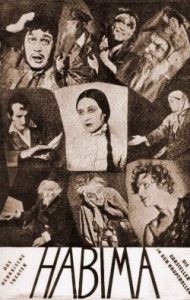
Poster for the play The Dybbuk by the Habima Theatre in Moscow, 1922.
Ultimately, the judges ruled that the play was indeed flawed and problematic, but given the paucity of the current Hebrew repertoire, staging it could be justified until more suitable Hebrew works will emerge. “It is to be hoped,” the verdict concluded, “that the new life in Israel and our burgeoning culture will inspire the popular writer and the Hebrew theater to create the original dramatic work that is faithful and complete in every aspect.” When Habima arrived with their production of The Dybbuk a few years later – as well as with other plays with fantastical, mystical, or supernatural elements, such as The Golem and The Eternal Jew – they were met with resounding success. The Dybbuk was performed hundreds of times over several decades. It was supposedly the triumph of fantasy. However, Habima’s repertoire changed and gradually responded to the demand for realistic plays that reflected the here and now of Zionist culture. When, in 1948, the new and young Cameri Theater swept the audience away with Moshe Shamir’s “He Walked in the Fields” – a play about the kibbutz and the Palmach of the time – the mysterious fantasy worlds of The Dybbuk were gradually pushed off the stage. Of course, they did not disappear completely, and continue to appear in Israeli theater in various forms. (3) However, the deep unease toward the fantastic that was expressed in the trial of The Dybbuk continued to accompany Israeli culture and shape its path.
Footnotes and Additional Thoughts
1 // For a further fascinating discussion of the trial, see: Batya Appelfeld, “‘Fighting within their souls, debating within themselves’: On the Trial of the Hebrew Writers and Literature Association in the Matter of the Dybbuk (1926),’ Al Na Tegarushni: New Perspectives on ‘The Dybbuk,’ edited by Dorit Yerushalmi and Shimon Levi (Tel Aviv: Safrah, 2009), pp. 108–122.
2 // The Sticky Trial: Stenographic Record of the Public Court Sessions at the Beit Ha’am Theater in Tel Aviv on the 24th of Sivan and the 4th of Tammuz, 5686 (Tel Aviv: Department of Fine Literature and Criticism of the Hebrew Writers and Literature Association, 5686).
3 // See, for example: Eitan Bar-Yosef, “Dibuk, Baal, Beit: Shmuel Hasfari and the Fantastic Tradition in Israeli Theater,” With Both Feet Deep in the Clouds: Fantasy in Hebrew Literature, edited by Hagar Yanai and Daniela Gurevich (Tel Aviv: Graf, 2009), pp. 82–109.