

Writer/director, social media influencer with over 20K followers, news anchor at Ynet, founder of Cinema Limbo, television actor.
Ari Aster plays with dolls.
Notably, his debut film, Hereditary (2018, screened at Utopia 2018), which made waves at The Sundance Film Festival and garnered praise from Martin Scorsese (who will continue to shower Aster with compliments with every subsequent film), opens with the camera entering a dollhouse: a miniature model of the Graham family home. There, just like toys, the family comes alive, and the film – along with Aster’s career – begins.
It’s a quintessential opening not just to Aster’s debut, but to his entire oeuvre so far. Dominant through all of his films is a deterministic aspect which ends with a surprising, or not surprising, reveal – that our characters did not go but were led as if blind, with no power or free will, to utter doom. Either out of a character’s self-interest or a group pulling the strings.
In Hereditary, a grieving family is led like sheep to the slaughter under the secret leadership of a family cult operating behind the scenes; in Midsommar (2019) students arrive at an isolated flowery summer festival in Sweden and are led like sheep to the slaughter under the control of a pagan cult. In Beau is Afraid (2023), an emasculated, angst-ridden man in a world full of terrors is led as sheep to the slaughter according to the plan of his overbearing mother who controls everything like a God; and in Eddington (2025, special screening at Utopia 2025), a town, or rather a right-wing conservative sheriff, or rather all of modern society, are led as sheep to the slaughter under the control of a capitalist deep state that wants to build an advanced AI data center.
This repetition evokes, of course, my strong intuition that his next film will also feature a string-pulling puppeteer hiding in the shadows. Aster’s next scripts, and with them the characters yet to be created, are led by his hand, powerless, to their inevitable fate: to be pulled as well by the strings they are unaware exist. Hence, the superior entity who pulls the strings of the string-pullers, is Aster himself. But if you turn on your phone and go to YouTube, you won’t find a mysterious figure standing in the shadows with puppets in their hands, but rather a balding, shy, stuttering, neurotic, seemingly guilt-ridden Jewish man, the essence of which will echo through the Oedipal odyssey Beau is Afraid.
What is the source of Aster’s obsession with determinism, then?
In an early interview with the Jewish Chronicle of London, Aster noted that despite not practicing very actively, he’s still a proud Jew. He also agreed that his pessimistic worldview may come from the Jewish background he grew up in and the pessimistic Jewish history. I see it as a key to understanding Aster’s determinism.
Consider for a moment the infamous blood libels in the Middle Ages. The narrative structure is mostly identical: winter ends, the snow thaws, uncovering the dead body of a Christian child – just in time for Passover. The blame, of course, is laid on the Jews (who allegedly needed the Christian blood to prepare the matzahs). Sometimes a show trial takes place but the outcome is foreknown – convicting the Jews. The sentence: death. Why, then, is the innocent Jew convicted? The answer is simple: they have no representation in the system of power or the system of power protecting them, because they are not a noteworthy subject, but rather a pseudo-subject.
The existence of the Jewish people has a Kafkaesque aspect to it in the spirit of The Trial: The Jewish people, like Josef K., are persecuted for an unclear crime (the crucifixion of Jesus, perhaps?) and eventually convicted and executed “like a dog”. The Jewish people are like a puppet devoid of free will whose strings are pulled by stealthy systems of power.
The Graham family in Hereditary does not think for a moment that there is something bigger than them, and tragically dies without knowing it’s true. Beau Wasserman, the Jewish protagonist in Beau is Afraid – which I consider to be Aster’s magnum opus and one of the most unique and impressive films to come out since The Great Train Robbery (1903, directed by Edwin Stanton Porter) [1] – gets to discover that there is a power higher than him controlling everything; but even that discovery isn’t derived from an action of his, but rather orchestrated by his mother who herself represents that power. His fate, just like Josef K.’s fate, is to stand trial in a kind of afterlife court of justice, where he is accused of a sort of blood libel: unclear crimes against his mother (for example, going through his mother’s laundry basket in his youth and showing her underwear to his friends). His lawyer is killed, his right to representation is deprived, and in the end the poor helpless Beau drowns to death when his boat – on which he stood during the trial – capsizes. Why, do you ask, did I mention the boat detail? Because in the third scene of the film, Beau passes by a fountain, where keen-eyed viewers will notice, for a few seconds, a boy playing with a toy boat which capsizes. Before he can cry, his mother arrives and pulls him away. Funny foreshadowing, isn’t it? It’s a routine element for Aster, whose obsession with determinism has developed a special hobby of his: opening his films with a prophecy that will come true.
In the dollhouse scene which opens Hereditary Aster exclaims: folks, the characters are like puppets being pulled by strings; in Midsommar, which opens with a mural foretelling the events of the film, Aster tells us exactly what’s about to happen; Beau is Afraid opens with a childbirth scene, followed by seeing the adult Beau watching an aquarium with a fish, which represents him (Beau’s last name is Wasserman, water man, who, just like the fish, lives in a huge aquarium, the prison, unwittingly); and finally, Eddington opens with a sign announcing the building of the data center and ends with a shot showing the data center standing, built, and operating. (See stills from the film.)

Still from Eddington, 2025.
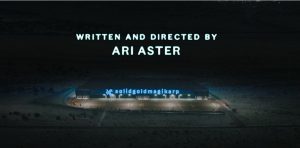
Still from Eddington, 2025.
As Aster’s determinist custom, nothing, not even murders and explosions, could stop the data center from being built, or the prophecy from coming true.
When Aster was asked what Eddington was about, he said: “It’s a film about a data center being built near a small New Mexico town.” Not for nothing did Aster say that; it’s clear the plot of the film focuses on the power struggle between the sheriff and the mayor through Covid and the Black Lives Matter protests in one of the peak moments of social and political conflicts in the United States, circa 2020. But in the interview Aster highlights the real significant aspect – the unstoppable construction of the data center. Aster makes clear that the film essentially depicts the story of the little people who have their strings pulled by an anonymous system of power so as to fight each other, and not notice much bigger things behind the scenes.
At some point in the film, sheriff Joe Cross (portrayed by Joaquin Phoenix), who opposes the building of the data center, its construction being facilitated by mayor Ted Garcia (Pedro Pascal), decides to finally take control. He decides to run against Garcia in the elections, but later resorts to progressively excessive steps. His actions do not stop the facility’s construction, because the string-pullers send mercenaries and professionals to disable any threat on their plans from Cross. Joe Cross ends up just like a puppet, and the data center will be erected.
My word limit is getting close like the inevitable ending in Aster’s films, so I’ll summarize and wrap up: As kitschy as it may sound, each one of us is being puppeted – by a mysterious shadow government, human society, the social network, our family, our parents, our genetics, or our innermost fears. And so we, like Aster’s characters, march blindly to an inevitable end. But the tragic mistake of his characters is that they did not imagine there are powers greater than them. If they stopped for a minute and noticed their hands are tied with strings, perhaps they could have freed themselves from them.
I would be happy to end here but I frankly must disprove my previous claim: at the midpoint of Eddington, sheriff Cross drives in his car and speaks through a loudspeaker about the data center: “That is deep fake from the deep state. And to who’s benefit? The same people that always benefit.”
Cross knows for certain there are powers greater than him pulling the strings, and he still can’t stop them, eventually joining them. So, what can we do? I don’t know. What I do know is that despite the limitations of the system of power (i.e. Utopia festival and magazine), I managed to go over my limit by 63 words (before editing – UA).
Footnotes and additional thoughts
1 // The Great Train Robbery, written, produced, and directed by Edwin Stanton Porter, a movie industry pioneer, is a silent short film from 1903 considered a milestone in the history of cinema.