


Director of the Utopia Festival for Science Fiction and Future Story-telling. As the Promethean Consultancy, program curator, PMO, artistic consultant and producer, writer and speaker on topics of technology and society, science fiction and the future.
On November 16, 1869, a festive flotilla left Port Said, ceremonially inaugurating the Suez Canal. During the hundred years that preceded this, Europe was netted with canals that were the main infrastructure for moving goods all over the continent. The canals were one of the hallmarks of an advanced society that shapes its natural environment as it wishes, and the giant canal in Egypt, an unprecedented engineering achievement, was a conceptual symbol of the subjugation of nature to man’s needs. No wonder then that the rumors spread in the winter of 1877 about giant canals on Mars ignited the imagination of many about the possibility that we are not alone.

Opening of The Suez Canal, Nov,17,1869
In October 1877, the Italian astronomer Giovanni Schiaparelli made observations on Mars, following which he published a detailed map of the red planets’ surface. In his observations, he named the various regions after earthly seas and continents, but his sensational discovery was the canals. Schiaparelli mapped huge grooves along the Red Planet and called them Canali. In Italian the word can serve to mean both artificial canals and as natural geological structures, but the English translation of the word canals, the word that was used for the infrastructure of canals that spread across Europe, struck the right cultural chords, and the invasion from Mars was launched.

1877 Map of Mars by Giovanni Schiaparelli
The discussion about the existence of extraterrestrial life has been of interest to philosophers and satirists for centuries. They used aliens for thought experiments and social criticism expressed in literature. Moving the earth and man from the center of the universe to an increasingly remote corner following the astronomical discoveries of the seventeenth-nineteenth centuries, carried the issue of extraterrestrial life into the field of scientific discussion. Alongside and inspired by the philosophers and scientists, writers of scientific romances began to appear in the 19th century; literature written out of great faith in progress and the scientific project, inspired by great scientific questions. This was the beginning of science fiction. They acted as if the hypotheses about life on Mars were hidden treasures, which they have come to plunder.
The writers of the scientific romances of the late 19th and early 20th centuries imagined the inhabitants of Mars as having a much more developed and advanced culture than ours, which, similar to the European one, subjugates its environment to its needs. Evidence of this is of course the monstrous construction projects that can be spotted from astronomical distances. A primitive scientific understanding of Mars – its distance from the Sun, size, the composition of its atmosphere, etc. – led to the assumption that the society of the Martians is indeed older than ours and has miraculous technological achievements, but the planet they live on is in advanced dying stages.
One of science fiction’s founding fathers, H. G. Wells, wrote at the time one of the genre’s seminal works. The British fear of the rising power of Germany at the end of the 19th century led to the flourishing literary “invasion” genre. Wells fused the two together and in “The War of the Worlds” (1897) the British author describes the Martian invasion of Earth, an invasion that will happen again and again, from then to now.
Wells bequeathed the Martians with the features of Mars, the Roman god of war, particularly the display of aggression without any emotion or mercy towards us, the earthly people, since they see us as inferior creatures – “We humans, the creatures living on Earth”, he writes, “are certainly alien and inferior to them just as the monkeys and lemurs are alien and inferior in our perspective.” The Martians destroy human cities with their state-of-the-art weapons, and only on the verge of our complete destruction, these demolishing machines stop, and the survivors discover that the Martians are dead. Ot is not that humanity defeated them by force of arms or trickery, they were simply unimmune to a series of viruses and bacteria that humans have endured for hundreds and thousands of years.

The War of the Worlds
Illustrated 1898 Edition
Wells very cleverly weaves a science fiction story that explores the scientific understanding and curiosity of his time while saturating it, not unlike the philosophers before who were engaged with aliens, with a sharp social critique. Wells presents deep criticism of the European colonialism: it tramples nations, destroys cities, and brings to the distinction of species, all via its advanced machines and devices, yet is beaten and subdued again and again by insects and bacteria. “And before we pass judgment on them,” he writes, “we must remember what cruel and absolute destruction our species has inflicted not only on animals such as the extinct bison and dodo, but also on the inferior races among humans. The Tasmanians, who were born as human beings, were completely extinct within fifty years, in a devastating war waged against them by European settlers. Are we angels of compassion because we come to complain about the Martians who wage war in the same way?”
Throughout the twentieth century, invasions from Mars, and over time from more distant planets, continued to take place over pages and on screens. Scientific knowledge about Mars grew further and further, while the likelihood of life on its surface grew shorter. Schiaparelli’s observations turned out to be inaccurate to say the least, particularly regarding the canals, which turned out to be nothing more than optical illusions. When NASA’s spacecrafts began to transmit close-ups of Mars and even landed on its surface in the 1960s and 1970s, the bitter truth was confirmed. Mars is an icy and arid planet. It does have ice caps, but even the ice there is dry (the ice caps of Mars are made of ice and frozen carbon dioxide, “dry ice”).
As Mars is being demystified, sci-fi artists are beginning to envisage other possibilities. Mars was and remains our closest neighbor, and relative to other landscapes in the solar system, it is the most similar to Earth, therefore it is granted that we be the ones who one day settle in it. From the middle of the 20th century, more and more stories have erupted concerning colonies on Mars, while this time the humans are the colonists who make the red wasteland bloom. Here, too, sci-fi artists used Mars as an arena for political criticism – in many cases the residents of the colony are being discriminated and seek autonomy (such as in the tv series “Babylon 5” by J. Michael Strazinski (1994-1998) or the book series – which was also adapted for television, The Expanse, by James Corey,) or that greedy tycoons control the natural resources critical for creating life on Mars, primarily oxygen (“Fateful Memory”, 1990, by Paul Verhoeven, based on Philip K. Dick’s story from 1966).
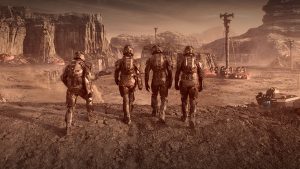
Marines of the Army of Mars during training, from the tv series “The Expanse”
The literary Mars quite often undergoes a complex and long process of “terrestrialization”, a technological intervention that slowly changes the surface of the planet and makes it Earth-like – atmosphere breathable for humans, soil fitting for agriculture – everything that can be done to make human settlement on Mars possible, without requiring space suits and domed cities.
One of the most recent works in the literary journey to Mars is Ridley Scott’s film, “The Martian, which tells the story of the survival of an astronaut abandoned on the planet. The spectacular beauty of the Red Planet is revealed in all its majesty and glory on the big screen, but this is no longer a distant and mysterious planet – a long series of NASA research missions brought breathtaking images from there and introduced us to the Martian nature up close. The Red Planet goes through the process of psychological terrestrialization and domestication. Mars is no longer a stranger to us.
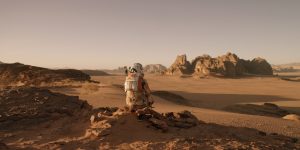
The Martian, Ridley Scott’s film starring Matt Damon (2015), based on Andy Weir’s book (2011). It turns out that the Jordanian deserts and Red Mountains look just like Mars.
And indeed, the highly inspired fictional ideas have turned over the years into viable plans of the space agencies. Not only robotic probes will explore Mars – a manned mission to the planet is not a fictional dream but a stated goal of the American space agency, and not only it. Private entrepreneurs have also entered the race, the most prominent of them being Elon Musk. The founder and CEO of the electric vehicle company Tesla and the space company SpaceX declares it unequivocally – his goal is to establish a human colony on Mars.
The last few years have brought with them twists and turns in the story of the Red Planet. It turns out that Schiaparelli’s erroneous observations nevertheless contained a hidden truth. There are no canals, but water does turn out to flow there. We have not yet found alien civilizations, but the possibility that life, even in its microscopic form, existed on the surface of Mars in the past, and is perhaps still possible today, is greater than ever. The possibility is exciting, but also raises new issues and difficult questions.
If there is microscopic life on Mars, but such that the human race has never come into contact with – when we invade this environment, will we not put at risk the fate of the invading Martians of H.G Wells? And what would happen if a human research expedition to Mars brings a living creature, even if microscopical, back to Earth, and it is exposed to an environment where it has no natural predators? These fictional scenarios become real and practical questions with the planning of manned research missions to Mars.
We started with a massive engineering project, and we are finishing with one. The billionaire industrialist Elon Musk, owner of SpaceX, suggests to the captains of the world – make constructive use of the hydrogen bombs you have, and prepare Mars for human habitation. Musk proposes to ‘terresteralize’ Mars – and he is not a science fiction writer – by launching hydrogen bombs towards the ice caps to melt them. The explosions will release water and carbon dioxide into the Martian atmosphere, making it much less hostile to humans. But what if there is already life on the surface of Mars, even if microscopic, what will happen to it? Do we have the right to affect their environment and in such an extreme measure, possibly to the point of destroying them, for our own purposes? Does the importance of biodiversity cross planets? How universal is the discourse of rights and will those who claim for animal rights or environmental protection seek to limit our intervention on Mars? We shall discover this over the next decades, but for those who wish to foresee the future- be attentive to science fiction.

Would gladly rent you an apartment on Mars, Elon Musk.