


Cultural researcher, content editor, and film critic at Portfolio Magazine. Has lived and breathed cinema from a young age and lives as someone who writes to find meaning.
It’s all a matter of perspective. This idea lies in the heart, mind and soul of Arrival, Denis Villeneuve’s 2016 cinematic adaptation of Ted Chiang’s short science fiction story, Story of Your Life.

Stories of Your Life and Others, a short story anthology by Ted Chiang, 2002.
Villeneuve’s work on Arrival foretold, and maybe even justified what was to come; his next bold and ambitious project – adapting the cult classic Dune into a cinematic epic, split into multiple parts and undertaken without the production company’s prior approval (a project that defeated Alejandro Jodorowsky and ended in disaster for David Lynch). When comparing the two adaptations, Arrival and Dune, the former may be far more modest in budget, yet all the more clever in form. The success of Arrival doesn’t lie in the brilliant way Villeneuve masters a simple drama to deliver a profound message, nor in its stunning effects or excellent performances (and they are excellent, and so is he); not even from its sophisticated narrative structure, its delicate thematic depth, or its striking visual grammar. In my opinion, the film’s success is rooted in a simple and applicable tool – perspective. Point of view. Perspective is the starting point and the conclusion of Arrival: one of the most complex, moving, and intelligent science fiction works of the 21st century, so far.

Arrival, a film by Denis Villeneuve, 2016, adaptation of the science fiction short story “Story of Your Life” by Ted Chiang.
On the surface the plot is familiar: the events surrounding the first encounter between humans and aliens. The setting is roughly contemporary. Aliens land on earth in 12 spaceships at 12 different geographical locations (including the U.S., of course, and Africa, Europe and China) with no obvious connection. The misunderstanding causes great anxiety. What do they want? Are their intentions hostile? Are they an advance colonization force? A trick that will end humanity? Maybe the cynicism reflects more on humanity than on the visitors? Maybe we’ve watched too much of the wrong science fiction?
The plot begins with deep, personal sadness. Dr. Louise Banks (Amy Adams) is a renowned linguist who suffers the death of her only daughter, losing her to a terminal disease. A tragedy. Like everyone else on Earth, she too is surprised by the appearance of the aliens (is it an invasion?), but she finds herself at the heart of the matter when she is recruited by the US military to join a team investigating the aliens’ arrival, specifically the spaceship that landed in North America, on American soil. Each ship contains two aliens (seven-limbed beings known as ‘Heptapods’). Louise will try to communicate with ‘Abbott and Costello,’ the names humorously given to them by Ian (Jeremy Renner), a physicist on her research team.

.Louise with Abbott and Costello
Where ‘Abbott and Costello’ and their friends came from remains a mystery, but it is likely they originate from an atmosphere different from ours, which is why they separate themselves from humans and the terrestrial environment. Inside their mysterious spaceship there’s a chamber with a solid, yet transparent, glass-like screen at its center, allowing humans and the Heptapods to share the space separately but simultaneously. The two strange looking aliens attempt to convey their language and the reason for their arrival through movement and writing, throughout all twelve points of contact. No one understands the message. It is difficult to communicate without knowing the language, which is why Louise is recruited: a woman who has devoted her life to the study of language, linguistics, and communication.
In the background, the geopolitical climate is unstable. The world wrestles with how to respond to the unexpected and uninvited visitors; global powers seek ways to leverage the situation and, of course, prepare for war. But contrary to what one might expect from a film of this kind, Villeneuve’s treatment of the global crisis is narrow, and deliberately so. Even when the global condition is shown, it is presented indirectly through news clips or brief mentions on background TV screens.
The global, universal, and thought-provoking implications, common within the genre, are still there, yet remain in the background, while Louise’s personal story unfolds and expands, center-stage. This happens both narratively and aesthetically through television screens as mentioned and through mise-en-scène that consistently keeps the foreground in sharp focus while blurring the background. This poetic principle also ties into the film’s iconography creative parallels between visual and auditory imagery. It is also evident in the editing, which, with near-religious discipline, trims away excess and centers us firmly within Louise’s point of view, guiding us through her private story.
Almost everything is told and seen through Louise’s eyes and her experience. Her private perspective drives the plot forward and raises mysterious questions, mostly about other moments in her life, scattered throughout the film. It is no surprise that her linguistic skill and personal experience combined are the key to unlocking the mystery of the alien language.

Dr. Louise Banks attempts to communicate with aliens.
Louise’s perspective not only gives the story structure and dramatic depth, it also contains a sharp reflexivity regarding the relationship between the film’s viewers and its protagonist, a dialogue between the creation and consumption of art, culture, cinema, and storytelling. An example of this is found in Louise’s character as a mother, in her personal and intimate experiences, from which emerge themes of grief, sorrow, acceptance, forgiveness, unity, transience, existential questions, fate versus choice, and much more. Another example is in the meeting space itself, where the communication between guest and host, alien and human, takes place through a large transparent screen in a dark room, somewhat (or rather, very much) like a movie theater.
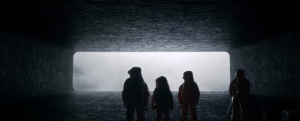
The Encounter as a cinema hall.
Similar to the aliens’ strange language that mimics circularity reminiscent of the ‘Ouroboros’ (a snake or dragon biting its own tail), the film’s language pursues itself and seeks to bite its own tail. Its aim is to close circles in a manner both melancholic and sophisticated. This effect is heightened when we understand Louise’s personal, emotional, and intimate connection to the aliens through her profession, education, specialization, and research – linguistics, but gradually, and especially around the scenes depicting her personal tragedy.
It’s not clear at first. Like us, the viewers, Louise must patiently and gradually extract meaning. The creator’s intention, whether in the original work or the film adaptation, is similar to the alien language. They are trying to tell us something beyond the world in which the encounter takes place. This ‘something’ is important. It’s not self-evident. It’s hard to understand. It takes time to grasp. But in the end, we get it. When? When there’s a shift in perspective.
The well-known and widely accepted understanding is that when learning a new language, thought itself can change. This does not happen in an abstract way, it occurs organically, deep within the mysterious neurobiological territory of the brain. In other words, language shapes perception. Language shapes perspective. Language shapes reality. In Villeneuve’s work, patience is required; one must shift one’s perspective. When that happens, so does the theme. What is seen from here cannot be seen from there – both in space and in time.
It’s challenging to write about a complex film such as Arrival without spoiling or giving too much away about the fascinating twists that unfold through it. Why? Because translating too much of the alien language would also mean translating the film’s unique language, thereby preventing the reader from experiencing the full range of emotions the film evokes. It’s a two-way street; too much revelation of the film’s language would expose the payoff.

The aliens’ language resembles in its form the circularity of the ‘Ouroboros’, the snake eating its own tail.
Arrival is circular, starting from the opening sequence. At the beginning of the film the protagonist walks down a circular corridor with no beginning or end. The corridor is in a hospital, the place where Louise’s daughter died. It is worth noting the change from the short story to the film: in the original work, Anna, Louise’s daughter, died in an accident. In Villeneuve’s film adaptation, she dies from a slow, incurable disease. This change amplifies, through the cinematic medium, the importance of choice, fate, and the confrontation with life and death.
The choice to change the cause of death requires confrontation with life’s suffering, with the one inevitable truth that ultimately awaits us all, that the only thing we can truly control is how we choose to face such a life, a life in which, in the end, choice itself is diminished in significance, perhaps even rendered… irrelevant? In spiritual terms it is simply acceptance. Maybe even surrender. To accept something terrible and devastating, knowing it will happen, but not giving up. Choosing to live with it, alongside it, within it, and beyond it. And under no circumstance, giving up. In the existentialist sense, drawing on the philosophy of Albert Camus, Louise evolves into something of a science fiction Sisyphus.
Like the mythological Sisyphus, despite the horrific, painful, and inevitable experience, she moves forward. She does as Camus suggests, she resists and pushes the stone uphill even if it’s absurd, even if it’s meaningless.
Arrival is not merely a meeting between humans and aliens. It is a meeting between humans and the unknown, the unfamiliar, the alien, of course, but also between one person and another, and perhaps most profoundly, between a person and themselves, the universe, their creator, whoever that may be, and death, whatever that may mean. A confrontation with one’s choices, even when the outcomes are undesired.
If you have yet to see Arrival and my impressions seem cryptic, vague, or obscure, somewhat like an alien language, watching the film will surely bring clarity. If you have already seen it, it will be clear why I choose to end these words exactly as they began: it’s all a matter of perspective.

It’s all a matter of perspective.