


A writer focused on the surprising connections between strange things - technology, psychedelia, science fiction, mysticism and esoterica, cute animals and strange peoples
Alongside speculations about the future and thought experiments like “What if Nazi Germany had won World War II?” or “What if humans had no sex or gender?”, science fiction often functions as a distorted mirror, stranger than any mirror we know, that manages to reflect the human condition in ways that realist fiction simply cannot. The tool, of course, is defamiliarization.
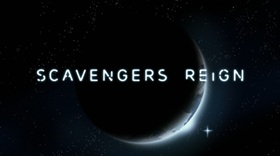
The cover image of the series Scavengers Reign.
In the third episode of the masterful animated science fiction series Scavengers Reign, the stranded astronaut Ursula finds herself confronted with a sight she cannot turn away from. Ursula is one of the few survivors of the Demeter spaceship crash on planet Vesta Minor. She finds herself in a strange forest, standing and staring in awe at one of the plants (or animals, hard to tell on this planet) that vibrates and emits light. Out of curiosity, with an almost childlike bravery, she extends her hand forward and touches a branch or limb of the plant/creature that is in front of her. A flower of many petals unfolds, revealing dozens of thin, blue stamens that open, exposing what appear to be glowing, hidden seeds.
-
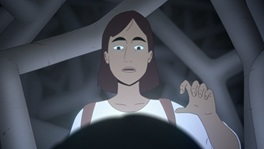
- This act seems excessive and complicated to us only because the processes on Earth are already familiar to us. An alien visiting Earth would probably find it no less strangely complex and intricate.Retry
-
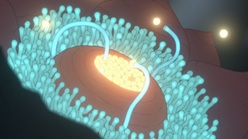
- A flower made of many petals opens and inside it dozens of thin, blue tentacles are revealed.
-
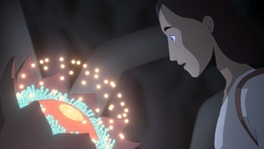
- Scangers Reign Image
-
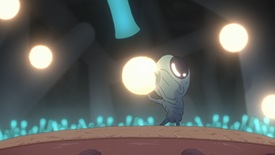
- The last seed is not like the others; it is a creature, resembling an insect or a thin frog, with large eyes and loose skin.
The stamens lift the seeds and release them into the air where they float. The last seed is unlike the others; it is a creature resembling a thin insect or frog with large eyes and loose skin. One of the stamens hands it a glowing seed, which it pierces open, releasing an even smaller red orb with five limbs. The orb fits perfectly into a recessed imprint of the same shape located at the heart of the open flower. When the orb and the imprint merge, countless tiny lanterns ignite around the plant, calling the glowing seeds to enter. The frog-like creature, exhausted from the act, wilts into the heart of the flower, dying with slow, measured breaths that the whole world seems to breathe along with. Upon its death, the blue stamens cover it with pollen. The flower closes. The process is complete.
This scene seems so strange, weird and alien-like, just like many other scenes on this planet. The reason for this alien strangeness is that the biological processes on Vesta Minor, which should be simple, are incredibly complex and convoluted. After all, it’s just fertilization, or something similar. The creators of the series designed the planet so that every organic process looks like a Rube Goldberg machine, where countless parts influence one another, each in its turn, in an exaggeratedly complex way, just to accomplish a simple task.
This act seems excessive and overly complicated to us, the viewers, only because the processes on Earth are already familiar to us. An alien visiting Earth would probably find it just as strangely complex. For example: if a primitive cell in the ocean swallows another cell, they form a symbiotic relationship as one cell provides protection and the other supplies energy. The consumed cell absorbs a photon that splits molecules, triggering a chemical reaction within the cell that produces nutrients like sugar, allowing what were once predator and prey, now symbionts, to grow, develop, and slowly become things like seaweed and plants. Another example: people want to spend the few decades they have on this planet in peace and for that they need to make money in jobs that are influenced by numbers on certain computers, numbers that are affected by how much rain fell on a distant continent, or by the number of ships that passed through a particular strait, which may be open or blocked because other humans are killing each other over various made-up stories they tell each other.
But the alienness of Vesta Minor is so profoundly alien for another reason. The creatures on it, whether plants, animals, both or neither, have no interest whatsoever in humans: the intruders, the survivors, the refugees, the parasites. They are almost entirely indifferent to them. Each creature simply goes about its function within the vast ecological web of which it is a part, consciously or not. Humans are not recognized as a threat, not even worth noticing. They are a tiny anomaly, infinitesimal. When humans are harmed by the planet’s creatures, it is, for the most part, by accident.
The only ones who show any real interest in humans are parasitic creatures. Despite being a small and negligible anomaly, the presence and activity of the humans who crashed on the planet still affect and disrupt certain biological processes. The parasites make use of humans, becoming stronger than they would be under balanced conditions. The ecological, planetary order of things is thrown off course.
The one creature who reminds the viewers of this natural order is neither human nor alien, but a robot. “Levi,” one of the survivors of the crashed spaceship, begins to develop a symbiotic relationship with the planet’s organic environment. Greenish-yellow organic tissues (seaweed? fungi?) gradually grow, shift, and interface with his electronic components, slowly granting him a consciousness and connection to his surroundings.
Levi begins his narrative arc as Azi’s robot, one of the survivors, within a familiar, classic human–tool, human–machine, human–robot relationship. Throughout the series the relationship evolves. They part ways and reunite. Azi finds Levi wandering somewhere, tending what appears to be a farm, caring for animals and practicing sustainable agriculture. She asks him, “What have you been doing all this time?” His answer resonates with me, grows more relevant by the day: “Adapting.”