


Writer & translator
There are series that cannot claim to be one of a kind, and from the day it was born, The Leftovers had to contend with the fear that it would follow in the confused footsteps of its older sister Lost, ending its run with a big bang of disappointment. But from the very first step, it became clear that even though they share the same creator (Damon Lindelof) and seemingly the same mystical/enigmatic genre, The Leftovers does not follow in the footsteps of any series that preceded it.
The defining event, known as the “Sudden Departure,” is the disappearance of 140 million people—2% of the population—in a single moment on October 14, 2011.
If in Lost and other similar series the natural focus, if we may put it that way, is on those who were lost and crossed the border into the unknown, in The Leftovers, as its name suggests, we focus on those left behind. On the people who lost spouses, children, friends and, in many ways, themselves and the world they had lived in until then.
Three years after the event, humanity is still trying to cope with the new reality, and is doing so with awkwardness, uncertainty, and hesitation that we surely recognize from the present day. Amidst a cacophony of cults, preachers, and self-proclaimed saints, countless statistics, conspiracy theories, and above all, a cold and terrible understanding that there is no choice. We must go on. We must call the missing “heroes” in the anniversary parades in their memory, because “those we have no idea where the hell they are” doesn’t sound good.
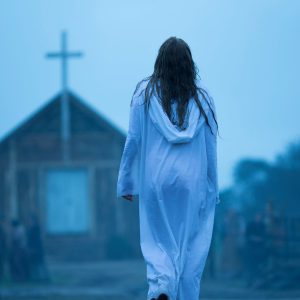
Image from The Leftovers
Kevin Garvey is the police chief in Mayfield, New York. Nora Durst lives in the town. Kevin’s family falls apart when his wife joins an anarchist sect that advocates silence and smoking in the wake of the event. Nora’s family fell apart during the event, in a way that is unusual even in this reality—her husband and two children disappeared.
This is a story about faith, love, and stubbornness—in the best sense of the word—while dealing with a scattered, indifferent, and illogical world. Kevin and Nora are meant for each other, and they reach out across the chasm that has opened up between them, across the boundary that separates the world of the living, the world of the dead, and the world of the disappeared.
The success of The Leftovers lies, in my opinion, in the poetic reverberations it leaves with the viewer, in the resonance it evokes between personal and universal tragedy, between the intimacy of the small communities in the United States and Australia where the three seasons of the series take place, and the journey across continents and worlds that the characters undergo. There is a resonance between the words and Max Richter’s perfect soundtrack, between our world and the one opposite it. And also between the mystery posed at the beginning of the series and its beautiful ending, which resolves only what can still be resolved.
The Leftovers manages to avoid the predictable pitfalls that seasoned viewers fear: kitschy leaks, plot holes, excessive grotesqueness, and above all, the feeling that we are trapped, even if willingly, in the trunk of a speeding truck driven by creators who should not have been licensed to do so in the first place.
My favorite moment in the series occurs at the end of the second season, and it stands on its own, without fear of spoilers.
Kevin Garvey is trying to return home from the other world, the beyond. He stands there, living dead, confused, facing a blinding light that could symbolize the end of the tunnel, but also looks like a tool of evil interrogation. He holds a microphone and sings Simon and Garfunkel’s “Homeward Bound” to the best of his ability. He is vulnerable, he is human, look at him and you will see us: blinking in the light, ready to do anything to try and return to a familiar place, a peaceful corner of the world that obeys foreign forces we did not shape ourselves, that give us no foothold in anything, and yet – we are there, choked with tears, singing at the top of our lungs, with faith, love, and stubbornness, until we succeed.