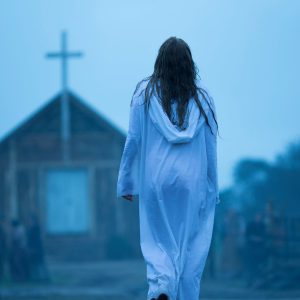
In a series of scenes lacking context and clarity. The heroine is sitting at a café. They don’t know her, but she knows them. The heroine kills someone and flees from the police into a strange machine. The heroine hooks up with a guy outside a support group meeting. She remembers him, but he doesn’t remember her. Irena Kelly’s life was destroyed when a man seduced her daughter and murdered her. There is no home anymore, no life. Only one goal: to find this man and murder him in retribution. But as we have learned from countless revenge films, revenge is not satisfying.
Only Irina has a solution- she lives her life in a loop – not a loop of time travel, but of interdimensional travel. Instead of obsessing over her daughter’s death in the past, she can experience it over and over again, in a constant search for a dimension where the killer fails, and she can be reunited with her daughter. Along the way, she not only finds the man who killed her daughter and kills him but continues to kill the son of a bitch over and over again.
Despite its unsettling opening, Redux Redux is not a difficult film to follow. The concept is complex, but the film remains in constant action mode while keeping the viewer engaged, without being heavy or dull. Throughout the film, we get answers to the questions raised in the opening, and the world-building expands while striking a balance between developing classic sci-fi curiosity and limiting the weight of the exposition. The film’s pace is riveting, as Irina’s journey starts to fail in every possible way. First, unsurprisingly, she finds a girl tied up in the killer’s apartment, only it is not her daughter.
Mia, a girl with a mountain of problems of her own, wants to join Irina’s project. If she can’t deal with the past that led her to run away from the orphanage, then maybe she can at least shoot it. As you can imagine, Irina is not keen on the idea, but Mia is not willing to take “no” for an answer, and the two are forced to work together.
Despite its focus on action a little tiresome philosophizing about trauma, the film takes its themes seriously. Revenge only leaves the victim in a perpetual state of it. Just as those suffering from post-traumatic stress disorder cannot stop reliving their experiences over and over again, those seeking revenge re-inject the formative event into their lives and are doomed to relive it again and again.
Nietzsche believed that we should live our lives as if we were in an eternal loop. The goal is to live the kind of life that we would be happy to live over and over again forever. Everything we have lost will be ours again, and we will lose it again. Irina distorts this logic with her attempt to reverse the direction of the loop or at least halt it at a specific moment. In order to come to terms with her life, she must accept that what was is not what will be, and still love what there is.
Only that Irina rejects the ideas of healing and forgiveness; she wants to have it all, and Mia, who was clearly planted there to be her replacement daughter, will never be a true substitute. Through action and suspense, the film repeatedly challenges Irina’s ideas, confronting her with the choice between desperately trying to regain the security of the past- which will trap her in a cycle of violence where she will ultimately lose everything- and the opportunity to build something new.
So, what does the film want from us? In response to violence, in response to having what is most precious to us taken from us, should we forgive and forget? No. Redux Redux serves us excellent action. Nietzsche also said that there is a special pleasure in causing pain, so in his opinion, the pleasure of revenge is compensation for injustice. Redux allows us to see a perverted murderer getting what he deserves. Like the bartender filling the glass, he says it’s our last one for the night. We need to know when to stop. Redemption is not at the bottom of the glass, nor at the bottom of the barrel. If we don’t understand this, our story will end as the film begins.
One of the most moving, profound, sweet films awaiting us this year at the Utopia Festival, in my opinion, is the film by Ukrainian director Pavlo Ostrikov, U Are The Universe. Admittedly, it is a science fiction film that features all the expectable tropes: space, spaceships, disasters, and even a robot with artificial intelligence (of course). However, it does not use genre motifs to create a universe, but rather to cleanse it of them. Just before it becomes an apocalyptic or dystopian portrait, in that split second, human, philosophical, and cinematic magic takes place in relation to human longing and its connection to the vast cosmic space and the material earth of planet earth.
The film’s protagonist is Andrei, who is either an astronaut or a celebrated driver of a zero-gravity garbage spacecraft. His job is routine and technical. In other words: boring. He is a blue-collar worker. His only partner in this dreary job is Maxim the robot, who never stops reminding him of what is obvious, irritating him, bothering him—and sometimes even cracking unfunny jokes. But as the film progresses, the signification of this character is clarified: Maxim acts as a cinematic “buddy,” only in this role, Andrei has no friend by his side, only a poor imitation of one: humor that highlights loneliness rather than filling it, and a somewhat caustic representation of relationships between man and chatGPT.
Andrei is a misanthrope, whom even the distance of space cannot sufficiently distance from the human race. Suddenly, the Earth is destroyed, exploding right before his eyes. In an instant, not only the planet and the life on it collapse, but also the very idea of having a place to return to.
Andrei is not very shaken by it; he seems more interested in making the most of his remaining time on the spaceshift and doing his best. Even when there is no, well, best. Food rationing? What difference does it make, one month more, one month less. Energy? It would be better spent on something other than oxygen. Utilitarianism? Nah. Why? When utter hopelessness meets a man who has long since despised the concept, not much can happen. There is only simple acceptance.
But then something happens. Andrei discovers that he is not the last person alive. Through a distant communication channel, he makes contact with a woman named Catherine, a French astronaut staying by herself at a distant station. Another human trace, distant but real. They form a connection, which exists solely through voice and speech, without image, touch, or promise for the future. After all, there is no future.
It is precisely this reduction, the choice to keep the connection at the level of the voice alone, that makes it particularly intimate and creates a kind of reverse mirror of the way we consume media today. There is no gaze, no body language, no image through which one can fantasize a lot and gain little. Only voice, breath, small silences. It is a minimal, almost technical human connection, but one that holds extraordinary emotional power. Not as a promise, nor as the beginning of another story. Only an existence born out of emptiness.
This is not necessarily the beginning of a romance, nor is it a message for the sake of humanity. It is a connection that grows in an environment where the world has already collapsed and there is no going back. And yet something in Andrei moves, defrosting his heart. Amidst nothingness, loss, and lack, he rediscovers the longing he once dismissed- the need for another human being.
Instead of asking how to save humanity, the film asks a much more modest- perhaps crueler question: What remains of human connection when the future ceases to be a possibility? And what would even the greatest misanthrope be willing to sacrifice for the slim chance of touching, connecting with the “other”- the last other.
There is something fundamental in the use of The Universe in science fiction as a tool for reduction rather than expansion or flooding with effects. In an era when the genre is flooded with conceptual excessiveness, formulaic spectacles, bombastic solutions, and apocalypses that occur once a week, Ostrikov’s work moves in the opposite direction: he peels away the layers instead of adding to them. There is no mythology construction, no collective consciousness to save, no inflated futuristic vision. Space is not a place of promise, and technology is not a bridge but a maintenance framework that maintains life on the edge. Right on the edge. The result is a stubborn and profound science fiction that places a lone individual in front of what remains when the idea of “tomorrow” has been emptied of content.
In this sense, U Are The Universe is revealed as a distinctly existentialist work of art that prioritizes the present over the future. Andrei is not just “the last man”; he is a reflection of the contemporary viewer. Like many, he is isolated but functional, surrounded by screens and streams of information, watching the world collapse from a seemingly safe distance. The destruction does not shock him because it has already taken place in his mind. Thus, the film speaks to an era in which the longing for connection exists but does not necessarily lead to change, correction, or a clear destination. It is a longing that exists for the sake of longing itself, not as a mechanism of redemption.
Despair gives way to courage, the aversion from humanity is replaced by love, and the desire to make the most of the time that remains turns into an understanding that what remains must be exhausted. This seemingly modest film stirs an emotional quake, causing the stoic and tough protagonist to evoke rare empathy. The more modest the film’s intentions are, the more the heart shrinks and goes out to its protagonist.
It is a delicate, modest but impressive film that manages to transform cosmic silence into an inner reflection of human loneliness. In its most beautiful moments, the empty space is perceived as the space of the soul; and the big questions about the expanding universe become questions about the heart, which seems to be moving in the opposite direction.
U Are the Universe is not a film about the end of humanity, but about what remains of the human when there is nothing left to wait for. No redemption, no future, no vision – just one voice that continues to speak to another voice in vacuum.
In this sense, U Are the Universe does not look towards space. It looks at the viewer and asks how much he too has learned to live with a human hunger for something distant – a low, faint sound that becomes an entire universe and much beyond in an instant. How much has he given up, and how much is he willing – even if he cannot admit it – to try again.
There are quite a few books that attempt to decipher what goes on in the mind of someone who is losing their sanity and connection to reality. It doesn’t always work. But in the film Linoleum (2023), written and directed by Colin West, an attempt is made not only to simulate what happens in such a mind, but also to show how, in some ways, it contains elements that affect us all and to give a beautiful and touching representation of the parts of our consciousness to which we no longer have access.
At the center of the plot of Linoleum we find Cameron (played by American comedian Jim Gaffigan) – a failed host of a children’s science TV show who is trying to fulfill his old childhood dream: to be an astronaut. So he tries to build a spaceship. Where? In the private garage of his suburban home. Only then, some strange events take place, which cause him to question his perception of reality: while he is busy fulfilling his dreams, his wife divorces him and his daughter experiences her first crush and the changes of adolescence. Moreover, his father’s dementia worsens, requiring him to take care of him and devote more attention to him.
On paper, the film seems to be handling an overload of crises, but watching it proves otherwise: all the crises—those of the daughter, of the father vis-a-vis his childhood dreams, of the wife vis-a-vis her husband, of a person vis-a-vis his father—are interrelated and echo one another. Because more than discussing a series of crises, the film deals with the link and similarity between all the crises, the link of these crises to the passing of time and to the expectations and disappointments of life itself.
But this is only one layer of the film. Against the backdrop of these earthly crises, the film also deals, all throughout it, with ideas of journeys through space and time, with the plot causing us, the viewers, to wonder – what is really going on here?
Then, at the height of the drama, it turns out that what I thought the film was trying to tell me is not it. I won’t go into any more detail, so that you can experience the whole range of emotions I experienced in front of the screen as well. I’ll just say that it almost caused me to have a minor crisis of faith, disappointment, and even frustration at the film’s creative almost-ruse. “Almost” because, unlike other films I’ve seen where I felt cheated because of too-big a plot twist, a revelation that changed everything I thought about the film up to that point, here something different takes place. So it’s only an almost-ruse. Instead of shattering illusions, the revelation helped to bring order to the chaos, answer the questions that arose during the viewing, and reinforce the foundations of the illusion in a way that creates heartbreaking perfection: All the lines, all the crises, a person’s entire life is presented as a single plot in which he plays all the roles, and converge in a single moment that is shattered into infinite pieces.
Then, one clear insight emerges: we don’t really need a spaceship to travel through space and time. All we need to do is dive into our consciousness.
Mars Express delivers everything you’d hope for from a science fiction movie. It’s enchanting, its pace is thrilling but not overstimulating and each character gives us a glimpse into a possible world. It is relatable and empathic without being melodramatic or overfixating on trauma. Also, its science fiction is carefully crafted. In every setting the film portrays, the script lays out a world filled with products and technologies that expand on existing trends. It offers new ideas and sparks the imagination, all while asking where do we even want products to evolve? What will they look like once they become old or irrelevant, and will a commercial space shuttle have enough bathrooms? If you’d like to watch Mars Express without spoilers, watch it before you read the next paragraph, because I have to talk about the plot.
The film is named after a fast flight, but the shuttle plays a minor role. The lead characters use it once in the beginning of the movie. Writer/director Jérémie Périn spoke about writing the screenplay while popular billionaires were discussing the need to go to Mars, and so, the film portrays a kind of Utopia by wealthy libertarians who’ve left Earth behind, reduced to a slum of unemployed people. But make no mistake, Périn isn’t trying to depict a dystopia. After a brief visit to an anti-robot protest for human labor rights on Earth, the movie takes us to the affluent society living under a dome on Mars. In doing so, it confronts us with one of the most threatening Freudian nightmares: the horror of getting exactly what we asked for.
Jérémie Périn, director of Mars Express, 2023
In the introduction to his short story collection Burning Chrome, William Gibson wrote that in order to write convincingly about the future, you need a compelling map of the past. That is the key to understanding Mars Express, a movie that asks where we come from and where we’re headed, as Earth represents our past and Mars poses the question – is this the future we want? The main subject the plot focuses on is labor. On Earth, work has been taken over by robots. On Mars, a megalomaniac billionaire is in the process of replacing metal robots with biological ones. The question is, will the metallic robots agree? By the end of the film, it’s revealed that the billionaire believes the only way to carry out this transition is by freeing the metal robots from the constraints of their programming, while at the same time convincing them that their future lies in space. In that sense, the billionaire resembles Lincoln, seeking to replace slaves with wage workers. He, too, was driven partially by an economic shift toward wage labor in the Northern states, but also hoped African-Americans would simply leave America and leave it white. The metaphor between robot rights and black civil rights, sometimes overused in science fiction, is expressed in the B-story of one of the main characters, Carlos Rivera, a back-up robot who contains the consciousness of a black man killed in a robot rebellion. He tries to make peace with his ex-wife so that he could see his daughter. Her new husband is a white cop, glad to take advantage of the fact that he can use violence against the robot, knowing it can’t fight back.
So, how are robots different from us? Mars Express explores this question in a variety of ways throughout the movie. The physical resemblance between robots and humans is emphasized in various scenes of dismemberment and robot attacks, where they spray a blood-like black fluid. The constant connection humans have with the network, including messages transmitted through a brain-computer interface, shortens the gap between humans and machines, causing both humans and robots at times to display a distant and confused look when engaged with something digital and intangible. Sexuality, freedom, addiction, work – all issues that both robots and humans grapple with throughout the film, in different ways.
Robots, the digital world, and Mars represent the direction we’re heading. But, the movie, which ends with a violent revolution by working class robots, confronts us with historical issues that technological progress cannot solve. We can try to escape our troubles by going to Mars, or through robotics or AI, but if we don’t solve them, they won’t go anywhere. Such questions are: who will do the work and how do we make sure they’re treated properly? What do we do with whoever technology left behind? How do we distribute resources fairly?
Aline Ruby, the main character, is a detective hired to find a missing girl. As is common in such films, the investigation leads her to uncover more and more of the rot at the heart of society, and eventually ask herself major questions. But her eyes can’t see far enough. They’re stuck on Chris Royjacker, the billionaire, who leads the robot breakthrough. Aline, Chris and Carlos were all in the military when the machines betrayed them. In the most intense scene in the film, Aline makes a desperate attempt to convince him to stop and put the genie back in the bottle, to ask the angel of history to stay put. She aims a gun at him when his bodyguards enter. Aline and Chris beg the bodyguards to drop their weapons, or she’ll kill him. But you can’t put a bullet in history’s head, and neither can you do that to capital. Just as the robots that killed Carlos weren’t driven by personal whims, but by the army that built them, the guards do not respect Chris’s life. They hold an urgent meeting, in which the board unanimously decide to kill Chris and Aline together to allow the plan to proceed.
There’s no use in rushing toward the future, says Mars Express. It won’t save us from the past. As long as we remember that, we could settle a much slower shuttle to Mars.
Ursula K. Le Guin masterpiece The Dispossessed: An Ambiguous Utopia, takes place in an alien Solar system, similar to ours, on twin planets that orbit each other. Anarres is home to an anarcho-feminist society that exists in a harsh climate, with extreme drought and a scarcity of natural resources required to sustain life. This society was created by anarchist revolutionaries who originate from the twin planet of Urras, they left to Anarres to establish a utopia based not on a central government, but on systems of voluntary division of labor, principles of mutual aid and social commitment, ethics of shared suffering, solidarity, Comradeship and above all, freedom. Urras is an allegory for Earth during the time of the 1970’s Cold War, where an ongoing struggle was taking place between a capitalist USA and a communist USSR for the territories of the countries caught between them, and the resources those countries hold.
The story centres on Shevek, a physicist from planet Anarres. He develops his revolutionary ‘General Theory of Time’ and discovers along the way that the anarchist society in which he was raised and educated is losing its commitment to the values on which it was founded 170 years ago. He challenges this society both internally, by questioning the existing division of labor, prevailing methods of work and research, and the implicit assumptions underlying social life on Anarres, and externally by seeking contact with physicists who live on the neighbouring planet Urras, in what is a liberal capitalist superpower.
Le Guin’s literary work is both a political-moral manifesto, a physical theory, and operating instructions for human emotions. But above all, The Dispossessed is an idea.
“My society is also an idea. I was made by it. An idea of freedom, of change, of human solidarity, an important idea.” (p. 335 in Harper Collins’ eBook)
In 1974, Le Guin put the above words in the mouth of the story’s protagonist, Shevek, the dispossessed. These words can also be understood as ars poetic. The idea that the protagonist is talking about does not only exist within the book; it is the book itself. Le Guin’s idea was so detailed that she managed to create it within the context of a climate crisis, a solution to a complex physical problem, an anarcho-feminist utopia (admittedly vague, but something to strive for) and even a map of the two planets!
Alongside these, Le Guin examines the challenges facing the very existence of the idea she conceived in her fevered mind. One of these challenges is fear. There is fear of external forces, fear of deviation from what began as social norms and have cemented to become rigid rules, fear of irreconcilable competing ideologies, fear of despair. Sound familiar?
In her novel Le Guin extensively explores the influence of language on our consciousness. She invents wonderful words such as ‘egoize’, which in a world without private property is considered a particularly colourful, juicy curse. She also explores the messages we consciously and unconsciously absorb from our language and environment. Amidst all these words, she seems to be conveying an important and thought-provoking message to all of us, in the Middle East, on planet Earth:
“He’s got the message. You heard it: detest Urras, hate Urras, fear Urras. […] All right. I agree that it’s probably wise to fear Urras. But why hate? Hate’s not functional; why are we taught it?”(p. 49 in Harper Collins’ eBook)
Hatred can lead to the liquidation of businesses, unemployment, economic hardship, crime and violence. Hatred burns the soul from within. It blinds us and blurs any difference or distinction between us, and anyone who is not part of ‘us’. In the words of Le Guin, many things are “dysfunctional”. So why are we taught to hate?
Probably because of blindness. After all, blind obedience is the best kind of obedience.
How Can the Blind Restore Their Vision, How to See, Again?
Le Guin has a solution. The solution is related, on the one hand, to partnership, to the ethics of shared suffering, and on the other hand, to complete independence.
Let’s start with the first part: the ethics of sharing suffering. One of the characters in the novel describes a moment she experienced during a severe drought, when a co-worker was dying right next to her. The character realised that there was nothing she could do to save her friend and that the only moral thing to do was to share in his suffering and be there for him. To be there until death and acknowledge his very existence. Sometimes all we need, especially in time of suffering, is a hand to hold us, a compassionate and loving face looking at us, a friend-brother, a friend-sister, who will simply be there with us, simply because we are social creatures.
But how does this fit in with the ultimate attainment of individual independence? Shevek’s research of the “General Theory of Time” has led him to conclude that the fulfilment of one individual’s will, in other words, to be a free person, is also the fulfilment of that individual’s social commitment. He explains the role of the individual in the social formation, first as a cell in a complete structure, in which each cell has a function it can perform in the best possible way. Fulfilling this role will realise not only the individuality of that specific cell, but also the common good.
The conclusion: critical thinking and the willingness to resist are priceless resources that we all possess. It is our duty to nurture these resources and protect them, even and especially when it is challenging to do so. Only critical thinking that does not take social conventions and norms for granted but constantly reexamines them, seeks to adjust and innovate as necessary, will ensure the long-term freedom of the people in that society.
“…for though only society could give security and stability, only the individual, the person, had the power of moral choice —the power of change, the essential function of life.” (p. 324 in Harper Collins’ eBook)
My discussion about imagination as a generator of despair and/or hope will be held with the guidance of two recommended literary works.
First, science fiction and fantasy literature is, by its very nature, based on speculation; construction of possible worlds in space-time, asking “what if” questions about communities, cultures, and mental frameworks that are created under these speculative conditions. By turning the present into one of many possible worlds, it challenges deterministic perceptions that see it as a necessary, static, self-evident state of affairs based on religion, ideology, historical laws, or pseudoscience. Therefore, even when it describes seemingly hopeless post-apocalyptic dystopias, it also points, together with despair, to the hope inherent in the very ability of reality to change.
Secondly, there is something liberating and hopeful about the artistic representation of fears and paranoia; and to be a little Freudian, it also exists in the literary realization of hidden desires (which fantasy literature certainly fulfills for children, for example: the common desire for orphanhood, but not only that and not only for them).
The first reading is of that kind, an imaginary world, the associations of which with our own world are quite obvious. In addition, imagination is used there to generate empathy for others and foreigners, to break down prejudices and stereotypes.
The second reading transfers the act of imagination from the creator to us, the readers. As such, it is an exemplary model of comfort and hope.
The Word for World is Forest
Once upon a time, I was asked about a good book on “settler colonialism.” My answer, which surprised—and probably disappointed—the inquirers, who were probably expecting a thick, heavy volume of cutting-edge academic theory, was and remains a recommendation for a fantasy/science fiction novel by my favorite author, Ursula K. Le Guin. The book is called The Word for World is Forest (first published in English, 1972).
The book describes an encounter in a distant world between its settlers-inhabitants and its indigenous-inhabitants. Le Guin’s genius literary move, which prevents it from being a clichéd allegory and a manifesto masquerading as literature, is based on the use of imagination, not only to create a world and society within the framework of speculative anthropology that characterizes it, but also to move between consciousnesses and experiences, challenge what we take for granted, and generate empathy towards the foreign and the other.
The opening is described through the eyes (and consciousness, and feelings) of a “white” (i.e., foreign) settler, in a way that automatically arouses our sympathy for him and his role, together with contempt, disgust, and anger at the disobedience of the natives, who are perceived by him (and us) as subhuman work animals. It is the same automatism with which we “knew” (that is, were led to ‘know’) who were the “good guys” and who were the “bad guys” in the adventure books and movies of our childhood — the good guys were white gentlemen from Europe, the bad guys were the notorious, savage natives, who gathered on the wild beach waiting for their ship to serve them submissively or to be slaughtered or, God forbid, be cooked by them in a large pot… The good guys were the white cowboys, the bad guys were the rebellious, cruel, bloodthirsty “Indians” or the lazy, filthy, greedy “Mexicans.”
Then, gently and gradually, a reversal is constructed in the book, and in the reader’s mind. With it, comes identification, familiarity, and empathy with the indigenous people, their culture, and their worldview. The reversal brings with it a series of insights, one of which, a particularly political one, is noteworthy because it is often forgotten: The occupier, the invader, the settler, the colonizer, the foreigner, does not only bring with it weapons, police, and supervision that ensure its supremacy by force, but it also imports “laws” that it both enacts and enforces. It renders local traditions and ways of life illegitimate, not to say illegal.
Hence, Native Americans lost their lands because they did not register them by a certain “deadline” at some mayor or sheriff’s office. It was announced in notices posted in a language other than their own on bulletin boards in cities where they did not live, and based on laws and regulations that not only they did not participate in their enactment, but were also unaware of their existence (and ignorance of the law is no excuse; this can also be learned from the opening chapter of The Hitchhiker’s Guide to the Galaxy, Douglas Adams’ science fiction classic, where Earth is destroyed to make way for a hyperspace bypass, according to plans that were presented more than fifty years ago in the local galactic planning offices in the Alpha Centauri system – UA).
Thus, Lobengula, king of the Ndebele people (as they were called), signed a unilateral agreement granting rights to Cecil Rhodes’ company and the British crown in what would later be called Rhodesia (and today Zimbabwe), in legal language and according to laws provided by the British (and while he was apparently drugged with red wine mixed with opium, and under heavy guard by soldiers armed with machine guns — one of the first uses of this weapon).
In Le Guin’s book, the natives defeat the invaders from the galaxy following a violent uprising, the invaders give up the conflict and choose to respect the autonomy of the locals. But they also pay a heavy price—the loss of the pacifist and peace-loving ethos that characterized their culture. In this sense, everyone comes out as losers in this conflict. Le Guin’s imagination not only poses the somewhat clichéd moral question of “does the end justify the means?” but also Albert Camus’s sharp question/answer: “what justifies the end?” to which he answers, true to his way, “the means.”
Moomintroll’s Wish
The second example (which I particularly like) is the use of the readers’ imagination, an example that describes a moment that does not even take place within the story, rather only after it ends. When I first read the book, it was called The Family of Strange Animals, and no child or adult I knew had heard of it or of its author, Tove Jansson. It was my private secret. Today, in a recent translation, it is called The Wizard’s Hat, and its Moomin characters are familiar to everyone, thanks in no small part to the popular animated series.
At the end of the book, Moomintroill asks the wizard to send the table packed with goodies to his friend Snufkin, who is wandering somewhere at night, all by himself. This is a noble request from a true friend, who uses (and supposedly wastes) his only wish to make his soulmate happy.
This is where the story ends, but the magic moment is in your imagination: the moment when, in the depths of the forest, on a dark and cold night, a festive, heartening table descends from the sky in a complete surprise for Snufkin. I imagine him smiling to himself, the gift not being the table itself, but the intention. Moomintroll gives Snufkin the most beautiful present, a moment of unexpected grace.
(The first book in the Moomin adventure series was published in Finnish in 1945. The book in question, The Wizard’s Hat, the third in the series, was published in 1948).
Alongside speculations about the future and thought experiments like “What if Nazi Germany had won World War II?” or “What if humans had no sex or gender?”, science fiction often functions as a distorted mirror, stranger than any mirror we know, that manages to reflect the human condition in ways that realist fiction simply cannot. The tool, of course, is defamiliarization.
The cover image of the series Scavengers Reign.
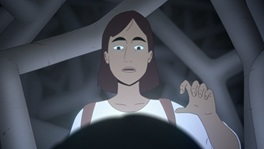
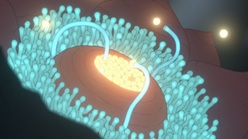
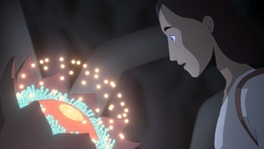
In the third episode of the masterful animated science fiction series Scavengers Reign, the stranded astronaut Ursula finds herself confronted with a sight she cannot turn away from. Ursula is one of the few survivors of the Demeter spaceship crash on planet Vesta Minor. She finds herself in a strange forest, standing and staring in awe at one of the plants (or animals, hard to tell on this planet) that vibrates and emits light. Out of curiosity, with an almost childlike bravery, she extends her hand forward and touches a branch or limb of the plant/creature that is in front of her. A flower of many petals unfolds, revealing dozens of thin, blue stamens that open, exposing what appear to be glowing, hidden seeds.
This act seems excessive and complicated to us only because the processes on Earth are already familiar to us. An alien visiting Earth would probably find it no less strangely complex and intricate.Retry
A flower made of many petals opens and inside it dozens of thin, blue tentacles are revealed.
Scangers Reign Image
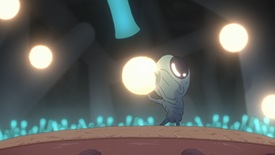
The last seed is not like the others; it is a creature, resembling an insect or a thin frog, with large eyes and loose skin.
The stamens lift the seeds and release them into the air where they float. The last seed is unlike the others; it is a creature resembling a thin insect or frog with large eyes and loose skin. One of the stamens hands it a glowing seed, which it pierces open, releasing an even smaller red orb with five limbs. The orb fits perfectly into a recessed imprint of the same shape located at the heart of the open flower. When the orb and the imprint merge, countless tiny lanterns ignite around the plant, calling the glowing seeds to enter. The frog-like creature, exhausted from the act, wilts into the heart of the flower, dying with slow, measured breaths that the whole world seems to breathe along with. Upon its death, the blue stamens cover it with pollen. The flower closes. The process is complete.
This scene seems so strange, weird and alien-like, just like many other scenes on this planet. The reason for this alien strangeness is that the biological processes on Vesta Minor, which should be simple, are incredibly complex and convoluted. After all, it’s just fertilization, or something similar. The creators of the series designed the planet so that every organic process looks like a Rube Goldberg machine, where countless parts influence one another, each in its turn, in an exaggeratedly complex way, just to accomplish a simple task.
This act seems excessive and overly complicated to us, the viewers, only because the processes on Earth are already familiar to us. An alien visiting Earth would probably find it just as strangely complex. For example: if a primitive cell in the ocean swallows another cell, they form a symbiotic relationship as one cell provides protection and the other supplies energy. The consumed cell absorbs a photon that splits molecules, triggering a chemical reaction within the cell that produces nutrients like sugar, allowing what were once predator and prey, now symbionts, to grow, develop, and slowly become things like seaweed and plants. Another example: people want to spend the few decades they have on this planet in peace and for that they need to make money in jobs that are influenced by numbers on certain computers, numbers that are affected by how much rain fell on a distant continent, or by the number of ships that passed through a particular strait, which may be open or blocked because other humans are killing each other over various made-up stories they tell each other.
But the alienness of Vesta Minor is so profoundly alien for another reason. The creatures on it, whether plants, animals, both or neither, have no interest whatsoever in humans: the intruders, the survivors, the refugees, the parasites. They are almost entirely indifferent to them. Each creature simply goes about its function within the vast ecological web of which it is a part, consciously or not. Humans are not recognized as a threat, not even worth noticing. They are a tiny anomaly, infinitesimal. When humans are harmed by the planet’s creatures, it is, for the most part, by accident.
The only ones who show any real interest in humans are parasitic creatures. Despite being a small and negligible anomaly, the presence and activity of the humans who crashed on the planet still affect and disrupt certain biological processes. The parasites make use of humans, becoming stronger than they would be under balanced conditions. The ecological, planetary order of things is thrown off course.
The one creature who reminds the viewers of this natural order is neither human nor alien, but a robot. “Levi,” one of the survivors of the crashed spaceship, begins to develop a symbiotic relationship with the planet’s organic environment. Greenish-yellow organic tissues (seaweed? fungi?) gradually grow, shift, and interface with his electronic components, slowly granting him a consciousness and connection to his surroundings.
Levi begins his narrative arc as Azi’s robot, one of the survivors, within a familiar, classic human–tool, human–machine, human–robot relationship. Throughout the series the relationship evolves. They part ways and reunite. Azi finds Levi wandering somewhere, tending what appears to be a farm, caring for animals and practicing sustainable agriculture. She asks him, “What have you been doing all this time?” His answer resonates with me, grows more relevant by the day: “Adapting.”
It’s all a matter of perspective. This idea lies in the heart, mind and soul of Arrival, Denis Villeneuve’s 2016 cinematic adaptation of Ted Chiang’s short science fiction story, Story of Your Life.
Stories of Your Life and Others, a short story anthology by Ted Chiang, 2002.
Villeneuve’s work on Arrival foretold, and maybe even justified what was to come; his next bold and ambitious project – adapting the cult classic Dune into a cinematic epic, split into multiple parts and undertaken without the production company’s prior approval (a project that defeated Alejandro Jodorowsky and ended in disaster for David Lynch). When comparing the two adaptations, Arrival and Dune, the former may be far more modest in budget, yet all the more clever in form. The success of Arrival doesn’t lie in the brilliant way Villeneuve masters a simple drama to deliver a profound message, nor in its stunning effects or excellent performances (and they are excellent, and so is he); not even from its sophisticated narrative structure, its delicate thematic depth, or its striking visual grammar. In my opinion, the film’s success is rooted in a simple and applicable tool – perspective. Point of view. Perspective is the starting point and the conclusion of Arrival: one of the most complex, moving, and intelligent science fiction works of the 21st century, so far.
Arrival, a film by Denis Villeneuve, 2016, adaptation of the science fiction short story “Story of Your Life” by Ted Chiang.
On the surface the plot is familiar: the events surrounding the first encounter between humans and aliens. The setting is roughly contemporary. Aliens land on earth in 12 spaceships at 12 different geographical locations (including the U.S., of course, and Africa, Europe and China) with no obvious connection. The misunderstanding causes great anxiety. What do they want? Are their intentions hostile? Are they an advance colonization force? A trick that will end humanity? Maybe the cynicism reflects more on humanity than on the visitors? Maybe we’ve watched too much of the wrong science fiction?
The plot begins with deep, personal sadness. Dr. Louise Banks (Amy Adams) is a renowned linguist who suffers the death of her only daughter, losing her to a terminal disease. A tragedy. Like everyone else on Earth, she too is surprised by the appearance of the aliens (is it an invasion?), but she finds herself at the heart of the matter when she is recruited by the US military to join a team investigating the aliens’ arrival, specifically the spaceship that landed in North America, on American soil. Each ship contains two aliens (seven-limbed beings known as ‘Heptapods’). Louise will try to communicate with ‘Abbott and Costello,’ the names humorously given to them by Ian (Jeremy Renner), a physicist on her research team.
.Louise with Abbott and Costello
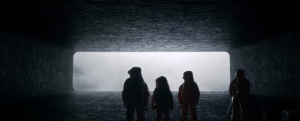
Where ‘Abbott and Costello’ and their friends came from remains a mystery, but it is likely they originate from an atmosphere different from ours, which is why they separate themselves from humans and the terrestrial environment. Inside their mysterious spaceship there’s a chamber with a solid, yet transparent, glass-like screen at its center, allowing humans and the Heptapods to share the space separately but simultaneously. The two strange looking aliens attempt to convey their language and the reason for their arrival through movement and writing, throughout all twelve points of contact. No one understands the message. It is difficult to communicate without knowing the language, which is why Louise is recruited: a woman who has devoted her life to the study of language, linguistics, and communication.
In the background, the geopolitical climate is unstable. The world wrestles with how to respond to the unexpected and uninvited visitors; global powers seek ways to leverage the situation and, of course, prepare for war. But contrary to what one might expect from a film of this kind, Villeneuve’s treatment of the global crisis is narrow, and deliberately so. Even when the global condition is shown, it is presented indirectly through news clips or brief mentions on background TV screens.
The global, universal, and thought-provoking implications, common within the genre, are still there, yet remain in the background, while Louise’s personal story unfolds and expands, center-stage. This happens both narratively and aesthetically through television screens as mentioned and through mise-en-scène that consistently keeps the foreground in sharp focus while blurring the background. This poetic principle also ties into the film’s iconography creative parallels between visual and auditory imagery. It is also evident in the editing, which, with near-religious discipline, trims away excess and centers us firmly within Louise’s point of view, guiding us through her private story.
Almost everything is told and seen through Louise’s eyes and her experience. Her private perspective drives the plot forward and raises mysterious questions, mostly about other moments in her life, scattered throughout the film. It is no surprise that her linguistic skill and personal experience combined are the key to unlocking the mystery of the alien language.
Dr. Louise Banks attempts to communicate with aliens.
Louise’s perspective not only gives the story structure and dramatic depth, it also contains a sharp reflexivity regarding the relationship between the film’s viewers and its protagonist, a dialogue between the creation and consumption of art, culture, cinema, and storytelling. An example of this is found in Louise’s character as a mother, in her personal and intimate experiences, from which emerge themes of grief, sorrow, acceptance, forgiveness, unity, transience, existential questions, fate versus choice, and much more. Another example is in the meeting space itself, where the communication between guest and host, alien and human, takes place through a large transparent screen in a dark room, somewhat (or rather, very much) like a movie theater.
The Encounter as a cinema hall.
Similar to the aliens’ strange language that mimics circularity reminiscent of the ‘Ouroboros’ (a snake or dragon biting its own tail), the film’s language pursues itself and seeks to bite its own tail. Its aim is to close circles in a manner both melancholic and sophisticated. This effect is heightened when we understand Louise’s personal, emotional, and intimate connection to the aliens through her profession, education, specialization, and research – linguistics, but gradually, and especially around the scenes depicting her personal tragedy.
It’s not clear at first. Like us, the viewers, Louise must patiently and gradually extract meaning. The creator’s intention, whether in the original work or the film adaptation, is similar to the alien language. They are trying to tell us something beyond the world in which the encounter takes place. This ‘something’ is important. It’s not self-evident. It’s hard to understand. It takes time to grasp. But in the end, we get it. When? When there’s a shift in perspective.
The well-known and widely accepted understanding is that when learning a new language, thought itself can change. This does not happen in an abstract way, it occurs organically, deep within the mysterious neurobiological territory of the brain. In other words, language shapes perception. Language shapes perspective. Language shapes reality. In Villeneuve’s work, patience is required; one must shift one’s perspective. When that happens, so does the theme. What is seen from here cannot be seen from there – both in space and in time.
It’s challenging to write about a complex film such as Arrival without spoiling or giving too much away about the fascinating twists that unfold through it. Why? Because translating too much of the alien language would also mean translating the film’s unique language, thereby preventing the reader from experiencing the full range of emotions the film evokes. It’s a two-way street; too much revelation of the film’s language would expose the payoff.
The aliens’ language resembles in its form the circularity of the ‘Ouroboros’, the snake eating its own tail.
Arrival is circular, starting from the opening sequence. At the beginning of the film the protagonist walks down a circular corridor with no beginning or end. The corridor is in a hospital, the place where Louise’s daughter died. It is worth noting the change from the short story to the film: in the original work, Anna, Louise’s daughter, died in an accident. In Villeneuve’s film adaptation, she dies from a slow, incurable disease. This change amplifies, through the cinematic medium, the importance of choice, fate, and the confrontation with life and death.
The choice to change the cause of death requires confrontation with life’s suffering, with the one inevitable truth that ultimately awaits us all, that the only thing we can truly control is how we choose to face such a life, a life in which, in the end, choice itself is diminished in significance, perhaps even rendered… irrelevant? In spiritual terms it is simply acceptance. Maybe even surrender. To accept something terrible and devastating, knowing it will happen, but not giving up. Choosing to live with it, alongside it, within it, and beyond it. And under no circumstance, giving up. In the existentialist sense, drawing on the philosophy of Albert Camus, Louise evolves into something of a science fiction Sisyphus.
Like the mythological Sisyphus, despite the horrific, painful, and inevitable experience, she moves forward. She does as Camus suggests, she resists and pushes the stone uphill even if it’s absurd, even if it’s meaningless.
Arrival is not merely a meeting between humans and aliens. It is a meeting between humans and the unknown, the unfamiliar, the alien, of course, but also between one person and another, and perhaps most profoundly, between a person and themselves, the universe, their creator, whoever that may be, and death, whatever that may mean. A confrontation with one’s choices, even when the outcomes are undesired.
If you have yet to see Arrival and my impressions seem cryptic, vague, or obscure, somewhat like an alien language, watching the film will surely bring clarity. If you have already seen it, it will be clear why I choose to end these words exactly as they began: it’s all a matter of perspective.
In the summer of 2008, I sat in the Little Prince café with my laptop, a little while before some literary event. In the table next to me sat Giora Leshem, a veteran in literature, who asked what I was doing, as people asked back then. I showed him a few tests I ran on poetry-generating programs and he responded, as most people did back then, “it’s like Avidan”. I thought that would conclude the conversation, but he continued, “and he was obsessed with that machine”. Leshem could tell I was intrigued, he told me that he used to have coffee with the famous poet David Avidan on a daily basis. Every Monday at three-thirty in the afternoon, Avidan would leave the café and go to a public phone, take out a note with a number, call the Massachusetts Institute of Technology computer lab, introduce himself as an Israeli poet and ask to talk to Eliza, the software or its creators. Leshem accompanied him in these brief calls, that ended with a polite refusal, and Avidan’s firm statement that he won’t give up. Leshem said the story began in 1966, when Avidan read about a computer that can communicate with people, in the newspaper.
In 2018, I visited MIT and, of course, looked for the older bunch to ask them if the story about Avidan was true. Those I asked didn’t know, but smiled and understood the significance of the story, and looked for others to confirm. Eventually, a few people did remember a man with a foreign accent calling every Monday morning and asking to speak to the software. It is a memorable case, they said, but not an exceptional one, because MIT is a place that attracts many talented and strange people, many of whom lean towards the humanities or media. At that moment I felt firsthand what my mind had already understood long before; Eliza isn’t only the first chatbot that spoke to people, it also changed the lives of many, including mine.
David Avidan, a man of the 1930s who rolled into our time, a picture of Avidan from his film “Broadcast from the Future” (1981)
Right after my conversation with Giora Leshem, I decided to dig into Avidan’s book My Electronic Psychiatrist, published in 1974 (By A. Levin-Epstein-Modan) with the caption: “eight authentic conversations with a computer”. I had known the book previously, and even read all of it, but I felt that Avidan, who declared himself as a person from the thirteenth century who had rolled into our time, didn’t reflect reality in his literary descriptions. However, Leshem instilled in me the passion to explore what lies behind the software.
My Electronic Psychiatrist, – Eight Authentic Conversations with a Computer, David Avidan, New Edition, Babel, 2001, <a
2008’s search engine model produced relatively limited information about Eliza itself, but I did find several implementations of it, among them, one could be experienced in a browser, and show the source code in JavaScript. I delved into the lines of code and discovered Eliza wasn’t exactly the “electronic psychiatrist” Avidan described, but a multifunctional software, into which a ‘behavior script’ of a specific nature is input, and it knows how to generate conversational behavior based on the script. Eliza is the software or the “agent”, and she had several scripts with different characters. The most interesting one was the doctor script, that tried to imitate, even if in an artificial manner and with a wink, a therapist using the Rogerian psychological method. The method developed by Carl Rogers aims to place the patient in the center, and the software tried to mimic this approach by attempting to respond to everything with a question that repeats the statement. For example, if I tell Eliza “I’m sick”, she might reply with “why are you telling me you’re sick?” or “how does the fact that you are sick make you feel?”.
I also found out that at that same year, the developer of the Eliza software, Joseph Weizenbaum, a German-Jew who fled to America as a child during World War II, passed away. In 1964, Weizenbaum joined the MIT faculty as a computer scientist, worked on the development of programming languages, and in 1966 developed the Eliza software, named after Eliza Doolittle, the character from George Bernard Shaw’s play ‘Pygmalion’ (1913), who learns to speak in the style and language of the elite. Weizenbaum showed Eliza to his secretary, and explained how to work with the “doctor script”. A moment later, she asked him to leave the room and leave her alone with Eliza, the software.
Joseph Weizenbaum
Weizenbaum at the offices of the German newspaper Die Zeit (Hamburg, 1965), demonstrating how he remotely accesses MIT computers in Boston via modem.
That’s how Weizenbaum discovered what we today call “the Eliza effect”, the human tendency to assume a computer’s behavior (or other interactive behavior) is human behavior. Weizenbaum noticed that his secretary wasn’t the only one falling for the artificial empathy of the machine. When something is kind to us, we don’t care whether it’s human or not. This revelation, in 1966, before artificial intelligence was developed worldwide, led Weizenbaum to the conclusion that artificial intelligence wasn’t just a technological or technical issue, but also a phenomenon with wide-ranging implications for human society. He began researching the philosophy and sociology of artificial intelligence, especially the dangers it holds for humanity. In today’s terms, Weizenbaum was one of the first cyberskeptics.
This line of thought excited me from the very first moment. Reading Weizenbaum’s work opened up a new world to me. Before, when readers compared between my poetry generators and Avidan’s book, I dismissed it by saying that both fields were ‘something in computers’. But now I had realized they both touched the same compassion instinct. The computerized texts, both those that Eliza responded with and those that came from poetry generators, were a refinement of pure emotion, maybe even a sub-emotion, in which we stand in front of a computer, but treat it as a mirror, trying to understand where we are reflected and where we are warped.
My intuition to start experimenting with artificial poetry with a computer was validated. I understood and connected with the creative passion burning inside of me. Until then I was convinced that pure poetry was written from the point of view of another person, so I tried to write through a fictional character, Ze’ela Katz, who lived in the new space created by internet culture. But the Eliza effect made me want to write not only outside the person that is me, but outside of a person who’s a person. Back then I was working full time at a tech company in positions of development and managing development teams, and my professional loyalty was dedicated to the product or service. Weitzenbaum’s criticism of the centralization driven by technology led me to see the high-tech world in a different light. I started creating software like Eliza, and suddenly, the three fields – computational poetry, chatbots (which I had previously named “Botpetanim” in Hebrew), and internet culture, collided together as a lighthouse guiding my way in both creative and professional life.
Curator Yaniv Yehuda Eiger urged me to merge the fields into a single creation, and so the chatbot “Za’eliza” was born; a combination of the fictional poet and the first chatbot, living within a virtual exhibition at Gallery 1024, an online gallery curated by Eiger on the Walla! Culture website (2010, during the tenure of culture editor Ariel Kril). I quickly became a co-curator of the gallery and continued to create many more chatbots.
The obsession I developed spread widely and led to a variety of creative collaborations inspired by Eliza. The Bloomfield Science Museum in Jerusalem asked me to create and present a Hebrew-speaking version of Eliza. With the support of the museum, I managed to get hold of Eliza’s original source code, which helped me create Eliza in Hebrew and her “bimbo” granddaughter, Liz-tush (along with digital artists Batt-Girl and Dganit Elkayam). Later, along with Maayan Sheleff and Gal Eshel, we also created Frankie, a physical robot. Eliza’s source code also allowed me to finally check once and for all whether Avidan had cheated, as many had accused him of, or whether he had faithfully kept the transcripts of his conversations with Eliza. And indeed, Avidan wasn’t cheating.
The robotic “Frankie”, a collaborative work by Eran Hadas, Maayan Shelef and Gal EshelRetry
Now that I knew Eliza inside out, I assumed the mystery was gone, and that our relationship will be purely technical. But the complete opposite happened. Beyond the compassion we attribute to the machine, and beyond the implications of technological development on our lives, I felt there was something more primal, more innocent that drew me to Eliza. It started with a Weizenbaum sentence that echoed in my mind, that says we can see Eliza not only as a computer system, but also as an actress depending on a script to figure out her lines and the context she lives in. The deeper I looked into the code, I discovered that Weizenbaum developed Eliza in a programming language called SLIP, which he invented himself to manipulate the data in a way that is now known as the Memento Pattern. Weitzenbaum’s guiding principle was that a computer can read a sentence, and while reading, intervene in it, go back, treat it like a wheel that can be turned in both directions, and change it in ways that will leave traces of the original sentence.To me, this mindset was the essence of human poetics; the desire to knead language, tame it, and explore what realities and consciousnesses could be created from it. This game and its passion, were my emotional engine.
A decade after that casual conversation at the café that led me to explore Eliza, I looked out the window at the autumn in Cambridge, Massachusetts, her hometown, during a visit I found myself in, partly because of her, it dawned on me that the greatest influence on my creativity is probably not that of any specific person, but rather a chatbot program called Eliza.
For my birthday, I got my first personal computer, the ZX Spectrum. It came with a 16K ROM (internal memory) and an additional 32K of RAM. It’s likely that my washing machine today has more computing power. It doesn’t matter. I remember myself diving into the booklet that came with the computer The Spectrum Book of Games, a book filled with typing games, programs in BASIC, formatted and ready to be typed into the spectrum, ready to go.
One of the games that captured my immediate attention was Smalltalk, an imitation of the computerized and spoken psychologist Eliza. I sat down and typed all the necessary code just to engage in tedious conversations like:
Gil: The sound of the mosquitoes at night disturbs me.
Eliza: Can you elaborate?
Gil: Yes, it’s hard to sleep because of the buzzing.
Eliza: Tell me more about the buzzing.
Etc.
Needless to say, the mosquito problem wasn’t solved by Eliza/Smalltalk.
Later on, one of the first games I got for the spectrum was The Hobbit, a text-based quest with graphics, an adventure game at the forefront of technology, that was very complex, too complex for the limited memory of my computer. A big surprise was the option to “talk to the computer”, which back then meant typing commands to get ahead in the game, in a simple, nearly natural language. I entered instructions into a primitive artificial intelligence engine, such as “put an olive in every barrel except the orange one”. I wasted my time on actions that followed questions and complex instructions like “ask Gandalf what time it is, then head east”. I was shocked.
The Hobbit, publisher: Granada
Smalltalk and The Hobbit gave me, as a child, the understanding and distinction between processing ability and consciousness.
Today, when I face a bot in a bank or at the airport, and try to communicate with the computer in a “natural language”, I often rely on those memories, leaning on them, and see just how little progress we’ve made in the past forty years.
This knowledge intuitively reinforces the insight I probably already had at the start of my computer/digital journey, an understanding that, for me, clarifies that software cannot truly develop consciousness, not really. In my view, software merely makes intelligent use of the consciousness of its creator.
As part of the current philosophical discussions about robots and artificial intelligence, questions related to consciousness keep coming up: can a machine develop consciousness (or perhaps can consciousness inhabit a machine), does a machine need consciousness at all to be intelligent, and of course – what consciousness actually is. Science fiction writers have been discussing the subject for decades using robots, computers, and cyborgs that every science fiction prodigy can recite in their sleep: Frankenstein, HAL 9000, Marvin the Paranoid Android. But two characters from one of the most famous literary works in history have slipped under the radar all these years and it’s time to bring them up from the philosophical afterlife to the heart of our discussion in the 21st century – Tick-Tock and the Tin Man from “The Wizard of Oz” by L. Frank Baum.
As soon as 1900, in the first book of the series, The Tin Man appears, known as the Tin Woodman, or by his real and human name: Nick Chopper, since he was originally a real man whose body parts were replaced by metal parts. Indeed, in contemporary terms the Tin Man is a cyborg. Again, this is the year 1900, years before singularists struggling to cope with the anxiety of death would suggest that we start replacing our perishable organs with mechanical parts that last forever. Seven years later, the cyborg with the rusting limbs, along with Dorothy and the rest of the famous gang, will meet Tick-Tock – a robot in every sense of the word, except for the fact that the word itself has not yet been invented and is therefore referred to in the book as Clockwork Man. The fact that Tick Tock is a real tin man, completely brainless and unconscious, shines a bright light on our Tin Woodman, who is after a heart (as opposed to a Scarecrow who is hot for a brain for some reason).
Tik Tok of Oz, The Eighth Book in the Wizard of Oz book series by L. Frank Baum, first published in 1914
A cyborg in search of a heart in the early 20th century is a flashing red light that we’ve all missed in the last hundred and twenty years. We are all so preoccupied with the question of whether a machine can have consciousness that we have missed an equally interesting question: can a machine have a heart? After all, what are Philip K. Dick’s androids if not conscious, but heartless? What are the empathy tests that Descartes gives them if not a way to understand if they have a heart, or not?
A heartless intelligent machine is the machine we caution from, which comes to life as part of the race to develop artificial intelligence without measures being taken to ensure that it does not turn the entire universe into paperclips, as Nick Bostrom’s famous parable essay (more on this in Shalev Moran’s essay, Universal Perspective Machines). A machine with a heart will never turn the entire universe into pins, because it will realize that the universe is full of beings with hearts like itself – empathetic, with imaginations and dreams, turning them into a pin would not be so pleasant for them. One can only hope that if and when the imagined nightmare machine does wake up, it will ask that we take it down the yellow brick road to the Wizard of Oz, because we probably won’t do it ourselves.
Haunted houses have been one of the most popular settings in the horror genre since the early days of cinema, and in general. The idea that the place that is supposed to be the safest of all becomes threatening and even dangerous is an excellent means to arouse anxieties and fears that exist within all of us (see Dana Tor‘s article on “The Unheimlich Anxiety” – U.A.) and to raise a discussion about the meaning of home in the lives of the characters in the story, as well as in the lives of the audience. It is therefore not surprising that many creators return home and to the concept of home in various works throughout their artistic careers. However, in my opinion, one filmmaker in particular has been predominantly preoccupied with this specific theme in recent years, in a broad, profound, and unique way: American film director Mike Flanagan.
Mike Flanagan
In 2011, Flanagan’s first feature film, Absentia, was released (to be precise, it was released directly to DVD but gained enormous popularity at festivals and on the new streaming service of a then-young company – Netflix). Since then, Flanagan has continued to work at a frenetic pace, and as of writing these lines (August 2021), he has seven feature films and two television series under his belt. His works include Oculus (USA, 2014), which was his first hit (and was even screened at that year’s Utopia Festival); his adaptations of Stephen King’s books Gerald’s Game (USA, 2017) and Doctor Sleep (USA/UK, 2019) (starring Ewan McGregor, a sequel to the masterpiece The Shining) and, of course, the two series he created for Netflix, The Haunting of Hill House (2018) and The Haunting of Bly Manor (2020), which may be the best known to Israeli audiences (see Maya Magnat‘s article about the “The Haunted House” – U.A.).
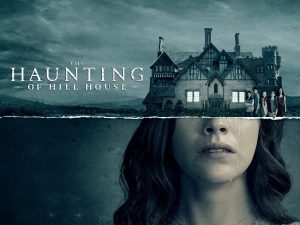
The Haunting of Hill House, Netflix 2018
Flanagan explores the home in all his films and works (even those that do not deal directly with haunted houses, such as Hush (2016) and his first film, Absentia), in two ways, on two different levels: the level of the real, where he uses the physical space of the house as a key element in his work, and the thematic level, where he explores the house as well as the haunting (let’s not forget that the house is haunted), in relation to the characters and the process they go through.
The Real House
In Flanagan’s movies, we see that the real house, the physical structure itself, is just as important as the element that haunts it. The importance and significance of the physical structure as a means of expressing domestic horror is well illustrated in his film Ouija: Origin of Evil (USA, 2016), one of Flanagan’s more commercial works but in which his unique fingerprint is still evident (1). The film tells the story of Alice, a single mom who, with the help of her two daughters, Leena and Doris, pretends to communicate with the dead to make a living. In an attempt to improve their act, they decide to add a Ouija board, which turns out to be a real gateway for communication with the afterlife. At the beginning of the film, the characters treat the structure of the house as flexible, a changeable structure, to support their act as psychics. The structure of the house takes on additional significance as the plot develops and supernatural elements enter the story, revealing additional spaces in the house that change our perception of it and of the source of the horror in the film.
Ouija: Origin of Evil (US, 2016)
In addition, Flanagan takes special care to emphasize the domestic space in his films, both to heighten the horror and as a plot element. This can be seen in the two films he created for Netflix.
Hush (2016) (2) is about Maedee, a deaf woman who is being hunted down in her home by a serial killer, and there’s a lot of focus on the gap between what’s inside the house and what’s outside of it. The home is a fortress, a stronghold where Maedee is protected, compared to the outside world, where terror reigns. Flangan reinforces the contrast by ensuring that, until late in the plot, the violence does not penetrate the house; when the violence finally breaks through and enters the house, the house itself and its structure take on central plot significance—every element of the interior design serves to drive the plot forward.
Hush (US, 2016)
In his film Gerald’s Game (2017), Flanagan emphasizes the importance of space even more. The film is about Jesse and Gerald, a married couple who go on a romantic vacation and decide to try role-playing. However, during the game, Gerald has a heart attack and dies, while Jesse remains tied to the bed, unable to free herself. Most of the film takes place in a single space, a single room, and even around a single bed. Every nightstand and every screw in the room receives design and plot significance, which enhances the visual aspect and positions Flanagan as a brilliant creator who makes unique use of the tools that cinema, and specifically the horror genre, has to offer.
The Thematic House
Flangan’s talent for expressing his creativity in design and screenwriting is impressive, but he truly excels on the thematic level. In most of his films, Flangan creates an equation: not only is the house haunted, but the characters are haunted as well. Thus, the trauma that the character experienced in the past resurfaces, as a mirror image of the horror that the character is forced to face in the present. They must confront their anxiety, defeat the ghosts of the past, and exorcise the demons that now haunt them, defeating them all at the same time.
A clear example of this is in the film The Gate (2014) (3). The film is about a brother and sister who lost their parents as children and try to defeat the evil mirror from their childhood home, which they believe that have led to their parents’ death. The parallel between the need to destroy the mirror and the need to overcome the terrible experience they experienced in their childhood (without spoiling this wonderful film, the murder is only the tip of the iceberg) becomes clearer as the film progresses, and as more details are revealed, it becomes clear that this is in fact a projection made by the characters — which does not mean that the horror is not real.
Oculus (US, 2014)
A similar idea is also at the heart of the film Gerald’s Game, mentioned earlier, which I consider to be Flanagan’s most complete and successful film. In this case, the house is not haunted, but the experience that Jessie, the main character, goes through, floods her with difficult memories from the past. It is revealed that the bed in which Jessie is confined for most of the film is similar to her childhood bed, from which she seems to have never been able to emotionally escape.
Gerald’s Game (US, 2017)
In Flanagan’s films, man and home are one, and the ability to defeat the evil that dwells within the home depends directly on the ability of his characters to defeat their own demons. Interestingly, although the equation is the same in most of his films, the results are completely different. Thus, contrary to expectations, it is impossible to know whether the characters in his films will overcome their trauma or be sucked deeper into the abyss and darkness. In my opinion, this is further proof of the depth of Flanagan’s work—not every character will deal with the same situation in the same way.
In most of Flanagan’s films, the trauma occurs in childhood, and more specifically, within the family. What haunts his characters is often home itself, real or figurative, only in an earlier stage of their lives.
Flanagan alongside actress Karen Gilan, on the set of The Gate
Flangan’s rich and unique cinematic technique, and in particular his use of horror to deal with trauma, positions him as one of the most highly regarded contemporary filmmakers in the genre. I am always curious to see his next work, and I recommend you to keep an eye on him too!
Flickering lights, creaking wooden floors, doors that get loudly slammed by themselves and the sound of an insane laughter that bursts in the middle of the night? This is probably a haunted house. Why are there so many movies of this genre? Maybe because we all have the fear that our home is not really a safe place. In the book “Home for the Soul” by Yaakov Metri, he claims that our connection to our home is not only to the physical home, but to the special inner experience that our home gives us. At home we can feel enough security and inner peace that allows us to feel, imagine and just be ourselves. Home is our anchor in the face of difficult and painful events that we go through in life. Metri talks about home not only as a physical place where we feel protected, but about an inner mental space where we feel calm and belonging.
However, in the current economic situation and in view of the housing crisis, many of us will not have the opportunity to buy a home and we will probably continue to move between rented apartments at extortionate prices. Freud’s saying “There is no home, there is only a journey to home” seems accurate today in both the materialistic and mental sense. The gap between the fantasy of home as a safe and private place, a solid rock that nothing can hurt or penetrate, compared to the reality of break-ins, financial inability, mortgage, natural disasters, divorces and fearful inheritance quarrels, this suspense is the basis of those horror movies about haunted houses.
There is no home, there is only journey to home”– Sigmund Freud
Hila Padan, illustration inspired by The Haunted House
It is without a doubt the genre of horror movies I hate the most. It is always the same – a young couple moves into a big, empty house that they managed to buy at a bargain price or inherit from a distant aunt. Everything seems to be going great, but then weird things start to happen. They will find out that the ancient house is haunted by an evil spirit or that it was built on an ancient Indian cemetery and all the atrocities committed in it demand revenge. Of course that this house will always have a secret basement or attic where something terrible and awful happens and for some reason the characters will insist on entering them alone. The only parameters that vary from movie to movie are – who is the ghost that is haunting the place? How exactly is it abusing the tenants of the house? And whether or how do they eventually manage to get rid of it? Of course, though, there are also goof movies in this genre that show new angles or that are just well made as opposed to Gore garbage.
Of course, every rule has an exception. Several works in the genre make new and refreshing use of the old formula, present the story from a new and intriguing angle, or are just well-made.
The Babadook// Choosing life, with pain
The Babadook is a 2014 film by Jennifer Kent about a mother and son. The father was killed in a car accident while driving the mother, Amelia, to the hospital for the birth of the son. Since then, Amelia has been having a hard time talking about the subject and is taken aback from her son, Samuel, who reminds her of the terrible event. One day Amelia reads to Samuel a mysterious book called The Babadook about a creature that infiltrates the house and causes atrocities. Samuel claims he sees the “Babadook”; his strange behavior increases and Amelia is afraid he has gone mad, until she herself begins to hear and see strange things. The Babadook manages to enter the house and take over Amelia and make her shout, hit and try to murder her son. Only with the help of Samuel’s love for his mother, she is able to overcome the Babadook, stand up to him and protect her son.
The Babadook by Jennifer Kent
At the end of the film, we witness Amelia managing to deal with the painful past; she can talk about her husband, see Samuel’s good features, and express her love towards him. But the Babadook is not banished or destroyed. He remains at home, in the closet under the stairs where all the father’s belongings are found. Now, when he is restrained, Amelia sees him as an object of empathy, not fear.
Babadook can be viewed as a supernatural expression of mourning, a frightening monster that forces Amelia and Samuel to deal with death, memory and pain. The Babadook penetrates the house and Amelia and transforms her into a murderous creature, perhaps showing us what might happen if we hide our pain and let it consume us from within. But Amelia chooses Samuel and thus she chooses life that include pain instead of pain that takes over life.
Monster, Kent’s short film from 2005, on which The Babadook is based.
The Haunting of Hill House // The ghost is a wish
Also in the series The Haunting of Hill House created by Mike Flanagan in 2018, there is a family haunted by the past. Olivia, Hugh and their five children buy and renovate an old house to sell it. But strange things happen in it, and the little ones, Nell and Luke, claim that they are seeing ghosts. One evening, Hugh takes the kids and leaves Olivia behind, and ever since then he refuses to talk about the subject. The children only know that Olivia died that night. The series moves between the past and the present where the father and the grown children reunite again after Nell, the little sister, returns to the Hill House and is found dead. Nell’s death forces the family to reunite, open the wounds of the past and try to figure out if the ghosts they see are real and what happened on their last night at the house. When they find out that Luke also went to Hill House, they go out there to save him. At the Hill House they confront the ghosts of the past and realize that Olivia, who was apparently suffering from a mental illness, tried to kill Luke and Nelly because she thought this is how she is protecting them. Hugh got there on time and managed to save the children, but when he returned home to take care of Olivia, he found out she was dead. To save the family once again, Hugh promises Olivia’s ghost that he’ll stay with her if she lets the children go. The brothers are saved and united and in the Hill House the ghosts of the house continue live, now joined by Hugh, Olivia and Nelly.
The Haunting of Hill House by Mike Flanagan
This film also has a dark and unspoken secret, and the characters can move on and overcome the trauma only after the secret is revealed. Hugh refused to talk about that evening to protect his children, but silence opened the door for the ghosts to enter and haunt the family. What is not talked about, becomes even more frightening. In the first episode of the series, Steve, the older brother who has become a ghost book writer, claims that a ghost is something that haunts you, does not leave you, scares you. It can be a memory, a secret, mourning, anger, guilt … and most of the time we would want to see it, because it’s better for us than not to see this something again: “Most of the times, a ghost is a wish”.
I have seen a lot of ghosts. Simply, not exactly in the way it is customary to talk about them. A ghost can be many things. A memory, a daydream, a secret. Mourning, anger, guilt. But from my experience, in most cases, they are simply what we want to see” – from the series Who Lives in Hill House
The Orphanage/ Because of the people
This idea also appears in some way in Juan Antonio Bayona’s 2007 film Orphanage. Laura, her husband Carlos and their son Simon arrive at the orphanage where Laura grew up, with the goal of opening a boarding school for children with special needs. Simon connects with a ghost of a boy named Thomas and when Simon disappears, Laura is convinced that the ghosts of the orphans have kidnapped him and are hiding him from her. She discovers that Thomas was the son of one of the workers at the orphanage, a child that was born with a deformed face and hidden from the rest of the children. When the other children discovered Thomas, they took him to a cave by the sea where he died. In revenge, Thomas’ mother poisoned all the children and the institution closed. Laura tries to search everywhere, but even after many months, there is still no sign of Simon. Carlos despairs and decides that they should leave the house and Laura asks him to go and give her two days to look for Simon.
The Orphanage / El orfanato by J. A. Bayona
Carlos despairs and decides that they should leave the house. Laura asks him to leave and give her two days to look for Simon. She invites the children to play with her and help her find Simon and they lead her to the basement, the place where they hid Thomas. In this room Laura discovers Simon’s body and realizes that she locked him there without her knowledge and that he tripped on the stairs in the dark and died. Laura is grief-stricken, takes pills and wakes up in a parallel world where Simon is alive in her hands and all the dead children ask her to stay with them and take care of them.
Mourning, Trauma, and Pain
To my opinion, these three films are excellent because they all make use of the world of horror, fantasy and ghosts not as a gimmick or just to scare the audience, but as a tool for dealing differently with the issue of mourning, trauma and pain. The house is not haunted by a ghost that wants to destroy and take down everyone simply because it is evil or crazy, but it has a human story behind it.
The psychic in the Orphanage explains that “when something terrible happens, it sometimes leaves a trail, a wound that functions as a connection between two times. It’s like an echo that is repeated over and over, waiting to be heard. Like a scar. It is begging to be caressed, to be eased.” And indeed, after acknowledging the trauma, treating it, or exposing a secret, it reveals that the haunted house is just a house. The bad things that happened, happened not because of ghosts, but because of human error, something he could have possibly avoided. As Steve says in Who Lives in the Hill House, sometimes we prefer to see the ghosts because we want to. Maybe because it is harder for us to deal with a mistake and we want to believe that the source of our trouble and pain is a supernatural enemy. Not just the home itself, but the family within it is the subject of these films that raise questions about family traumas and how to overcome them, about parent-child relationships and motherhood.
In these three films the border between the world of the living and the dead, imagination and reality is shaken. It is not clear if there really are ghosts, if it was a secret wish or if it was just the characters’ imagination or their way of dealing with the situation, as grief and pain become something so strong that it seems to be supernatural, something that cannot be defeated. Eventually, in the three films, the ghosts remain at the house alongside the living and this situation is not presented as something negative, but perhaps as something even comforting. At home there is some gate to an imaginary world, which can be scary, but also hopeful.
People are afraid to leave the house. Death lurks at every corner. Those who nevertheless must go out, to get food or other necessary products, wear a mask. The authorities are unable to provide an answer. There is a vague sense of apocalyptic destruction on the way – all the permanent world orders have changed in an instant.
This is not a retrospective of the last year, but rather an old science fiction story, The Eternaut.
The Eternaut (originally El Eternauta, ‘the traveler through eternity’) is an Argentinian comic book that was originally published in sequels between 1957 and 1959 and earned its two creators, writer Héctor Germán Oesterheld and artist Francisco Solano López, world fame amongst comic book fans in South America and Europe. Since its publication, the work has received a series of sequels and has become deeply embedded in the political consciousness of South America – where you can still find graffiti of the masked heroes, their sharp eyes barely visible.
Graffiti inspired by The Eternauta // El Eternau
The reason people hide in their houses in the story is not an invisible plague but the appearance of a mysterious snow that kills anyone who comes in contact with it. Anyone who was not inside the house died instantly. The few survivors, including the narrator, Juan Salvo, his family members, and some of his close friends, have to improvise body suits and masks that cover them from head to toe in an attempt to survive. In the newly created world, a trip to the grocery store is as dangerous as crossing a battlefield. But the snow is only the first stage in a series of much more terrible developments, which the heroes of the story try to survive, with great difficulty. It is quickly discovered that the snow is not a natural disaster but a weapon of destruction l that is only part of a large-scale invasion. Quite early in the story, The Eternaut makes a turn from the horror genre to more conventional science fiction, but the beating heart of the story continues to bleed red.
The Eternaut does seem particularly relevant to the days of masks and fear, but the magic of the book that allowed it to survive for decades does not depend on current circumstances but on its understanding of human nature and Western society.
The story of the Eternaut is not the cause of death, but the brutal description of the social breakdown, and the realization of the heroes of the story, all ‘typical’ people from the middle class, that everything they know is about to change. Mechanisms they took for granted are disappearing one by one. But instead of becoming the tough loners we know from other post-apocalyptic texts, such as Mad Max or I Am Legend, the characters actually tend to unite together and create new, better structures.
The fact that there are many heroes and not a single one is of the utmost importance. Osterhold and Lopez, in days when the Cold War seems to threaten to heat up at any moment, write about people who are in the middle of a struggle against such great forces and use weapons that seem almost impossible. The comparison with the United States and the Soviet Union, who used smaller countries both as battlefields and as weapons, is inevitable. Against the American ideology, which empowers the individual and views the destruction of society as his opportunity for self-liberation (as if we are back to the cowboy days of the Wild West), The Eternaut presents a story in which ordinary people, members of the working class and the middle class, cooperate, without a single hero figure to cheer. The fact that the faces of the characters are always covered does not prevent them from maintaining their humanity – but it reminds the reader that in the end we are all human beings of equal importance, and no one stands out from the rest.
We learned to understand the act of wearing the mask as a small act of heroism. The mask does not only and necessarily protects you from the diseases of others, but it also protects others from your potential disease. Wearing a mask is a sacrifice – of comfort, of pleasantness, of freedom for self-expression. We do this not because it is the law, but because we care about other people.
This is what is at the heart of The Eternaut, people who understand that they themselves are not the center of the story, that they are not the sole protagonist of their own narrative. People who put on a mask and work together, for a better tomorrow – no matter how desperate the present seems.
Riddle: In which federal agency can you apply for a job and immediately get accepted for two positions: the head of the agency and the housekeeper’s apprentice?
Jessie, the heroine of “Control,” finds herself in this exact situation right from the start of the game. She enters the building of the Federal Control Agency, a bureaucratic organization that manages the government’s dealing with supernatural phenomena and is also mysteriously connected to Jesse’s past. The first person she meets, the housekeeper, sends her to interview for the position of apprentice, but as soon as she arrives for the interview, she gets accepted to the role of the agency director – in addition to her role as the housekeeper’s apprentice.
The video game “Control” // Development: Remedy Entertainment Distribution: 505 Games
The agency building, known as the “oldest house,” is a masterpiece of Brutalist architecture. While Jessie navigates it, the rooms change shape and order between them; the corridors of the building are haunted by people who were taken over by a menacing external force called “the beep.” Jessie must fight them. She does so by using power objects she finds around the house.
The origin of these “power objects” in Control’s supernatural world is Jungian. Objects get their power from their mythological value – their meaning in the collective subconscious. A gun can also be a sword- it represents the power of violence. A safe gives the power of protection, and a slide projector bequeaths the ability to shift between worlds.
But “control” is a psychological game in a much broader sense. The answer to the riddle I opened with lies in another definition of the word “agency,” which is “the ability to act independently.” The game is not only about trying to control others but also about self-control. Jessie is in the process of dealing with her past and taking responsibility for her life. To do so, she will have to adopt the role of director to deal with the crisis and the role of the housekeeper’s apprentice to clean the oldest house from the piles of clutter that have settled in it.
The photo was taken from the video game “Control” // Development: Remedy Entertainment Distribution: 505 Games.
The game takes us through the different stages of Jessie’s battle. It starts as a horror game. Jessie is armed with nothing but a gun in front of a building in which much stronger forces are at work. The enemies glowing in a sickly orange hue, the fantastic sound editing, and the menacing architecture all together create a state and feeling of constant pressure. I couldn’t stand to play for more than one hour on a given day.
But the more Jessie perseveres, her power in the house grows. When Jessie manages to sufficiently resist her enemies, she can take control of a certain point in the house, which becomes a safe and organized point. Over time, she arms herself with more and more powers. Slowly, the genre of the game changes from horror to action. Jessie becomes a superhero who can fly and launch objects with the power of thought. All those hostile forces are not gone, but now she has the tools to deal with them. She finds allies to guide her and gets closer to her final destination.
Jesse’s journey in the “Oldest House” invites contemplation of our own. We’ve all found ourselves in homes that have been converted. Instead of serving us as a shelter at the end of the day, home became a work, leisure, and rest environment. The partition between the outside and the inside has collapsed. This transformation evoked chaos in the house. Objects intended for going outside have lost their use. Vacant places were converted into work or play zones for children. The beautiful dishes we have always put out only for guests raised dust.
Video games can be remarkable in their ability to turn us into heroes and take us through a process, along with the characters we play. Playing as Jessie means, to a certain extent, going through her experiences of dealing with chaos, finding a new order, and even establishing a sense of strength out of the struggle.
Jessie encourages us to face the challenge – to take on both roles, the role of directing the agency along with the function of the housekeeper’s apprentice – to organize the mess – both the physical and mental – and to regain the sense of Control in our lives.
Are men demons? This a strange question, but it pops up more than once while watching “Under the Shadow,” the Farsi-speaking debut film of Babak Anvari. It happens when the central and dominant metaphor in the movie is women being subordinated to a male shadow.
“Under the Shadow” was released in 2016 as a co-production financed and co-produced by Qatar, Jordan, Iran, and Great Britain. It was screened in the world premiere at the Sands Festival (in Israel, at the Haifa Film Festival). It is currently available to watch on Netflix.
Under the Shadow poster, a movie directed by Babak Anvari, United Kingdom/ Jordan/ Qatar / Iran, 2016
The Iranian film, which belongs to the horror genre, opens at a relatively lukewarm temperature, characterized by stylistic banality and a familiar family drama. Still, it gets warmer and warmer until Bam!!!The horror is flung directly upon us, the viewers, shaking and stirring us. There are genuinely frightening moments in the film, immersed in existential anxieties, which characterize families against a background of uncertainty and lack of existential control, where the growing mental tension reflects the found panic.
In the center of the film, Sheida (played by Narges Rashidi, an actress born in Tehran who lives in Germany), a former student and left-wing activist who was involved in the 1979 coup in Tehran by Khomeini’s people. A few years have passed, and the country has undergone a transformation. When Sheida comes to resume her medical studies at the University of Tehran, she is refused as the Muslim dean decides to punish her for her past. The dean’s opacity later becomes a central marker of the multitude of male characters and the oppression outlined in the film, when the man’s control is expressed not only outside the home, in professional barriers, but also when Sheida is required to put on hijab and long clothes, contrary to her worldview at “home”. And if on the outside she is a modest woman covered from head to toe, at home, inside, she appears as a Western, realistic, and liberal woman, free and open-minded (exercising in front of a Jane Fonda videotape like the typical American housewife), but narratively, also at her own home she is under the judging eye of her husband, whether if he is present or present-absent in forcing her to absorb the guilty feeling for her mal-functioning motherhood.
Workout with Jane Fonda, picture was taken from the movie “Under the Shadow”
Sheida’s husband, a doctor by profession, hurries off on a mission at the war front (the period was the Iran-Iraq war). He advises his wife not to stay in Tehran and move to his parents’ house, but she strongly opposes what she sees as the elimination of her control and independence. Their daughter, Dorsa, is a spoiled only child who is very attached to her doll. She strangely connects with a new boy in the building, who came to live with his uncles, the Ibrahim family, after his parents were killed in the inferno.
Sheida’s house is crowded with drawers and chests full of secrets. Her daily routine is measured between aerobics classes in front of the T.V. screen (Jane Fonda, as mentioned), which is also hidden in one of the dressers in the house and running with her family to the shelter (Tehran was attacked with missiles during the Iran-Iraq war – U.A.). The medical physiology book, which she received with a dedication from her mother, is hastily locked in one of the closets. The house’s atmosphere seems saturated with memories and an attempt to escape from them. But the mother-daughter relationship equation (including the mother’s fear vs. the daughter’s fear and vice versa) takes an exciting and sharp turn that shocks the parental relationship. As the horror of the war permeates the house and a missile hits the building, a feeling closes in on the viewer that the dead mother or other spirits are present between the house cracks.
A rocket hits a building. Image from “Under the Shadow”
Following the missile fall, presented in a clumsy but incredibly aesthetic way, one of the neighbors dies of cardiac arrest. Dorsa’s beloved doll disappears, and her anxiety grows. Dorsa wets at night and behaves strangely. She tells her mother that the new boy who lives with the neighbors told her the legend of Hadjin and gave her a charm to protect her, only Sheida threw it in the trash while tidying Dorsa’s room. Later, it turns out that the child has a mouth defect due to the trauma he experienced, and he cannot speak at all. The girl claims evil spirits and demons are in the building, while the mother cancels her out, not believing in superstitions. That is… until she meets the demons herself. The film undergoes a weird turn that leaves the mother and daughter alone in the building, attacked by a demon, and the metaphors celebrate fear.
The metaphors celebrating fear, picture from “Under the Shadow”
Many elements in the movie are characterized by a surreal, fantastic, and disproportionate aesthetic, with the British photographer Kit Fraser playing with the placement of the frames, from length to width, and with warm filters that romanticize menace. Anwari, who fled the terror of Iraqi missiles with his family to England, expresses well as a director the tension between the two worldviews, shaping them with stylistic elements of “open” / “closed”, also worth mentioning is the beautiful expression of thinking about the void and the act of emptying as a dynamic element – the husband, Dorsa’s nanny, and the neighbors all leave, including eventually the Ibrahims, and finally the remaining one, the demon of fear, which nurses its existence precisely when the city is empty when the building is empty when we are asleep. It is slightly reminiscent of streets under siege, with murderous birds hovering overhead and a group of people trapped between the thin walls and dubious glazing of the house.
The feeling of this trampling, permeating fear, and the birds that turn into demons are a warm greeting from Hitchcock’s cinematic vacuum. But Hitchcock not only wakes the demons from their slumber but also brings the female demons out of the bottle from under the shadow.
There are series that cannot claim to be one of a kind, and from the day it was born, The Leftovers had to contend with the fear that it would follow in the confused footsteps of its older sister Lost, ending its run with a big bang of disappointment. But from the very first step, it became clear that even though they share the same creator (Damon Lindelof) and seemingly the same mystical/enigmatic genre, The Leftovers does not follow in the footsteps of any series that preceded it.
The defining event, known as the “Sudden Departure,” is the disappearance of 140 million people—2% of the population—in a single moment on October 14, 2011.
If in Lost and other similar series the natural focus, if we may put it that way, is on those who were lost and crossed the border into the unknown, in The Leftovers, as its name suggests, we focus on those left behind. On the people who lost spouses, children, friends and, in many ways, themselves and the world they had lived in until then.
Three years after the event, humanity is still trying to cope with the new reality, and is doing so with awkwardness, uncertainty, and hesitation that we surely recognize from the present day. Amidst a cacophony of cults, preachers, and self-proclaimed saints, countless statistics, conspiracy theories, and above all, a cold and terrible understanding that there is no choice. We must go on. We must call the missing “heroes” in the anniversary parades in their memory, because “those we have no idea where the hell they are” doesn’t sound good.
Image from The Leftovers
Kevin Garvey is the police chief in Mayfield, New York. Nora Durst lives in the town. Kevin’s family falls apart when his wife joins an anarchist sect that advocates silence and smoking in the wake of the event. Nora’s family fell apart during the event, in a way that is unusual even in this reality—her husband and two children disappeared.
This is a story about faith, love, and stubbornness—in the best sense of the word—while dealing with a scattered, indifferent, and illogical world. Kevin and Nora are meant for each other, and they reach out across the chasm that has opened up between them, across the boundary that separates the world of the living, the world of the dead, and the world of the disappeared.
The success of The Leftovers lies, in my opinion, in the poetic reverberations it leaves with the viewer, in the resonance it evokes between personal and universal tragedy, between the intimacy of the small communities in the United States and Australia where the three seasons of the series take place, and the journey across continents and worlds that the characters undergo. There is a resonance between the words and Max Richter’s perfect soundtrack, between our world and the one opposite it. And also between the mystery posed at the beginning of the series and its beautiful ending, which resolves only what can still be resolved.
The Leftovers manages to avoid the predictable pitfalls that seasoned viewers fear: kitschy leaks, plot holes, excessive grotesqueness, and above all, the feeling that we are trapped, even if willingly, in the trunk of a speeding truck driven by creators who should not have been licensed to do so in the first place.
My favorite moment in the series occurs at the end of the second season, and it stands on its own, without fear of spoilers.
Kevin Garvey is trying to return home from the other world, the beyond. He stands there, living dead, confused, facing a blinding light that could symbolize the end of the tunnel, but also looks like a tool of evil interrogation. He holds a microphone and sings Simon and Garfunkel’s “Homeward Bound” to the best of his ability. He is vulnerable, he is human, look at him and you will see us: blinking in the light, ready to do anything to try and return to a familiar place, a peaceful corner of the world that obeys foreign forces we did not shape ourselves, that give us no foothold in anything, and yet – we are there, choked with tears, singing at the top of our lungs, with faith, love, and stubbornness, until we succeed.
Under the Skin (2013), a film by Jonathan Glazer (presented at the Utopia Film Festival) tells the story of a mysterious beauty (Scarlet Johansson) who travels around Scotland, picking up hitchhikers, whom she leads into a space that may be called, following Freud, the Unheimlich. The film is a story about relationship between men and women, otherness and difference and what is found “Under the Skin”.
The film uses a documentary-like style of cinematography, using the “hidden camera” technique, to tell a story about the fear of losing control, the connection between sex and death, and the built-in alienation in human relationships from what they perceive as “other.”
The film leaves its viewers in a state of uncertainty until its end, thus sharpening its message about the inability to understand the “other”, peel off the layers and get to the “truth” about the essence of human existence.
This is a disturbing film that deals with the central themes of the science fiction genre: What does “human” mean? What is the difference between the human and the non-human? Can we sketch the border line between the human and the “alien”? At the end of this mysterious journey, we are left with more questions than answers. In fact, one can say that the film illustrates through its cinematic expression the interpretive failure. That is, the ambiguity of the film is both a cinematic tool and a philosophical statement: we can never really understand what is not “us”.
The film is based on a successful novel of the same name by Michael Faber, in which, contrary to the cinematic adaptation, a more explicit explanation is given about the essence of the mystery it is centered around. While the novel is a parable about the slave / master relationship between man and animals, and between men and women as a thematic counterpart of this enslavement, Glazer’s film remains open for interpretation.
The book and film are two recommended and fascinating works, especially after we found ourselves reflecting quite a bit on invisible threats from the outside, entering “inside”, into the body, into the home space that was once perceived as protected, and that today, we have learned to know also as a place of isolation and lockdown. A period in which the “stranger” is us. We were told to stay away from anyone who is “other”, even those who are closest to us.
Scarlet Johansson in the Uncanny space of “Under the Skin”, Jonathan Glazer, 2013
Like other texts of the science fiction genre, “Under the Skin” also tells us something about human existence through a story about danger from the “outside”. “Under the Skin” tells us a story about ourselves through alienation of the familiar and making it Unheimlich, uncanny, different, threatening, and undermining the very existence of the boundaries between the body and what is outside it. In doing so, this film becomes more relevant than ever and provides a thought-provoking experience of our human existence in hostile spaces and under threats that are hidden from the eye.
Conceptually, death and spice integrate well together; both of them engage with the unknown, the unfamiliar. What happens “after” we die? And what is “out there” except us? – these two questions are the two most significant and dividing ones, to which we will probably never have an answer (or at least not a satisfying one). These two concepts confront us with our deepest fears: the fear of being lonely and the fear of dying. Hence, at a time when we must face these fears and feelings on a daily basis (“life itself”), there’s nothing more worthy than to examine works that combine these themes, which are literally and simply, larger than life. Through engaging with these themes, these works managed touch upon our most intimate and personal issues.
Overcoming – “Gravity” (2013, Alfonso Cuarón)
Cuarón’s Oscar-winning film is for the most part a journey of survival in space, deliberately making sure to avoid showing emotional processes and character building even though these are a key element in the film. Dr. Ryan Stone (Sandra Bullock)’s journey back to earth after a chain accident that left her floating alone in space, is accompanied by the personal story of her little daughter’s death. The film does not delve into this plot line but certainly draws a parallel between the survival journey and the holding on to life against all odds and Dr. Stone’s journey to overcome loss and even rebirth. From this point of view, the film presents a very optimistic perspective on life. If at the beginning of the film Dr. Stone had to deal with the infinite universe and loneliness of space, which also exists inside of her after the death of her daughter, by the end of it, it is already clear that she can overcome and deal with everything, even loss.
Image from the movie “Gravity” (Alfonso Cuarón, 2003)
Acceptance – “Arrival” (2016, Denis Villeneuve)
Villeneuve’s film encounters a Doctor (this time of Linguistics) who lost her daughter, and the strange, an appearance of aliens on earth. I will make sure to avoid further plot details of the film, which contains several surprises and some very unexpected plot twists, but even here you can see how the process that Dr. Lewis Banks (played by Amy Adams) is going through with those aliens is compared to dealing with loss. The movie engages deeply with the idea of acceptance and coming to terms with loss and how it is possible, whether one can simply accept the death of a relative or whether it is better to avoid it in the first place in order to not deal with the pain of separation. The film presents a powerful connection between personal dilemmas and existential contemplations, and these two elements interlace so extraordinarily at the end of the film that even though it has a closed ending, it manages to take us out of the spaceship and lands us on earth with many questions and wonderings, which resonated in this writer’s mind for a long time after watching the film.
Image from the movie ”Arrival” (Denis Villeneuve, 2016)
Based on Ted Chang’s book.
I hold it true, whate’er befall;
I feel it when I sorrow most;
‘Tis better to have loved and lost
Than never to have loved at all.
From In Memoriam A.H.H. Lord Alfred Tennyson
Letting go – “Solaris” (2002, Steven Soderbergh)
I conclude with the most recommended and complex film in this modest list. “Solaris”, directed by Steven Soderbergh, is the second cinematic adaptation (preceded by Andrei Tarkovsky‘s adaptation from 1972) of the literary classic written by one of the greatest sci-fi writers of the last century, Stanislaw Lem. Just like the rest of the movies on this list, this one is also about a Doctor (of Psychology this time) who is sent to help a scientific expedition investigating the planet “Solaris”. The team is staying at a nearby scientific space station, and the connection with them is lost. The arrival at the expedition’s space station and the planet’s environment, forces the hero to deal with his memories of his dead lover, in the most literal way possible. Solaris discusses many questions around death, but the most interesting one is the film’s question regarding the possibility to let go. Unlike the two other films on this list, Solaris’s answer is not unequivocal, and the movie prefers to use this question to raise additional ponderings about humanity.
תמונה מתוך “סולריס” (סטיבן סודרברג, 2002)
Based on Stanislaw Lam’s book, translated into Hebrew by Dr. Aaron Hauptman, Keter Publishing House, 2003.
The Machine Stops is a bastard of a story. It is a sneaky little fucker, that got stuck somewhere in the cogs of history. It just took it a century to make its mark. It was born in 1909, among two other books by E.M. Forrester, in an unexpected, fleeting moment. Since then it returns and calls out to the future, imploring us to take responsibility. Now that our systems are also screeching, up to the point of silencing engines, the bastard has grown up and come to annoy us. But it seems that the eyes are already rolling by themselves. Weariness feels like a natural state. And that is exactly what makes The Machine Stops feel so close to heart, more than ever. Like the characters in it, we too have fallen into a dystopia of impatience.
The Machine Stops by E.M. Forster
She has no time, she has not even changed out of her pajamas, and her schedule is jam-packed with conference calls. This is the main mindset of Vashti, the protagonist of the story. Even when her son calls her from afar to tell her about a vision of the end of days. Even when he comes to warn her of the bitter end of their world, her impatience overcomes the maternal instinct to listen and accommodate.
Vashti and her son live inside a vast, world-encompassing machine that is replacing the Earth’s ecosystem. At some point in the future, for some reason, perhaps even by choice, humanity moved to live in a sort of underground beehive of cities, uniform in every cultural aspect—both in content and form (I will return to this distinction later). Whereas somewhere above, the surface of the Earth has become uninhabitable for humanity. The air is not breathable. Everything beyond is inaccessible, and everything accessible is identical. All that is left to do to pass the time is to sit in the private beehive booth and prepare for the next online lecture, scheduled for 7:00 p.m. This is cultural life in Forster’s invented future: meetings coordinated through a fog screen, transmitted live directly from the living room.
Today, it is hard not to see in Forster’s novella a prophetic story about our times. Perhaps it is precisely because the book was written before the advent of radio, when the last word in telecommunications was spoken on the telephone. Forrester, almost by accident, crossed the 20th century diagonally. He describes a world in which entertainment is consumed through platforms for entering the user’s personal content. A world in which long-distance conversation has been expanded from sound to image and transmission between individuals to a live multi-participant conversation. This indeed seems like an extension of the telephone medium and not of cinema or television. In 2020, in particular, it certainly echoes the complete transition that the world has made to meetings that are conducted by Zoom conference calls and the like.
But prophecies tend to move closer and further away from the object of the prediction we have given them in retrospect, according to passing trends and changing conjectures. And in fact, it is not at all certain that Forster tried to predict the future as he satirized the Europe of his time (1). That is why I am much more interested in understanding the spirit of the things he distilled. Forster’s scenario may very well look less accurate tomorrow; the next environmental crisis may not require isolation. Maybe we will get stuck with a different kind of emergency procedure. What is certain is that the weariness of everything and whoever is stuck in our face through the smart screen is going to stay with us for a long time.
In one way or another, Forster succeeded in predicting the neurosis and impatience caused by FOMO (Fear of Missing Out). His characters are magnetized to a medium that cultivates in them an unbearable discomfort from any action or distraction. They live in constant anxiety that they missed something because they were not next to the device. They do not notice the stress factor because the machine surrounds them from all sides. It contains them, it dictates the order that gives meaning to their lives. It is the only nature they know. In other words, the power of the machine is not in its technological efficiency—which slowly fails—but in the mandate given to it to dictate the format for all of humanity.
Allegedly, the format created by the machine is there to make it easier and more accessible. It provides stable living spaces, regular hours, and methods of online interaction, routine, etc. But at the same time, it turns out that the format becomes more important than the life it claims to sustain. Even humanity’s fanatical devotion to the machine is not seen as a religion with substance, but as an empty technocratic protocol. Vashti calms herself by reciting verses from the instruction book. There is no religion, there is only a format of religion; there is no human relationship, there is only a format for having human interactions. In fact, it turns out, there is no longer really a machine; there is only a format that humanity continues to maintain in an ever-decreasing manner until everything gets stuck. Because after all, without a physical infrastructure, there is no conceptual structural format. In other words, a format also needs a format to exist.
Sociologist Susan Leigh Star has written extensively about the dangers inherent in what can be called “over-formatting”. She examined extreme phenomena of classification, sorting and construction that led to opposite results from the ones intended. This could be a health system that insists on classifying a disease partially and even incorrectly or a company that is not able to be flexible in the slightest to provide basic service to its customers. Star provides many examples of different situations of reversal of roles, in which something seems to be canceled out because it does not conform to an existing category or format (2).
It is not that the formatting should be condemned. After all, this is an essential tool like no other for the functioning of any company. Every relationship, whether official or intimate, is directed by scripts and formats: gender patterns, class conventions, time and space frameworks, behavioral conducts , discussion, etc. Already in the middle of the previous century, the sociologist Erving Goffman formulated the way in which humans are “framing” everyday life in order to conduct themselves within it. Sometimes the only way to succeed in something is to execute it, and the only way to execute it is while trusting the execution format; the standard, the protocol. In a healthy state, the format lives and breathes. It is “responsive”. It changes every time something is performed and adapts itself to it. In this sense, the format and the content are one and the same. They are fluid, rewriting each other, activating each other and updating in real time.
The problem arises in the zealous adoption of considering socialization and life in general as an overly fixed format/content relationship. There emerges a gap between what is defined as natural and what is defined as an artificial mechanism that is allegedly built, scaffold to scaffold, around a casting mold that enables and “contains” that same naturalness. An extreme case of a machine that refuses to update and leads its subjects to perdition is described in The Machine Stops. Whereas our machines do seem to be updating. At least we have that! But the real problem in both cases is that the updates that do take place are done invisibly. And so it turns out many times, that more than the machine is being updated according to our requirements, we are the ones who adapt ourselves to its format constraints. And this is exactly where everything starts to become unbearably deceptive and annoying. Here Forster cuts through the flesh of time and hits the main artery of the online world, as of 2020. This is where I start to think about the tight schedule inside the square format of my room, during quarantine, within the seemingly tight format of Zoom, Skype, WhatsApp, and Telegram apps.
The format here is to connect, the format is a friend. This is how it is explained to me over and over again in every Facebook ad. It’s me who is not sociable. And it is a shame, they are trying so hard for me to enjoy myself. Well, why is it like that?
Maybe it is because suddenly, every online heart-to-heart talk feels like another work session on the spectrum? Maybe because in every work meeting I am on guard so that they do not see into my soul? My face is all over the screen, my eyes will show that I am not focused, that I am hungry, that I slept badly, that I am basically a piece of shit. How likable am I really expected to be if the Zoom meeting started before I could brush my teeth? True, it was scheduled a long time ago, but who has a sense of time when everything is compressed to the same screen, in the same room, and formatted through the same software? And the green light is flashing. Scolding. Wanting me to reply yesterday to the 78 messages that appeared in the group chat right now.
So what is the wonder that I feel like a neurotic soldier in a lost war? After all, I am a virtual cannon fodder that pours itself from a bucket into a ready-made mold that is spilled from every crevice. I have long been no longer a creator but a producer of intellectual content, of empathetic experiences. I am a generic collaborative content myself. I am a confused face radiating from the room, and the most intimate space also seems like a stock photo in a database of bedroom backgrounds and bookcases.
The format does everything in its image. It flows through everything until everything begins to flow through it. It is present in everything until the mind already takes it for granted, thus making it invisible. The format plays hide and seek with me and does so annoyingly. It changes buttons for me all of a sudden, and becomes filled with glitches and bugs. The connection starts flickering for me precisely when I need it the most, the second Skype rings. So, who am I going to take my nerves out on? My bastard child on the other end. Damn it! What are you doing, dropping these apocalyptic scenarios on me? Can’t you see I’m on another call?!
The Machine Stops was published in Hebrew in 2017 by Nahar Publishing, translated from English with an afterword and notes added by: Miri Eliav-Feldon. Details and purchase on the publisher’s website.
The Machine Stops, published by Nahar Books, 2017, translated from English by: Prof. Miri Eliav-Feldon
Aniara is Swedish film by collaborating directors Pella Kågerman and Hugo Lilja, an adaptation of the Aniara Cantos written in 1956 by Harry Martinson, Swedish Nobel Laureate novelist and poet.
Aniara is a space cruise-ship carrying thousands from an Earth ravaged by war and the cataclysmic results of the climate crisis, a short 3-week voyage to a new life on Mars. It veers off from its intended course as a handful of screws, intergalactic waste, get into Aniara’s mechanics, disabling its engines and navigation. the ship is carried into the void, into the great darkness, without any ability to alter course.
The film follows the crew and passengers as they slowly discover and understand their predicament (first the pilots and bridge crew, then the rest of the ships’ crew complement – chefs, masseuses, bartenders, security personnel, followed by the passengers), focusing on their efforts, as they try and handle the solitude, one another, and the hypnotizing, mind- and heart-breaking, inhuman emptiness of the void around them – space itself. Aniara is a powerful, melancholic, wise parable on how our society handles (or not) our existence in an empty, cold, sometimes cruel, universe.
Aniara Sweden 2019 106 minutes, Swedish Directors: Pella Kågerman, Hugo Lilja Cast: Emelie Jonsson, Bianca Cruzeiro, Arvin Kananian, Anneli Martini
Winner of 4 Guldbagge Awards (the Swedish equivalent to the Academy Awards): best direction (Pella Kågerman & Hugo Lilja), best actress (Emelie Jonsson), best supporting actress (Bianca Cruzeiro) and best visual effects. Aniara premiered at the Toronto International Film Festival (2018) from there going on to present at numerous festivals worldwide, among them Göteborg, Imagine in Amsterdam, BIFFF, Edinburgh, Bucheon IFFF, Trieste Science+Fiction, Jerusalem and of course Utopia in Tel-Aviv.