


A writer focused on the surprising connections between strange things - technology, psychedelia, science fiction, mysticism and esoterica, cute animals and strange peoples
The last one hundred years have been a bloody battlefield of utopias. Is it still possible to imagine a utopian future, and if so, how? Exactly 50 years ago, Ursula Le Guin wrote a short story that marks the beginning of the answer to this question.
According to the famous quote attributed to philosopher and literary scholar Frederic Jameson, “it is easier to imagine the end of the world than the end of capitalism”. In his book Capitalist Realism, cultural critic Mark Fisher adopts this quote and uses it to analyse the process by which capitalism became an all-consuming system lacking in opposition and preventing us from imagining an alternative. In fact, it is a system that has virtually eradicated the future.
This encapsulates a cultural process that has been occurring with varying intensity for around a century, and which largely explains the human condition at the beginning of the 21st century: the extinction of utopia.
To understand this process, let us begin with an exercise in guided imagination. Imagine a beautiful ocean bay, surrounded by eighteen snow-clad peaks. On the shore, between the sea and the mountains, lies the town of Omelas. Its inhabitants are happy and free from violence and oppression. They have no stock market or advertisements, secret police, priests, army or powerful weapons. They may have sophisticated technology, but they do not accumulate more than they need. They know no guilt. Sexuality in all its forms is free, unencumbered and celebrated, as are drugs, that are available to all who want them, equally. Not everything about the city is known, and everyone is free to imagine it as they wish. Indeed, Omelas seems to be a complete utopia, except for one small detail: in the bottom cellar of one of the houses in Omelas there is a locked room with neither a door, nor window. A girl sleeps in this room. She is not allowed to leave. Food is brought to her every once in a while, through an aperture that opens and shuts for that purpose alone. She never hears a single kind word. This is how she spends her days. All the residents of Omelas know about her existence. In fact, every child who reaches a certain age is given the same explanation: if we were to take the girl out of the room, clean, feed and take care of her, all the happiness and wealth of Omelas would disappear in a heartbeat. The townfolk’s happiness depends on the girl’s misery. From time to time, residents become curious and come to see her. They are often filled with rage, or feel a desire to help her, but they know there’s nothing they can do. Every now and again, a youthful visitor who goes to see the girl, witness the truth of her agony, does not return home afterwards. They withdraw into themselves, turn silent, move away from the city and walk into the darkness, beyond the mountains, to a place beyond imagination.

The Ones Who Walk Away From Omelas by Ursula K. Le Guin
What is this place? and who are these people? Is Omelas a utopia or a dystopia? When Ursula K. Le Guin’s story The Ones Who Walk Away from Omelas was first published in October 1973, some 50 years ago, the way these questions were presented came as a surprise. Thanks to Le Guin’s extraordinary story-telling talent, writing fiction, which resembles the writing of myths (she was called a “Mythological Fantasist” by literary critic Harold Bloom), and which asks the reader to actively participate in the creation of the world, this story has become one of the most frequently printed in speculative fiction anthologies.
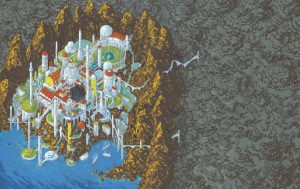
A visual illustration of Omlas by artist and author Andrew DeGraff, from his book Plotted: A Literary Atlas
Today, however, many readers will tell themselves that the parable is clear: in order to sustain our capitalist society of abundance, others must suffer – be they children mining cobalt, social media content moderators, or animals in slaughterhouses. There is nothing we can do. Some may also consider the question of whether utilitarianism is the appropriate moral method (whereby an action is measured by its results with the aim of bringing the greatest happiness to the greatest number of people; i.e., the girl’s suffering is justified) or whether it is duty (whereby every action has its own value, detached from the value of its results, i.e., the girl’s suffering is unjustified). But if we think that Omelas is too innocent and superficial a parable for the second decade of the 21st century, we are mistaken. The re-reading of it will provide explanation of the disappearance of utopia from our lives and the reason for our inability to imagine another future – if indeed that is the case (1).
Omelas is a story at the boundary, on the boundary, which fits American literary scholar Robert C. Elliot’s definition of utopia, “The application of man’s reason and his will to the myth [of the Golden Age]. Utopia (in the sense we are concerned with here) is man’s effort to work out imaginatively what happens – or might happen – when the primal longing embodied in the myth confront the principal of reality.” Just as Le Guin encourages her readers to create Omelas according to their own imagination, so does Elliot as he defines utopia: “In this effort man no longer merely dreams of a divine state in some remote time; he assumes the role of creator himself” (The Shape of Utopia, Chicago: University of Chicago Press, 1970).

Image from the television series “The Handmaid’s Tale”, based on Margaret Atwood’s dystopian novel
Utopias are nice as long as they remain in the realm of fiction. When Thomas More wrote the original Utopia in 1516, the “perfect place” he imagined—a place without private property or war—echoed the pun in its Greek name, which means “no place” or “nowhere.” The 20th century dawned, bringing with it a plethora of groups and individuals who sought to bring to life and actualize utopias that had been confined to literary imagination in previous centuries. Man began to embody the role of creator, revealing how easily utopia could turn into dystopia. Accordingly, from the middle of the 20th century onwards, dystopias became the most popular setting in speculative literature. Try to think of a dystopian work from the last one hundred years. You will not have any trouble remembering 1984, Fahrenheit 451, The Handmaid’s Tale, or the movie Brazil. Now try to remember a utopian piece — what have you got?
The dystopian shock of the twentieth century was, of course, reflected in the writings of many thinkers, including members of the Frankfurt School. For example, Theodor Adorno expressed a fear of any way of thinking that tried to grasp the totality of human experience. Herbert Marcuse, on the other hand, claimed that technological progress has brought humanity to a state where we can achieve a true utopia. The answer to the question of why such a utopia is not realised can be found in the ways in which any possibility of radical change is suppressed by capitalist society.
However, utopias did not fade solely because of political failure. There are also internal literary reasons, though they might be one and the same. In the 1970s, Vita Fortunati, head of the Center for the Study of Utopia at the University of Bologna, shed light on the dominance of men in the genre. Alongside the economic, political and religious innovation these men brought to people’s awareness in their books, they continued to treat women conservatively.(2) Indeed, in the 1970s, a dystopian thinking took over the genre. However, another subgenre flourished, that of critical utopia, in which women writers such as Sally Gearhart, James Tiptree Jr. (aka Alice Sheldon), Joanna Ross and Ursula K. Le Guin, took a significant part. These writers preferred a utopia in a constant process of audit, review and inspection, over utopias of stasis, of perfect and eternal bliss.
In her 1982 poetic and philosophical essay, A Non-Euclidean View of California as a Cold Place to Be (The Yale Review) (3), Le Guin laid out the main points of her utopian theory. According to her, since Plato’s time, utopia is stuck in a strong, active, aggressive, linear, expanding and hot masculine motorcycle journey, parabolic to Yang, the masculine nature of reality in Daoism. Le Guin claimed that utopias should go in the direction of Yin, the feminine nature of reality — “What would a yin utopia be? It would be dark, wet, obscure, weak, yielding, passive, participatory, circular, cyclical, peaceful, nurturant, retreating, contracting, and cold.” Her main criticism of male utopias stems from their view that progress is a value on its own, and it tramples everything along the way. Stasis, according to her, is not a dirty word. Utopias and dystopias make us choose between happiness and freedom, a choice she refuses to make. “Totalitarianism is not only hell, but also the dream of paradise — the ageold dream of a world where everybody would live in harmony, united by a single common will and faith, without secrets from one another.”
In a 1975 essay on Le Guin’s androgynous classic The Left Hand of Darkness, Frederick Jameson argued that utopia should not be viewed as an attempt to depict an ideal society, but rather as a reflection on our inability to imagine such a society (4). Like Adorno, he was opposed to “closed” utopias that resolve all social contradictions. He argued that the new wave of science fiction should be read in light of our society’s inability to sustain a utopia, rather than as a literal recipe. Utopias that have become a reality are doomed to fail. One can only imagine what Herzl would have thought of the corrupt realization of Altneuland. In 2005, after witnessing both the fall of the Eastern Bloc and the takeover of neoliberalism, Jameson suggested that utopia in its traditional form is no longer possible — a utopian novel can no longer be taken seriously, but the utopian impulse, the utopian imagination, is not dead. Dystopia, therefore, is our way of making utopia (5). Similar sentiments were written in 2018 by award-winning science fiction author Kim Stanley Robinson, against the backdrop of the climate crisis (6).
Therefore, Omelas is an allegory not only about the human condition and society, but also about the possibility of writing utopias. Who, then, are The Ones Who Walk Away from Omelas? What are we to think of the people who walk away from the city after seeing that wretched girl and go to a place Le Guin herself couldn’t describe? N.K. Jemisin, one of today’s most successful fantasy writers, criticizes their choice to leave. The Ones Who Stay and Fight (2018), the story she wrote as a response to Omelas, describes a similar town, only that in it, the residents do not walk away, but stay and fight against the ideology, according to which human sufferings necessary (7). But maybe the ones who walk away in Le Guin’s story are not doing it because they cannot bear the evil done in their name. Maybe they do not walk away to establish a more just society. In an article published about a year ago in “Mythlore” magazine, Sabina Sherinmakers claims that the ones who walk away are people who have come to a reconciliation between good and evil, between happiness and suffering — they are the masters of the Tao (8). Le Guin is known for centering her work around the Tao, the Daoist concept of a unity of opposites that underlies the universe. The description of those who walk away matches the description of the elusive concept of the Tao in the book Tao Te Ching: they go into the darkness, through gates, into an indescribable place, gathering in silence. In fact, they go beyond good and evil.

N.K. Jemisin, one of the most successful fantasy writers of our time, wrote “The Ones Who Stay and Fight” in 2018 in response to Le Guin
Like Frederick Jameson, Ursula Le Guin is also unable to describe the world beyond an all-embracing system. To be fair, we must mention the solar-punk genre that has been established in recent years as a utopian alternative to the late and malignant capitalism, and which offers visions of a society that has learned to harness renewable energies for a more complete existence between man, nature and machine. But an alternative is not to walk beyond the matter. As Mark Fisher taught us, one can assume that the capitalist system, certainly Hollywood, will digest and purge solar-punk as well. In fact, it is already happening: Dear Alice is a solar-punk animated commercial for an American yogurt brand that had swept the Internet about two years ago. A critical reading will immediately notice that yogurt is a product of the cruel dairy industry that is destructive to Earth.
So how do we go beyond good and evil, beyond total capitalism? Is there a way to imagine a utopia in the days of the Anthropocene? Mark Fisher concludes Capitalist Realism on an optimistic note: “The long, dark night of the end of history has to be grasped as an enormous opportunity … even glimmers of alternative political and economic possibilities can have a disproportionately great effect. The tiniest event can tear a hole in the grey curtain of reaction which has marked the horizons of possibility under capitalist realism. From a situation in which nothing can happen, suddenly anything is possible again.” He gives concrete examples and advice, but in the big picture, Jameson’s “end of the world” can be reclaimed: if the way we imagine the world is stuck in the predatory motorcycle journey described by Le Guin, perhaps imagining the end means adopting a different imagination. Less Yang, more Yin. In her essay, Le Guin quotes Robert C. Elliot who said that only those who have followed utopia into the abyss and come out the other side will be able to redeem the word “utopia”. She writes: “We have got ourselves into a really bad mess and have got to get out; and we have to be sure that it’s the other side we get out to; and when we do get out, we shall be changed. I have no idea who we will be or what it may be like on the other side, though I believe there are people there. They have always lived there.”
Footnotes and additional thoughts
1 // Robert C. Elliott, The Shape of Utopia (Chicago: University of Chicago Press, 1970), p. 8-9
2 // Vita Fortunati / Iolanda Ramos, Utopia Re-Interpreted: An Interview with Vita Fortunati, Spaces of Utopia: An Electronic Journal, nr. 2, Summer 2006, pp. 1-14
3 // A Non-Euclidean View of California as a Cold Place to Be, The Yale Review, VOLUME LXXII, NO. 2, January 1983, pp. 161-180
4 // Jameson, Fredric. World-Reduction in Le Guin: The Emergence of Utopian Narrative, Science Fiction Studies, vol. 2, no. 3, 1975, pp. 221–30
5 // Jameson, Frederik, Archaeologies of the Future, New York City, Verso Books, 2005
6 // Robinson, Kim Stanley, Dystopias Now, Commune, February 2018
7 // Bereola, Abigail, A True Utopia: An Interview With N. K. Jemisin, The Paris Review, December 2018
8 // Schrynemakers, Sabina, The Tao Masters Who Walk Away From Omelas, Mythlore, vol. 40, no. 2, 2022, pp. 192–96