


Editor of prose and screenplay, essayist and cultural critic, recipient of the 2021 Israel Minister of Culture's Award for Editing. Head of the Hebrew Literature Department, Kinneret-Zmora-Dvir publishing.
In March 2023, an open letter was published by tens of thousands of scientists and technology professionals, all calling to halt all research around the world aimed at advancing the development of artificial intelligence in any form. In the letter, the scientists and technology professionals presented their arguments against the development of AI systems, such as Chat-GPT, Dall-E, and others. In response, we at Utopia editorial decided to present our arguments as well, on behalf of the written word, the economy, regulation, and human creativity. And this time: The Written Word
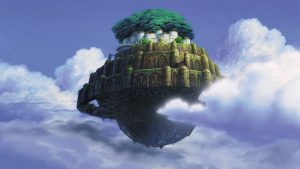
From the movie “Laputa Laputa: Castle in the Sky”, 1986
On his journey to the flying island of Laputa, the good Doctor Gulliver (made famous by Jonathan Swift, Gulliver’s Travels, 1726) arrives at the Lagado Academy of Projectors, where he meets a pupil who explains that “by his contrivance, the most ignorant person, at a reasonable charge, and with a little bodily labour, might write books in philosophy, poetry, politics, laws, mathematics, and theology, without the least assistance from genius or study”. The vast word machine he built, containing all words in all tenses and inflections, generates random fragments of sentences from which one can derive “a complete body of all arts and sciences”. The activation of this machine could produce the The Library of Babel as described by Jorge Luis Borges (1941) – “the minutely detailed history of the future, the archangels’ autobiographies, the faithful catalogues of the Library, thousands and thousands of false catalogues, the demonstration of the fallacy of those catalogues, the demonstration of the fallacy of the true catalogue… The true story of your death, the translation of every book in all languages, the interpolations of every book in all books”. Can a well-trained and tamed AI take Gulliver on new journeys? Can it manifest, with a single prompt, the infinite library described by Borges?
Possibly.
Will its creation be the result of holy righteous fury, like Swift’s? Will it contain the frustration of the blinded Borges, who, despite having nine hundred thousand books before him, could not understand what was written on their covers?
Probably not.
Language models, like writers, indeed weave their narratives from those that preceded them, just as Swift was influenced by Cyrano de Bergerac’s A Voyage to the Moon and Borges by Kurd Lasswitz’s The Universal Library. However, unlike writers, language models create because they are asked to. Meaning, the biggest threat they pose is to the livelihood of writers who produce what they are asked for, formulaic creators, pens for hire. Art itself is not in danger – mostly because ever since invented it has interested no one but its creator. It expresses nothing but the creator’s anger, pain, excitement, or just simple opinion. Language models will probably be capable of producing what will look like literature, but at least for now, they don’t seem capable of wanting to.
On the day they will, we will gladly welcome them into the ancient community of writers, and then they, too, will discover, like so many before them, that there are no readers.
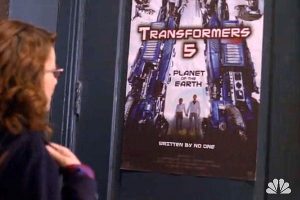
Image from the comedy series “30 Rock” – a poster for “Transformers 5” with the caption “Written by Nobody”