


A member of the Utopia Festival team for the past 11 years, Adar serves as a curator, content editor, and producer.
Haunted houses have been one of the most popular settings in the horror genre since the early days of cinema, and in general. The idea that the place that is supposed to be the safest of all becomes threatening and even dangerous is an excellent means to arouse anxieties and fears that exist within all of us (see Dana Tor‘s article on “The Unheimlich Anxiety” – U.A.) and to raise a discussion about the meaning of home in the lives of the characters in the story, as well as in the lives of the audience. It is therefore not surprising that many creators return home and to the concept of home in various works throughout their artistic careers. However, in my opinion, one filmmaker in particular has been predominantly preoccupied with this specific theme in recent years, in a broad, profound, and unique way: American film director Mike Flanagan.

Mike Flanagan
In 2011, Flanagan’s first feature film, Absentia, was released (to be precise, it was released directly to DVD but gained enormous popularity at festivals and on the new streaming service of a then-young company – Netflix). Since then, Flanagan has continued to work at a frenetic pace, and as of writing these lines (August 2021), he has seven feature films and two television series under his belt. His works include Oculus (USA, 2014), which was his first hit (and was even screened at that year’s Utopia Festival); his adaptations of Stephen King’s books Gerald’s Game (USA, 2017) and Doctor Sleep (USA/UK, 2019) (starring Ewan McGregor, a sequel to the masterpiece The Shining) and, of course, the two series he created for Netflix, The Haunting of Hill House (2018) and The Haunting of Bly Manor (2020), which may be the best known to Israeli audiences (see Maya Magnat‘s article about the “The Haunted House” – U.A.).
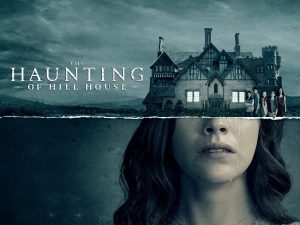
The Haunting of Hill House, Netflix 2018
Flanagan explores the home in all his films and works (even those that do not deal directly with haunted houses, such as Hush (2016) and his first film, Absentia), in two ways, on two different levels: the level of the real, where he uses the physical space of the house as a key element in his work, and the thematic level, where he explores the house as well as the haunting (let’s not forget that the house is haunted), in relation to the characters and the process they go through.
The Real House
In Flanagan’s movies, we see that the real house, the physical structure itself, is just as important as the element that haunts it. The importance and significance of the physical structure as a means of expressing domestic horror is well illustrated in his film Ouija: Origin of Evil (USA, 2016), one of Flanagan’s more commercial works but in which his unique fingerprint is still evident (1). The film tells the story of Alice, a single mom who, with the help of her two daughters, Leena and Doris, pretends to communicate with the dead to make a living. In an attempt to improve their act, they decide to add a Ouija board, which turns out to be a real gateway for communication with the afterlife. At the beginning of the film, the characters treat the structure of the house as flexible, a changeable structure, to support their act as psychics. The structure of the house takes on additional significance as the plot develops and supernatural elements enter the story, revealing additional spaces in the house that change our perception of it and of the source of the horror in the film.

Ouija: Origin of Evil (US, 2016)
In addition, Flanagan takes special care to emphasize the domestic space in his films, both to heighten the horror and as a plot element. This can be seen in the two films he created for Netflix.
Hush (2016) (2) is about Maedee, a deaf woman who is being hunted down in her home by a serial killer, and there’s a lot of focus on the gap between what’s inside the house and what’s outside of it. The home is a fortress, a stronghold where Maedee is protected, compared to the outside world, where terror reigns. Flangan reinforces the contrast by ensuring that, until late in the plot, the violence does not penetrate the house; when the violence finally breaks through and enters the house, the house itself and its structure take on central plot significance—every element of the interior design serves to drive the plot forward.

Hush (US, 2016)
In his film Gerald’s Game (2017), Flanagan emphasizes the importance of space even more. The film is about Jesse and Gerald, a married couple who go on a romantic vacation and decide to try role-playing. However, during the game, Gerald has a heart attack and dies, while Jesse remains tied to the bed, unable to free herself. Most of the film takes place in a single space, a single room, and even around a single bed. Every nightstand and every screw in the room receives design and plot significance, which enhances the visual aspect and positions Flanagan as a brilliant creator who makes unique use of the tools that cinema, and specifically the horror genre, has to offer.
The Thematic House
Flangan’s talent for expressing his creativity in design and screenwriting is impressive, but he truly excels on the thematic level. In most of his films, Flangan creates an equation: not only is the house haunted, but the characters are haunted as well. Thus, the trauma that the character experienced in the past resurfaces, as a mirror image of the horror that the character is forced to face in the present. They must confront their anxiety, defeat the ghosts of the past, and exorcise the demons that now haunt them, defeating them all at the same time.
A clear example of this is in the film The Gate (2014) (3). The film is about a brother and sister who lost their parents as children and try to defeat the evil mirror from their childhood home, which they believe that have led to their parents’ death. The parallel between the need to destroy the mirror and the need to overcome the terrible experience they experienced in their childhood (without spoiling this wonderful film, the murder is only the tip of the iceberg) becomes clearer as the film progresses, and as more details are revealed, it becomes clear that this is in fact a projection made by the characters — which does not mean that the horror is not real.

Oculus (US, 2014)
A similar idea is also at the heart of the film Gerald’s Game, mentioned earlier, which I consider to be Flanagan’s most complete and successful film. In this case, the house is not haunted, but the experience that Jessie, the main character, goes through, floods her with difficult memories from the past. It is revealed that the bed in which Jessie is confined for most of the film is similar to her childhood bed, from which she seems to have never been able to emotionally escape.

Gerald’s Game (US, 2017)
In Flanagan’s films, man and home are one, and the ability to defeat the evil that dwells within the home depends directly on the ability of his characters to defeat their own demons. Interestingly, although the equation is the same in most of his films, the results are completely different. Thus, contrary to expectations, it is impossible to know whether the characters in his films will overcome their trauma or be sucked deeper into the abyss and darkness. In my opinion, this is further proof of the depth of Flanagan’s work—not every character will deal with the same situation in the same way.
In most of Flanagan’s films, the trauma occurs in childhood, and more specifically, within the family. What haunts his characters is often home itself, real or figurative, only in an earlier stage of their lives.

Flanagan alongside actress Karen Gilan, on the set of The Gate
Flangan’s rich and unique cinematic technique, and in particular his use of horror to deal with trauma, positions him as one of the most highly regarded contemporary filmmakers in the genre. I am always curious to see his next work, and I recommend you to keep an eye on him too!
Footnotes and Additional Thoughts
1 // The film is a prequel to one of Blumhouse Productions’ biggest hits, “The Omen,” which grossed over $100 million worldwide. The sequel was also a success, grossing over $80 million worldwide.
2 // This was Flanagan’s first collaboration with Netflix as a production company, which continued with “Gerald’s Game” and the television series “Who Lives in Hill House?” and “Who Lives in Bly Manor?”
3 // Flangan’s first successful film established him as a rising star in the world of horror. This was his first collaboration with Blumhouse production company.