


Program curator, speaker and music & culture journalist, programmer for Utopia, the Tel-Aviv International Festival for Science Fiction and Fantastic Film, editor-in-chief of Heavy Blog is Heavy, web developer and scifi enthusiast.
I suppose, then, that the bottom line of what I’ve rambled on about here, ties the stories in with what I felt in Rio (and with “waves,” of all kinds): the stories that are merely stories—what Vonnegut calls foma, harmless untruths—are for entertainment. The others are to tell you that as night approaches we are all aliens, down here on this alien Earth. To tell you that not Christ nor man nor governments of men will save you. To tell you that writers about tomorrow must stop living in yesterday and work from their hearts and their guts and their courage to tell us about tomorrow, before all the tomorrows are stolen away from us[…]”
– Harlan Ellison, The Waves in Rio, introduction to The Beast That Shouted Love at the Heart of the World
The Cold War for Our Hot Future
In my essay, “Science Fiction as a Tool”, I mentioned that the fight for the sort of future we imagine for ourselves is one of the most important fights of our lives. Our “future imaginaries”, the way we envision and dream about the future, are productive sites for control by the cultural hegemony; if we stray too far into imagining weird and radical futures, we might imagine one where the hegemony is different than what it is today (or, perhaps most dangerously, one where there is no hegemony at all). Therefore, controlling the sort of stories we tell about who we might become, and how we might get there, is a very effective way for power to act the way that power usually wants to act: subtly. If power (understood here as anything exerting control over how we behave and the limits of our thought) can spend less energy accomplishing the same goal, it will invariably pursue that path. Telling us tame stories, creating boring, repetitive futures under the guise of innovation, and limiting our capacity to fundamentally retell the story of our society is much cheaper than censoring books, outlawing stories, or threatening us at gunpoint to “stop thinking about utopias, damn it!”. Controlling our future imaginaries, the stories we tell of who we might become, that’s done quietly and subversively, very rarely exposing the machinations and techniques of power. The thing is, the ability to create radically different future imaginaries is becoming more and more crucial to our survival.
It’s safe to say that the public debate over climate change actually happening and whether it is anthropogenic, has been settled. Even the staunchest opponents have buckled in the face of overwhelming evidence, ongoing collapse and daily catastrophes, even though those same climate change deniers rarely have any sort of relationship with evidence, with changing public opinion and the tantalizing opportunity for “green profits”. However, those who would celebrate this triumph (and it is a triumph; there would be no chance for us to adapt or soften climate change without this victory), are now faced with an even greater challenge: now that we agree that climate change is happening, what ought we do about it?
When we factor in power’s desire to control future imaginaries in order to maintain its existence in those futures, we can easily suss out which type of answer to climate change power prefers. Generally, the people in power prefer two types of answers to this question: a Utopian answer and an Adaptive answer. The Utopian answer, wherein futures are imagined as perfect, harmonic societies where climate change has been solved and balance reached, between human society and ecological environment (technology to the rescue, of course), is preferred because it is the most impractical. It leads to flights of fancy which are often disconnected from actual solutions in the here and now or, more importantly for power, actual changes to the current system and way of doing things, today, now. The Adaptive answer, which focuses on assuming that climate change is “locked in” and nothing can be done to mitigate it, is preferred because it moves the focus away from how things might be made better and instead centers on the question of how to survive what is already seen as coming. This is bitter irony because, in practice, power is what will bring about the type of future which the Adaptive answer reacts to and will deny any possibility of futures imagined in the Utopian answer from ever occurring; and yet, it uses both in wily ways, first to distract us and keep us imagining futures which don’t practically threaten power’s structures and secondly to tell us that it will be OK, that we will work things out, that whatever may come, we will find ways to survive. These answers are put in place instead of other answers which might include radically changing our ways of life now.
Let me pause to make something absolutely clear: neither the Utopian or the Adaptive types of futures are inherently conservative (in the sense that they help solidify and essentialize, or conserve, power). There are plenty of actually radical Utopian future imaginaries that challenge our assumption about who gets to enjoy utopia, how utopias are built, and what it means for a society to be Utopian. Likewise, there are many Adaptive futures which are radical because the adaptations which they imagine are all about adjusting the nascent power structures in our society: who we help when we adapt, how we can help them further, and what needs to change in order for adaptation to be possible and effective. At the same time, any other type of future (radical ones included) can be co-opted by power. It’s just that the Utopian and the Adaptive modes are easier for power to co-opt because of the reasons mentioned above, namely utopia’s lack of practicality and adaptation’s lack of a demand for radical change. Therefore, it’s just more often the case that power uses these imaginaries to its benefit.
With the understanding of which sort of futures power would rather have us imagine, we should ask ourselves how they craft these future imaginaries and, even more importantly, how they spread them, how they proliferate them through culture. This is, once again, something which I outlined in my essay “Science Fiction as a Tool” but let us, briefly, reiterate the main point: because power wants us to build these safe future imaginaries, it uses (that is, creates, encourages, signal boosts, and magnifies) a certain sort of science fiction. It does so because science fiction is one of the main tools we have of creating future imaginaries. This sort of science fiction, which I have dubbed “suburban science fiction” in the aforementioned article, appears radical; just like the Utopian type of futures, it appears to imagine different societies which are radically different from ours. But once we investigate it and ask what it really challenges, we find that many of the ideas presented as part of its imagined future are surface level: sure, some things might be different but power structures are the same and the main suppositions which serve power in the present (Individualism, Kantian morality, Meritocracy, Liberalism) are all maintained wholesale. Therefore, this sort of science fiction remains appealing to those who seek exciting future imaginaries while “importing” existing power structures and the assumptions which underpin them without effectively challenging current conditions, in essence “replicating” them and naturalizing them into the future.
Make the Age Golden Again
When looking back at science fiction, there’s a sort of overreaction in many social circles which we’ll call, for lack of a better word, “woke”. That overreaction is a classic “throwing the baby out with the bathwater”, looking at the entirety of science fiction (and fantasy, a genre that’s more often the target of said overreaction) as inherently reactionary and regressive. While that overreaction is just that, an exaggeration of certain elements within the genre, we would do well to consider the fact that in order for something to be exaggerated, it needs to exist in the first place. Indeed, when we survey the roots of science fiction, we find that this perspective is, at least, somewhat true. As Frank Herbert tells us, “A beginning is a very delicate time” and the beginning of science fiction is not very diverse or progressive, to say the least. At best, much of those roots are centrist liberal, conservative or, too often, outright fascist and racist.
Of course it would be easy to point to the more egregious examples here. Robert Heinlein was a war hawk and an objectivist, and his works are so misogynistic that it overshadowed much of his better books. John W. Campbell once said that “the much-maligned ‘peculiar institution’ of slavery in the American South had in fact provided the blacks brought there with a higher standard of living than they had in Africa”. Other authors suspected him of racist views and his views on US imperialism (positive) and more were no secret. Jack Vance used rape as a plot point way too often for it to be a critique or anything but fetishism. The list goes on. But, as I stated previously, this is all easy. What’s harder is confronting the liberalism and centrism of even the more “enlightened” characters of the Golden Age of Science Fiction. What’s more, the literature itself hardly provides more refuge for those who would like to ignore the conservatism, liberalism, and centrism of Golden Age Science Fiction. If we look at the actual books, big and small, these milquetoast at best and heinous works at worst come screaming from out of the pages.

Image from the TV series The Foundation (Apple’s streaming service).
Isaac Asimov is a prime example, both because of his popularity and because of the propensity of science fiction enthusiasts to cite him when looking for examples of more progressive authors. Indeed, there is much to be lauded when looking at the politics of Asimov; he was a feminist at a time when this was still unpopular, supported gay rights, opposed the Vietnam war, and was in general an active voice in progressive circles. However, he also supported population control from a Malthusian perspective (that is, not generally leftist and progressive ideas of birth control as a vessel for women’s liberation and agency but rather as a scientism-infected desire akin to eugenics) and was incredibly critical of “radicals”. In short, he was a capital-L Liberal and nothing more. The examples of this centrism, in Asimov and other writers, abound.
When turning to the actual literature that these authors provided, the worst is, again, easy and boring; if you want to read about militarism in Heinlein’s work, you can find countless articles on the topic, as well as on the fascism of Campbell and the many, many awful passages of Vance’s career. But consider the supposedly more progressive works of authors like Simak, Asimov, Pohl Anderson, Blish, or Roddenberry. Most, if not all, of their ideas and values are realized through individualist, liberal lenses. They are mostly concerned with heroes who uphold values such as compassion, honor, duty, and virtue. They very rarely, if ever, engage with meaningful, systematic criticisms of society. Indeed, they are perfect examples of “suburban science fiction”, importing much of the underlying, and thus powerful, presuppositions of our own society into the future. Their heroes are almost invariably male, white, abled, and dripping with machismo and “charisma”. Solutions to problems revolve around rationalism and scientism at best and downright calls for technocracy at worst. The idea of the supremacy of science, without engaging in its colonial roots, without engaging with ideas and problems like eugenics, without any meaningful critiques of its role in serving capitalism, is one of the main motivating powers of much of the careers cited above.
We can keep going; very few authors escape the criticism above, with examples of authors in the Golden Age who tackled systematic ideas quite rare. You can start to see where I’m going with this. This is what I’d like you to imagine the next time you read some “nerd” outlet going on about how Bezos being a Star Trek fan or Musk growing up on Star Wars. Of course they did! Because they are privileged, white, upper-class men whose entire family’s raison d’etre is served, imagined, and supported by the sort of cultural scaffolds that the Golden Age of science fiction was built around and for. You’ll notice that it’s almost always works from that era being cited by these would-be trillionaires (and while Star Trek and Star Wars were made nominally after the Golden Age of science fiction, they are still very much of its space opera creed and style). And, of course, it’s not just billionaires citing them; the amount of “anarcho-capitalists” who cite those same works as inspiration is uncountable. It’s always those kinds of works and not Ursula K. Le Guin, Philip K. Dick (and if PKD is mentioned, it’s almost always stuff like Do Androids or one of the more “action” packed books), Octavia Butler or any number of more subversive, interesting, non-hegemony serving authors being cited. The powerful understand, whether consciously or on a more basic level of “like recognizes like”, what science fiction serves their interests and “meshes” with their cultural perceptions of how society should be ordered.
Going back to Asimov will help us explain exactly why these are the works always being cited and all we have to do is choose one of his most popular book series, Foundation. Now adapted to TV by Apple (wow, what a coincidence!), Foundation is fundamentally a narrative which serves the ultra-rich “geniuses” extremely well. Hell, the leading figure is a “too cool for school” mathematician whose formulas and calculations run counter to every single political institution and power broker he encounters. And, of course, in the story, he’s proven right; they ignore him at their own peril and, when they do, they plunge humanity into a dark age with only the bright light of the individual hero, the brain-genius who’s not only wicked smart but also rebellious and independent, is left. This is a crucial point. Many people have high opinions of themselves; such a protagonist, a “simply” incredibly bright individual can and does appeal to hundreds of millions of people. But that specific concoction? That of a genius deemed as delusional? The prophet who refuses to bow down to norms and instead dares to dream?
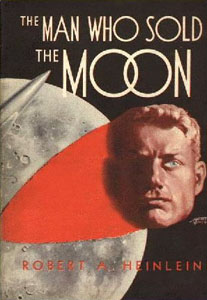
Cover of the first edition of The Man Who Sold the Moon (1950), a short story collection by Robert Heinlein. Image: Wikipedia.
You can see how that proposition might be uniquely appealing to the likes of Bezos or Musk, certain of their genius but widely reviled and perceived as buffoons by more “traditional” sources of power and culture. In fact, my questions above might as well come from one of their social PR campaigns; it’s how they perceive themselves and how they are perceived by their fans. And science fiction enables this perception! The whole idea of a benevolent, ultra-rich, benign and contemporarily maligned genius around which so many of the ultra-rich construct their own myth comes to us straight from science fiction. In fact, this essay is named for one such story: Robert Heinlein’s The Man Who Sold the Moon. In it, a protagonist who feels like a Musk/Bezos prototype (because he is), defies the laws of common sense to brilliantly “buy the moon” and, through arcane financial and legislative clauses, owns the entire Earth as a result. But not really, right? Wink wink. It was only for an hour. He was actually an idiot, right? Wink wink. During that hour, he redrafts some laws, moves money around and becomes, you guessed it, the richest man alive. And his riches pave the way for things like automated sidewalks, nuclear piles, clean space travel, and, finally, the stars.
For you and me, this is simply fiction, an exercise in cleverness. But to uniquely positioned men (and women), empowered by their class and all the power which it allows them, this is not merely a flight of fancy. It is, instead, one of the foundations of a messiah complex in which all of their horrible actions are excused. This is something which I find myself disagreeing with a lot of people on; Bezos or Musk or Branson or whoever, they are not sociopaths. They know how much pain they are causing when union-busting or driving their workers into the dirt or destroying any chance for meaningful solutions to climate change. They simply think it’s all justified because, in the end, history will vindicate them in exactly the same way as it vindicates the heroes of the books and stories they, and all of us, grew up on. We’ll see, don’t worry. We’ll see how it all fits together, all those gambles, all those flights of fancy will one day coalesce into reality. In a way, they are an example of how much of the science fiction community views itself: today, we are fools. Tomorrow, you will realize we were prophets. Musk is an especially pertinent example of this, as he spouts his end goal of “keeping the light of human consciousness alive in the universe” whenever any criticism is made of him.
The worse thing is that these stories allow the ultra-rich to masquerade their depravity as heroism. It’s not just that they associate with these heroes; it’s that they think they are anti-heroes, misunderstood messiahs who must work against the grain. The stories and their heroes become self-reinforcing: the more people criticize you, the more you are being misunderstood, the more you will one day show them all and save everyone.
As Michael Moorcock said: “Traditional SF is hero fiction on a huge scale, but it is only when it poses as a fiction of ideas that it becomes completely pernicious. At its most spectacular it gives us Charlie Manson and Scientology (invented by the SF writer Ron Hubbard as an authoritarian system to rival the Pope’s). To enjoy it is one thing. To claim it as ‘radical’ is quite another. It is rather unimaginative; it is usually badly written; its characters are ciphers; its propaganda is simple-minded and conservative – good old-fashioned opium which might be specifically designed for dealing with the potential revolutionary.” The problem is not just that much of science fiction is reactionary and conservative, as we have briefly explored, but that science fiction, just like Jobs or Cook, masquerades as being a savior, a revolutionary, an innovator, and a radical. This makes it the ultimate cultural weapon against real revolution because it not only opposes change from the outside, it infiltrates it and poses as change, used to de-fang radicalism and keep it safe.

Make Star Trek Real! – Image from the live broadcast of the US Secretary of Defense’s remarks, YouTube.
Of course not all science fiction is like this. It can be radical, it can be revolutionary. People very much like to point out authors like the aforementioned PKD, or Arthur C. Clarke (who once said “the goal of the future is full unemployment, so we can play. That’s why we have to destroy the present politico-economic system”, even though the politics in his books and personal life are suspect) or indeed Le Guin and others as evidence of the good of science fiction. And I agree;
But we can not escape reality, some of the most prominent figures who cite science fiction today use it to justify their own “robber baron”-like appearances and behavior and abuse it to scifi-wash themselves into gallant saviors of the human race.
I love science fiction and I love it as a radical tool, but I think we need to reckon with the fact that the foundations of the genre are built more on individualism, militarism, misogyny and conservatism than on anything else. Luckily, the mercurial nature of culture means that we have the power to change SFF, regardless of its roots, by exploring the more radical political futures it is capable of expressing. More to come!