Imagination and fantasy play a central role in society. They allow us to visualize alternatives, options of better worlds to strive for. They can make our fears and the challenges we face tangible, thereby giving us space to deal with them and think of solutions. Films about the Israeli-Palestinian and Israeli-Arab conflicts have tried over the years to develop these imaginations and fantasies to allow us to envision possibilities for repair, reconciliation, connection, healing, and peace. Films such as Behind the Bars, Avanti Popolo, Cup Final, and The Band’s Visit are not fantasy films in the classic sense, but they are films that have allowed us to fantasize about a different reality. A reality of dialogue, cooperation, brotherhood, and closeness between Israelis, Jews, and Palestinians (directly or indirectly). To imagine how we can heal our wounds and live as a tolerant society, with compassion for the other as well as for ourselves.
The gradual disappearance of films about the conflict from the local feature film scene attests to our failure as a society to dream, imagine alternatives, and strive for them. The almost complete disappearance of conversations about peace talks and coexistence symbolizes the stagnation of our society in the last twenty five years, since the summer of 2000, when former Prime Minister Ehud Barak declared that “there is no partner” and the perception that “there is no one to talk to” has become fixed. October 7 was not supposed to cause a sobering realization that there is no point in promoting a peace process because the other side only wants to slaughter us. This is the perception that has been promoted in Israeli society since the failure of 2000. On the contrary, it should have been understood that Israeli society’s failure to imagine an alternative to managing the conflict and its unwillingness to imagine a solution for over twenty years (with few exceptions) is what led to this total collapse. If anything, October 7 should have been followed by a call to awaken the imagination—to the existing urgency to reimagine peace as a possibility.
In fact, the main failure of Israeli society is also related to the Oslo Accords themselves, and to the inability of the leadership, but mainly of the Israeli public, to imagine peace even then. Israeli society holds on to a mistaken and problematic perception of what “peace” is. Songs, plays, films, and others, imagine peace as a kind of “instant” utopia. Like pouring a little water into powder and voilà – coffee. “I was born for peace that will just dawn on us,” songs tell us. “Once we recognize each other’s humanity and see that we are not so different, there will be peace immediately,” movies tell us. In the public imagination, the peace process is something actually lacking in process.
Thus, Israeli society lacks patience. The connection between peace and security has created a feeling that the Oslo Accords have failed to fulfill their role of bringing security in the short, immediate term. Peace, by definition, is the opposite of war and violence, but in reality, the peace processis exactly that – a process. It takes patience and time, even when violence continues. This doesn’t mean that peace has failed or that there’s “no one to talk to.” It means that it takes time, and that if we persevere and continue, over the years, the violence will decrease, there will be more understanding, more dialogue, more “peace.” As Rabin said, paraphrasing Ben-Gurion: “To continue to fight terrorism as if there is no peace process, and continue the peace process as if there is no terrorism.” This is seemingly a paradox: how can there be peace if there is still war? This complexity requires our imagination, our ability to illustrate through culture, art, and entertainment the ability to persevere, to believe, to not give up. To be strong, not in the sense of defeating the enemy, but in the inner strength to stand up to violence and continue to believe in peace, despite everything. This is a peace that will not “just dawn on us,” but that will be built, step by step, over decades, until our children or grandchildren can live it to the fullest.
Israeli cinema has failed in its ability to imagine this insight, in its ability to communicate and evoke emotion through it. It is bound and captive to the simplistic notion of immediate and utopian peace, and is unable to imagine it any other way. Since the collapse of the Oslo process, the few films made about the conflict have failed to change the situation or offer an alternative, but they have offered interesting images of a different kind and addressed the fantastical dimension in a unique way.
Children’s Fairy Tales on the Battlefield
Dr. Yael Munk (film researcher) argues in an article from 2011 that “Lebanon films” are characterized by nostalgia for the innocence of youth, their lost purity and beauty. But why do Lebanese films from the first decade of the 21st century lament the death of youth? Munk interprets the image of the tank in a sunflower field, which marks the end of the film Lebanon (2009, directed by Shmulik Maoz), as a symbol of the painful memory of something pure that has been irretrievably shattered: it is no longer possible to look at the beautiful field with an innocent eye; the tank is stuck in it like a traumatic memory. Indeed, Lebanon is replete with poetic images, but its analysis reveals that the lament for lost youth also has broad socio-political implications. The lost innocence, expressed through images associated with fantasy and children’s fairy tales, actually signifies the shattered hopes for peace.
In Lebanon, a ray of light penetrating the tank from the top hatch is a common image. The film’s protagonist, Shmulik (Yoav Donat), looks up, and for a moment the darkness in which he is immersed is illuminated by a bright ray of light that floods his face and those of his friends. The image brings to mind artistic-religious imagery, mainly because of the upward gaze and the light shining from “the heavens.” In one of the film’s climactic moments, light penetrates the tank as the body of a dead paratrooper is removed, and a voice coming from the radio device refers to the body as an “angel.” In the chaotic and upside-down world of Lebanon, the word “angel” means the body of a dead soldier. But instead of ascending to heaven, the angel descends into a tank, a kind of poetic and symbolic hell.
Lebanon creates its poetic world, among other things, with the help of the military-like jargon it uses. This credible but exaggerated language lends a poetic and surreal layer to the events. For example, a phosphorus bomb becomes “exploding smoke”; the destination the soldiers are supposed to reach is called “Saint Tropez,” the tank is called “Rhino,” the combat unit is called “Cinderella,” the commander whose voice is heard on the radio device is “Cornelia,” the wounded soldier is a “Flower,” and the enemy is a “Cricket.” The code words (some of which were taken from military jargon and some of which were invented especially for the film) are intended to emphasize the abstract, surrealistic dimension, as if taken from a fantasy or a children’s fairy tale. They create a dissonance between the signifier and the signified. Thus, when the paratrooper is wounded, the commander calls out over the radio, “I have a flower, I have a flower,” and later, when he dies from his wounds and his body is being evacuated, the radio transmits, “An angel is rising, an angel is rising.”
The clear symbolism, perhaps even deliberately crude, is intended to transport the viewer from the hyperrealism of the bloody, harsh, and cruel images to the realms of surrealism and fantasy. In this context, Lebanon belongs in a sense to extreme cinema, a cinematic style that depicts extreme images and situations in a graphically blunt manner, explicitly presenting physical and mental violence. However, in addition to and sometimes instead of evoking disgust and horror, these extreme and cruel images take on a poetic tone. This poetics of cruelty invites discussion of moral issues and man’s tendency toward violence and evil. The cinema of the extreme, sometimes referred to as the cinema of cruelty, gained popularity in the West in the late 1990s and in the beginning of the 21st century, and European and American cinema began to incorporate aspects of it into both horror and thriller films as well as art films. Lebanon‘s connection to extreme/cruelty cinema is expressed in its blunt depiction of horror and the surrealistic and poetic connotations it imparts, which add subconscious aspects to the image of extreme realism.
This strategy of combining elements from the fantasy genre and even children’s fairy tales with the context of violence and harsh reality characterizes not only Lebanon, but also a number of other films about the conflict since the collapse of the Oslo process. Ajami (2010, directed by Yaron Shani and Scandar Copti), for example, despite its realistic stylistic tendency, also flirts with fantasy, with the world of children’s fairy tales and, most of all, with comics. In the film, Nasri (Fouad Habash) is a boy whose hobby is drawing comics. He also narrates the beginning and end of the film. Nasri’s comics and narration bridge the violent world of reality with the harmonious world of his illustrations. In retrospect, we discover that Nasri was killed and what we heard throughout the film was the narration of a dead child. Nasri’s voice emerges from the world of the dead, addressing the viewers and asking them to close their eyes, imagine, and then open them. His narration is sometimes accompanied by his comics, which recreate events that took place in the film or, alternatively, describe his memories or thoughts of better, more beautiful and harmonious times. The dimension of comics and fairy tales appears in Ajami as a kind of escape from the violence and difficulties generated by the stubborn conflict.
Comics as a bridge between the violent world of reality and the harmonious world of imagination | From the film Ajami, 2010, directed by: Yaron Shani and Scandar Copti
With the collapse of the hope for peace, filmmakers lost the ability to create a space for closeness and peace in “reality,” and therefore new films about the conflict tend to invent an imaginary, utopian, poetic world that attempts to repel violence and nullify it, or turn it into a naive expression of childhood. This is also the case in The Band’s Visit (2007, directed by Eran Kolirin), which depicts a world that behaves like a fairy tale, unanchored in place and time, thus creating a fantastical alternative to the violence and hatred that exist outside it. But this imaginary world collapses, unable to hold its own.
In Lebanon, the combination of elements from children’s fairy tales with military jargon and the image of a tank in a field of sunflowers creates tension between naivety and horror. In Ajami, Nasri is a kind of ghost hovering over the film, and his spiritual presence lends a mythical dimension to everything that happens in it, but Nasri’s illustrations ultimately also depict the violence around him, and as in Lebanon, here too the innocent world of childhood is corrupted and tainted. The ambivalence created by this combination of innocence and violence and the depiction of a corrupted fairy-tale world produces images that mourn the innocent hope for peace that has been violently murdered. In this context, the post-Oslo conflict films not only speak of the inability to create a space and time for dialogue, peace, and innocence, but also point to the impossibility of even imagining such space and time.
The End of Fantasy, an Opportunity for Imagination
Thus, the films of the early 21st century about the conflict constitute a kind of “requiem for peace,” an elegy for the naive hope for utopian peace that prevailed in Israeli society.
However, there may be a positive side to departing from this conception of peace – a value in attempting to understand the concept of “peace” in new ways, less unambiguous, deterministic, and immediate, ways that recognize that peace is a process and that violence, paradoxically, will continue to be part of reality, part of our lives, even during the long and painful period of peacebuilding. Hopefully, it will fade away throughout years of action, healing wounds, dialogue and mutual communication.
Part of the necessary work is imagining. The inability to imagine a peace process in a way that is not childish or fantastical is a serious problem not only for cinema, but for Israeli culture and society as a whole. In this sense, the idea of “the death of peace” in cinema has a double meaning. While it refers to the “requiem” films of the early 2000s, it also constitutes a positive call to finally bury the simplistic, utopian, and misleading concept of “peace” in Israeli society and to adopt a new concept that views it as a long-term process that requires perseverance to ensure a more equal, better, and safer society for future generations.
Israeli culture in general, and Israeli cinema in particular, must find ways to reimagine peace. October 7 demands that we do so, because giving up on imagination means giving up on the future, and giving up on the future means choosing death.
In the following remarks, I ask to return to a specific moment in the history of Hebrew theater that, in my view, can serve as a key to understanding the problem of imagination in Israeli culture. In the current context of the Investigation committee on the failure of imagination, the moment to which I return is a sort of an investigation committee in itself, or more precisely, a public trial.
The year is 1926, the location is Palestine-Israel. A local theater troupe called the Eretz Israeli Theater (Hatai) performs The Dybbuk, a play by S. An-Sky, directed by Menachem Gnessin. Gnessin was one of the founders of the Habima Theater in Moscow and even played in the legendary production of The Dybbuk at Habima (1922), directed by the renowned Armenian director Yevgeny Vakhtangov, which brought the theater international renown. At some point, Gnessin left Habima, joined Miriam Bernstein-Cohen in Berlin in leading the Hatai group, and together they came to Israel. Here, he staged a version of An-sky’s play, which he explicitly stated was based on Vachtangov’s production. The name of the Habima production had already spread far and wide, but the group had not yet arrived in Tel Aviv, so the local audience had to make do with the Hatai production for the time being.
The Dybbukwas written by An-Sky after his ethnographic travels among Jewish communities in Russia between 1912 and 1914. An-Sky, an educated Jew who had distanced himself from Jewish tradition in his youth, sought in these journeys to collect and preserve the folk-traditional culture of Eastern European Jewry. Feeling that this culture was destined to disappear due to revolutions, pogroms, emigration waves, modernization, urbanization, and secularization processes, and believing that this culture contains important knowledge that must be preserved, An-Sky led an expedition among the Jewish towns (shtetls) in the Yishuv. They collected folklore, stories, traditions, melodies, and beliefs of the local communities. The expedition’s findings were presented in a special exhibition in St. Petersburg, and from the stories An-Sky heard on his travels, he also wrote The Dybbuk.
The plot of The Dybbuk revolves around Hanan, a young, poor yeshiva student who studies Kabbalah and practical mysticism. Hanan is in love with Leah, the daughter of a wealthy man, but when he discovers that she is to be married to another man who is richer than him, he tries his hand at magic in order to force God to give him Leah. Hanan dies during the attempt, but returns as a dybbuk—a dead spirit that enters Leah’s living body, possesses her, and is revealed from within her during her wedding ceremony. Leah-the-dybbuk screams in a man’s voice during the wedding, resists the marriage and disrupts the ceremony. She/he is taken to the local Hasidic rabbi so he would exorcise the dybbuk from Leah’s body. After a long and complicated debate and impressive ancient rituals, the rabbi finally succeeds in exorcising the dybbuk. However, Leah chooses to join Hanan in the afterlife and dies.
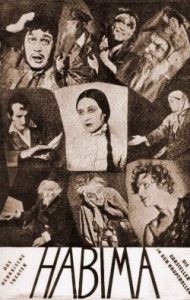
The Dybbuk was performed by Habima in a Hebrew translation by Bialik and, as mentioned, received great success. Vakhtangov’s direction emphasized the mystical, ritualistic, and mysterious elements of the play’s plot, using expressive and exaggerated theatricality: heavy makeup, stylized movement, and the majestic pronunciation of Hebrew as an ancient sacred language. Gnessin’s production, “Following Vakhtangov,” was also a hit with local audiences in Israel, but the play sparked a heated debate among critics—a debate that culminated in a public literary trial of The Dybbuk held in Tel Aviv by the Writers’ Association. (1)
Poster for the play The Dybbuk by S. An-sky | The National Library
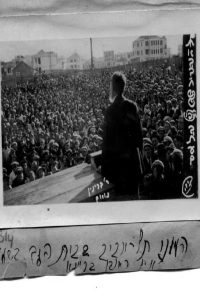
Approximately five thousand people gathered in two evenings at the Beit Ha’am in Tel Aviv to watch the trial against An-Sky (who had passed away six years beforehand) and the Hatai Theater. Among the judges, defense attorneys, prosecutors, and witnesses in the trial were some of the key literary and intellectual figures of the Jewish community in the Jewish settlement in Israel at the time. The trial transcript provides a fascinating glimpse into the internal negotiations that took place in the community regarding cultural policy, as well as the tensions and profound questions that troubled the cultural personas at the time. (2) Of particular interest to us is the reference to the unrealistic and fantastical elements of the play.
The indictment against the play, which included no fewer than sixteen counts, claimed, among other things, that:
Most of the characters depicted in the play are not realistic types cut from Jewish-human existence […] but rather they are ethereal souls, mechanical creatures lacking solid and complete character traits, androgynous beings—some of them immature monstrosities and some of them creative freaks, passing before us like shadows.”
Reuven Brainin speaking before an audience at Beit Ha’am, 1926.
The claim that the characters are unrealistic touches on the basis of the anti-fantastic suspicion woven throughout the indictment. The characters are described as mere “shadows,” vague and unclear, lacking substance, as if the fact that they are not cut “from human-Jewish existence” prevents them from being real. Of particular note in this context is the description “androgynous,” which refers to the crossing of gender boundaries between masculinity and femininity performed by the Dybbuk, and perhaps also points to the queer discomfort raised by the fantasy of The Dybbuk: It seems that the requirement that the characters be grounded in reality also contains a desire for them to be anchored in a normative sexual, gender order.
The main problem with the unreality of The Dybbuk, according to the indictment, is that it corrupts both the audience and the actors. It:
provides the audience solely with entertaining stimulation of the senses of sight and hearing, but in no way can it serve as a decent educational tool and healthy spiritual nourishment for the people. Not only that, but it accustoms the viewer to superficial effects and momentary excitement on stage, thereby spoiling the taste of the audience, which needs aesthetic training and education.”
Similarly, it “also has a negative effect on the actors, since in its false design it forces the performers to create characters devoid of reality and castrates the actor’s human and artistic perception.” This supposedly negative influence of imagination on both actors and audiences naturally has political and ideological implications. The success of The Dybbuk, which the indictment is forced to acknowledge, distracts attention, according to the indictment, from the important cultural project of “cultivating, within the limits of possibility, plays that embody secular and humanistic contents, in order to fortify the renewed Hebrew culture and clothe it in the mantle of healthy and fresh secularism.” In other words, the mystical-Hasidic fantasy of The Dybbuk stands in contrast to a healthy and fresh secular-Zionist reality. And so, the indictment continues:
The excessive attention paid by members of Hatai to the The Dybbuk here among the emerging Jewish settlement, amid the buds of new life, the glimmers of a rising new culture, so different from the withered and futile forms of life, is a double error, both logically and aestheticlly, as it distracts emotional and artistic energy from the spiritual dilemmas and vital problems associated with the reality of life in Israel and with the sorrow and pains of prosperity of renewed Hebraic humanity, and it hinders the theatrical rise of original Hebrew expression.”
What is important to note here is the contrast between “the emerging Jewish settlement,” “the buds of new life,” “the reality of life in the Land of Israel,” “the pains of prosperity of renewed Hebraic humanity,” and “withered and futile forms of life.” These forms of life are, of course, diasporic Judaism and religious tradition – but also fantasy, imagination, and the worlds of legend offered by Kabbalistic and Hasidic tradition. All of these are contrasted with the supposedly healthy and fresh Hebraic, secular-Zionist reality. If the Zionist project is based on the urge to fulfill your dreams in reality (“if you will it, it is no dream”), then the imaginary worlds of The Dybbuk – fantastical, diasporic, queer, indeed fairy-tale worlds – challenge it to its core.
In this context, Zalman Rubashov (Shazar)’s testimony in favor of the play is particularly interesting. Shazar sought to explain why the play—with its Hasidic and mystical content—was so successful among secular, educated, and modern Jewish audiences at the beginning of the century:
All the decorations together with An-sky made him what he is. Why did we all gather here, if not for the power of the “dybbuk,” something that brings people together, something that speaks to the heart and invites the artist to come and join in and contribute something of his own? Indeed, you may recall the mood in Hebrew and Jewish literature, in Jewish culture, in those years before the war […] There was a tremendous longing both for the town and for the cultural wealth that remained there, beyond the threshold. There was a feeling among the young people of Israel that they had rushed to leave the town, rushed to get out of it before they had gathered all they could from it. […] When you hear and see it live on stage, something moves in your heart – the artists gathered all the forces of folklore and sent a greeting from a place where our souls still flutter in some form, and there is a desire to hear a greeting from there. It was everything.”
Shazar’s explanation naturally relates to An-sky’s own motivation to save something of the traditional Jewish world he left behind, and extends it to the audience coming to see the play. In contrast to the rejection of exile that underlies the criticism of The Dybbuk, Shazar seeks to make room for nostalgia for the world of the Jewish shtetl even among the Zionists who immigrated to Israel. At the same time, his words about the longing to hear a greeting of peace “from a place where our souls still flutter” touch on more profound questions about the emerging Hebrew culture. First of all, this wording echoes the situation of the dybbuk situation itself – a situation in which the soul is still attached to a place other than where the body is currently located, at a different time, in a past that refuses to let go. There is a subtle criticism here of the total Zionist demand to be fully present in the here and now, in reality. In this sense, Shazar’s words can be read not only as a reference to nostalgia for the shtetl, but also as an in-depth analysis of the need for fantasy, for the unrealistic, and as an attempt to qualify a cultural policy that is completely devoted to the “mantle of healthy and fresh sand.” The attraction to fantasy, according to Shazar, is rooted in longing, in the profound duality of the soul that is both here and not here at the same time. We must recognize these forces that operate inside ourselves, even in the midst of a large-scale project to establish a new culture.
Poster for the play The Dybbuk by the Habima Theatre in Moscow, 1922.
Ultimately, the judges ruled that the play was indeed flawed and problematic, but given the paucity of the current Hebrew repertoire, staging it could be justified until more suitable Hebrew works will emerge. “It is to be hoped,” the verdict concluded, “that the new life in Israel and our burgeoning culture will inspire the popular writer and the Hebrew theater to create the original dramatic work that is faithful and complete in every aspect.” When Habima arrived with their production of The Dybbuk a few years later – as well as with other plays with fantastical, mystical, or supernatural elements, such as The Golem and The Eternal Jew – they were met with resounding success. The Dybbuk was performed hundreds of times over several decades. It was supposedly the triumph of fantasy. However, Habima’s repertoire changed and gradually responded to the demand for realistic plays that reflected the here and now of Zionist culture. When, in 1948, the new and young Cameri Theater swept the audience away with Moshe Shamir’s “He Walked in the Fields” – a play about the kibbutz and the Palmach of the time – the mysterious fantasy worlds of The Dybbuk were gradually pushed off the stage. Of course, they did not disappear completely, and continue to appear in Israeli theater in various forms. (3) However, the deep unease toward the fantastic that was expressed in the trial of The Dybbuk continued to accompany Israeli culture and shape its path.
On October 7th, 2023, we, whose homes and lives are located between the river and the sea, found ourselves in a present we could no longer recognize. Since then, too many of us lost our homes, too many of us lost our lives, and most of us found ourselves no longer able to imagine a future.
I was similarly lost in the suffocating darkness, grieving and fearing for my loved ones as I saw my homeland lose itself in a dark spiral of fear, hate, racism and violence. Rebecca Solnit’s book Hope In The Dark provided essential guidance. The darkness Solnit writes of is not a sad and desperate place, but instead she argues that the only place where hope can actually be found is within the darkness of uncertainty:
“Hope locates itself in the premises that we don’t know what will happen and that in the spaciousness of uncertainty is room to act.”
—Rebecca Solnit
Solnit encourages us to look for hope beyond the lamplight of the certain. Hope therefore is used not as a noun, but as a verb — it is not something you get or something you lose, hope is something you do. It is something we, who have been committed to a just and equal future in our shared homeland, have to get better at, and it requires practice.
Since the war broke, even more urgently than before, we at the Israeli/Palestinian peace movement A Land For All — Two States One Homeland, try to practice and teach that stubborn hope in the dark. With that in mind, over the past few months, I have developed a new methodology for political imagination. It revolves around a simple exercise inviting participants to quickly capture diverse images of futures in the form of scribbled on paper mobile-phone-shaped “screenshots” and then map their potentialities together.
I have used different adaptations of this workshop with a wide range of participants: Israeli and Palestinian peace and climate activists, designers, urban planners, artists, policy makers, community leaders, members of parliament, academics, youth, etc… At this point more than a thousand participants already experienced this workshop which we found ourselves running almost every week for the past few months. There seems to be a demand for political imagination.
Inspiration
On a Novemeber morning in 2008, I was climbing the stairs out of the subway station in Manhattan. It was only a week after Barak Obama was elected for office under the banner of “hope”, and I was handed a free newspaper declaring: “IRAQ WAR ENDS”. It was a special edition of The New York Times, dated 8 months in the future (July 4th, 2009) and in it every story, every letter to the editor, every correction and every ad represented a world transformed for the better (from a progressive standpoint): “Maximum Wage Law Succeeds”; “Nationalized Oil To Fund Climate Change Efforts”; “All Public Universities To Be Free”; “National Health Insurance Act Passes”; etc… It was “all the news we hope to print”, as the Times’ famous motto was wittily subverted.
This project by The Yes Men, Steve Lambert and others, serves as a great inspiration. The textual format of the news story maintained the appeal and accessibility of short-form science fiction (or speculative fiction) writing. At the same time, the newspaper as a familiar yet strange object and the performance of spreading and reading it in public space functioned as a work of design fiction. As writer Bruce Sterling framed it:
“Design fiction doesn’t tell stories — instead, it designs prototypes that imply a changed world.”
The New York Times Special Edition (NYTSE) provided both stories and a prototype that demonstrated what it would be like for these news to hit the streets. Like an archaeological artifact it required imagination to piece the reality around it. Yet, the production of the NYTSE took a lot of time, effort, skills and funding, none of which fit the context of this workshop.
Today fiction (and occasionally some truth) is wirelessly delivered straight into our pockets. The mobile phone is the channel to our imagined worlds whether they are based on an objective reality or not. A mobile screenshot freezes a fleeting moment in time with very limited space for information and context. It can serve both as a minimal format for text-based fiction and as a piece of design fiction, an artifact of future archeology.
Screenshot templates
The mobile screenshot format serves as a reference for the paper format we use in the workshop. I designed 6 printed cards as screenshot templates to be written and scribbled on:
Social media post from a future: what would someone want to publish to the world in that future? Who is that someone? (Monologue)
Chat between two or more people in a future: what are they talking about? Who are they? What is their relationship like? (Dialogue)
Notification sent in a future: it could be from a news app with a title, but also a fitness app, a calendar event reminder, a language app, etc… (Alert)
Question for a future AI agent: in this case we’re more interested in the human questions than in the artificial answer. (Often used for inner dialogue)
Map of the region in a future: what layers are significant to draw above the geography? (I also used street maps when we focused on defined urban contexts)
Picture taken in a future: what would make people want to document a moment in a photo? What are they witnessing? (sketching and stick figures are encouraged for both accessibility and speed)
Transition Bar
The bottom of each template features a bar indicating a transition period taking place in the future that this screenshot is taken from. These transitions represent a future time period of change that distinguishes itself from the present we are currently in. This could be “peace process”, “regional war”, “elections”, “pandemic”, “flood” or even something personal like “immigration” or “pregnancy”. The transition could be long and gradual or immediate and swift, clearly defined or ephemeral. The wording of the transition is up to each participant but should be short and comprehensive — ideally one or two words.
Several axes of change, from top-left: ‘Opening borders and changing laws of physics’, ‘Nuclear war’, ‘Levant Unification Agreement’, ‘The War’, ‘Relocation’, ‘Real estate revolution’, ‘Transfer’, ‘Calm and arrangement at the Temple Mount’, ‘Attempt at a two-state agreement’, ‘Coming of the Messiah?’, ‘Legal revolution’, ‘Rising seas’, ‘Cessation of operations to stop climate change’, ‘Liberation of Palestine’, ‘Drought’.
Next we circle whether the screenshot was taken either:
Before the transition — hence closer to our present and possibly leading towards or attempting to prevent the transition (ex: before the civil war)
During the transition — representing how it feels to live through it (ex: during global isolation) After the transition — in a possibly changed reality following that transition period (ex: after regional treaty)
It’s a good opportunity to mention we do not talk in dates and years, only in relative time periods. We try to focus on how time periods are experienced and constituted in time as social realities. Objective time measures like years and exact dates are mostly counterproductive in the context of this exercise.
Note: This part about relative time periods is worth explaining well as it is slightly more abstract than the screenshot templates that most participants find quite straight-forward. Some participants had to be reminded to add the transition period and mark the screenshot’s relativity. Most used the bar quite technically, marking a relative period that could also be understood from the context of the screenshots. Some did manage to use the transition bar creatively, in a way that adds context and depth to the screenshot.
For example take this chat screenshot provided by Maya Van Leemput in the online workshop on MediumDay:
A familiar human correspondence containing an unusual detail, and understandable only after reading the additional information on the axis of change.
Maya: Congratulations on becoming a granddad! Funny that the little one came at night. How long before you saw her face? Rony: I am over the moon. I saw her as soon as they carried her out of the delivery room. The glow of the candle light made her look beautiful and soft. ( pre -> Solar Flare -> post )
The familiar personal human exchange is only fully understood once you read the transition bar. The bar discloses that Rony’s granddaughter was born after a solar flare. We are left to imagine how a personal human moment like childbirth may be affected by the potential cosmic phenomenon of a solar flare. In a workshop focused on the Israeli/Palestinian conflict it called into focus both the human/personal and the planetary/cosmic contexts that persist in parallel to the conflict. And finally, this specific screenshot challenged the assumption embedded in the screenshot templates themselves — that mobile technology as we know it today will remain available in our futures going forward.
Themes and Variations
Unlike the NYTSE, we did not limit this to preferred futures and in fact actively encouraged participants to express both their hopes and their anxieties. This framing allowed participants to sincerely imagine both.
Of course the screenshots content and the use of the transition bars depend on the theme of the workshop. In a workshop focusing on the futures of shared society in Jaffa we got less screenshots having to do with technological shifts or climate change and more concerning housing and local community issues. And in a workshop about Partnership Based Peace there was much more focus on wide societal shifts, education and diplomacy.
I also ran a workshop with opposition MPs where we decided to fix the transition bar on three states: opposition / election / coalition (acknowledging these states may not necessarily follow chronologically). And in a workshop focused on urban policy regarding the futures of the Tel Aviv bus station megastructure we fixed the states on: planning / building / using.
Hope is not a ‘thing’, a noun, but rather a conscious action, it is not something to receive or lose, hope is doing | ‘Hope’ in Barack Obama’s election poster, in New York, October 2010 | Photo: ChameleonsEye, Shutterstock
Working Individually
We take about 10 minutes to generate the screenshots. Each participant works alone and is encouraged to generate at least 5 screenshots and consider both “preferred” futures and “prevent” futures. They often try different templates, and different relative transition periods, as well as different degrees of potentiality (more on that later).
When the time is up each participant is asked to make sure they titled the transition period and circled the relative time of the screenshot capture.
To make sure we have full documentation and credits for each screenshot card, I ask each of the participants to photograph their screenshots and share themes to a chat group (for that, sharing a QR code for joining a WhatsApp group has proved useful).
The Futures Cone
Anticipation is something we do in the present. We consider alternative futures to evaluate the potential of the current moment given our experience of stability and change in the past.
We often imagine a timeline stretching from the past to the future with the present marked as a point in between. This visualizes the future as already determined and the present passively flowing along.
But “The Future” does not exist. There is never one future, what we (should) mean by the future is a hyperobject of possibilities. Futures are always potentially endless possibilities, but they are not all equally probable. When we say “the future” and represent it as a single line we often project the patterns of the past into the future. Tomorrow the sun will shine, the world economy will not crumble and no peace treaty will be signed between Israel and Palestine (I can’t wait for this example to grow old). We conveniently surrender to determinism and minimize our own agency from the image of “The Future”.
The field of Futures Studies often uses the iconic diagram of the Futures Cone, developed by Josef Voros. It represents futures, not as a single deterministic line and not as an unimaginable chaotic void, but as a cone of possibilities with varying degrees representing adherence-to or divergence-from the patterns of the past.
In the workshop we use Voros Futures Cone with slight variations as a physical visualization. 9 strings are stretched from left to right (between columns, poles or tripods). They represent four overlapping cones and a straight line in their center (see image).
The Cone of Futures, Beit Radikal in Tel Aviv, October 2024.
The strings are marked:
Projected: The central straight string represents a single “projected” future — the most certain forecast — the future previously known as “The Future”.
Probable: The two slightly angled strings above and below the projected line represent a narrow margin of error around the projection, they allow some variation but are still quite safe predictions.
Plausible: The next two strings above and below represent futures that may not be the first idea that comes to mind but do not stray from our general image of what the future would look like. They are not the most predictable but at the same time they are not surprising.
Possible: The next two strings represent unexpected and unlikely futures that nevertheless cannot be labeled as impossible. This degree of potentiality is of extreme interest to us and often attracts many interesting screenshots.
Preposterous: The outermost two strings represent impossible futures. It is interesting to reflect on how much of science fiction is focused on this degree of potentiality and how dismissing something as “impossible” defuses much of its political threat. At the same time especially today between Israel and Palestine it is exactly those extreme preposterous messianic and genocidal images of the future that set the tone and fuel the flames on the ground. At the same time those of us promoting partnership and peace are discredited and labeled as “delusional”.
Hanging on the futures cone
After they share their screenshots on the WhatsApp group, participants are invited to step forward, one by one, and choose one of their future screenshots that they feel most strongly should inform our anticipation in the present. They introduce themselves briefly and present their screenshot to the group by reading, showing or describing it.
The facilitator then offers them a choice: either choose the blue clip marking this future as “preferred”, or choose the red clip to mark this future as “prevent!”. Using both clips is also allowed to mark ambivalence.
What would you choose? A blue pin symbolizes a ‘preferred’ future, a red pin symbolizes a future ‘to be prevented’, from a workshop at the Van Leer Institute in Jerusalem, October 2024.
The participant chooses a degree of potentiality from the projected to the preposterous and hangs the screenshot on the string of their choice. The upper strings are reserved for the preferred futures (blue clips) and the lower ones for the prevent futures (red clips). Ambivalent screenshots can be placed in either one of them, and the projected string is used for all preferences.
The horizontal positioning is determined by the before/during/after circling of the transition bar. Screenshots taken before the transition will be positioned further to the left, closer to the present. Those taken during the transition will be placed in the center. And those marked as after the transition will be placed on the right side, furthest from the divergence point of the present. It is important to mention that each screenshot is individually positioned relative to the cone, not relative to other screenshots that represent other independent futures.
After everyone has had a chance to present a screenshot, the group is encouraged to clip any other screenshot they made and believe deserve our anticipation to the futures cone.
Evaluating Screenshots with Stickers
This is a good time for a break. During the break, participants can review the screenshots individually. Each participant gets a few colored stickers to mark the screenshots that most convey futures deserving of further investigation. This is also a way for them to explore and evaluate screenshots that were not presented to the group. It naturally also invites curiosity as participants want to know whether their imagination resonated with others. Finally, depending on the purpose of the workshop, these sticker-votes can inform the next steps.
Part 2: Diving Back into the Present
I had the chance to run the future-screenshots workshop in diverse contexts, with diverse groups and for diverse purposes. In some cases it was a short interactive introduction to political imagination, an exercise in what I fondly describe as “Unlearned Helplessness”. These last from a minimum of 60 minutes to 2:30 hours.
In other opportunities it was followed by a dive back into the present. I’ve been experimenting with 3 types of present-focused part-twos, diverging on different contexts and expected outcomes:
Activism and strategy — used when the group attempts to evaluate its potential impact on a complex present and an uncertain trajectory. The future-screenshots’ potentials are then evaluated through the dominant, disruptive and diverging flows in the present, and how those may influence the futures (both positively and negatively). The friction points between these flows are then mapped to an affordance map. The group evaluates its capacity to influence the friction points through actions in the present. In the final stage, each participant in the workshop created a new screenshot, this time, depicting a plausible action they intend to take in the near future.
Policy and design — where a policy or a design project are in early exploratory stages and we need to evaluate their potential future impacts as an initial step of co-design. The future-screenshots are then used to identify needs, audiences, challenges and disposition in the present. The methodologies used involve an unorthodox mix of Job Stories + stakeholder analysis + How Might We + Assumptions Mapping + Prototyping.
Storytelling and artistic expression— where creative output, world building and playfulness are the main motivation for the exercise. In these cases we emphasize the difference between the present reality and the potential futures we anticipate and how comparing them may inform our creative work. The methodologies used involve identifying signals in the thick present + The Thing From The Future (modified) + optional sketching using generative AI.
This is still a work in progress. I intend to write a few more follow-up articles to expand on these methodologies and maybe offer an additional post for general reflections. Feel free to contact me directly or in the comments if you have a specific interest in any of these or if you have any questions.
A futuristic screenshot from a workshop attended by Palestinian and Israeli peace and climate activists in Larnaca, Cyprus, September 2024.
Thank yous
Many people have been essential to this long journey, which is both coming to fruition and is continuing to evolve. This list is far from complete, and I hope to keep it growing. My heartfelt thanks go to:
Game designer Shalev Moran, who, as part of the Speculative Tourism project, helped develop the Sea Change project and the Chronomaps platform that form the basis of the screenshots methodology;
Critical Futurist Maya Van-Leemput, my personal guide to the futures, a colleague, a friend, and a mentor for the paths ahead;
My Israeli and Palestinian partners at A Land for All — Two States, One Homeland, and mainly Eve Tendler and May Pundak, who exemplify the power of political imagination, inspire my work, and co-resist this present while co-creating critical hope for shared futures worth fighting side by side for.
Futures cone (on the right) and possibility map (in the center) from a workshop for the staff of ‘Bimkom’ organization held in Philbeit, Jerusalem, November 2024.
Why did you decide to adapt Aniara to film? What attracted you to this specific sci-fi story?
In 2010 Pella and her grandmother saw a theatre play of Aniara and the following night the grandmother got a stroke. They had always role-played different books and when her grandmother got better, Pella started to read the book out loud to her at the hospital. They started to role-play the story, pretending that the big hospital was the spaceship, Aniara. The doctors, crew and patients, the passengers.
That was when the story truly hit us with its existential theme.
״We really wanted to create a ’here and now’ feeling. We wanted the ship to feel familiar. If we were to emigrate on a large scale to Mars today, we’re pretty sure that the ships would contain both shopping malls, bowling parlors and spa facilities. But especially shopping malls״
Especially shopping malls | Behind the scenes of Aniara, Photo by: Kuba Rose
We’d love to know all you can share about the process of making the film – how long did it take from inception of the idea (“we should adapt Aniara to film”) to completed product? What obstacles did you meet on the way and, as you are both accomplished film-makers – were there any special obstacles with this specific film, due to it being scifi, it being an adaptation, an adaptation of a cantos, by a Nobel Laureate?
We acquired the rights in 2014 and started adapting the poem into a script. So it took 4 years until the finished film screened in Toronto 2018.
There were many obstacles making Aniara into a film. The poem has a dramatic structure but is very condensed and is written in verse. It was challenging to adapt it into natural language. There’s not much dialogue and the story also takes place over a vast amount of time.
We ended up having a decent budget for a Swedish drama, but that proved to be very little for a complex sci-fi movie. We didn’t have the prep time or didn’t have enough time to get all the scenes during principal photography. So we did additional shoots where we really stretched the budget using a very small team – sometimes just us and an actor with a shitty camera. There’s some inserts of Emelie that are shot with a mini team in our living room.
In the end one of the financiers, Unbranded Pictures, gave us more money so we could do some additional shootings with more extras that we really needed for the story to come across.
Directors of Aniara Pella Kågerman & Hugo Lilja on set, Photo by: Kuba Rose
Was the funding process unusually difficult or was as difficult as any other film project?
Prior to Aniara we wrote a Swedish language zombie movie for many years which finally derailed for several reasons. So this time we decided that we would make Aniara on whatever money we could come across. We were lucky that a film commissioner, the director Baker Karim, at the Swedish Film Institute, loved the project from the very start and gave us an LOI that made it possible to get the rest of the funding.
We also got an international offer to get more budget if we made the film in English, but this time we wanted to keep control of the project. We also loved our Swedish cast and the language in the original poem.
״There were many obstacles making Aniara into a film״ | Behind the scenes of Aniara, Photo by: Kuba Rose
How was the idea for the Aniara film adaptation received by your environment – was it considered to be “just another project”, was it considered exceptionally challenging? By your friends and family, colleagues and peers, film industry, cultural scene, potential funders etc…?
It was seen as challenging by a lot of people, but we’d made short films that looked way more expensive than they were, and that helped convince people we could do this.
However we underestimated how hard it would be to make Aniara. It took us a year longer than we expected and we ended up finishing the editing at home. And Hugo lost parts of his hair.
Who eventually fully funded the film?
The film was funded by the Swedish film institute, Stockholm and Gotland film regions, Nordic film and TV fund, ViaPlay and Unbranded Pictures.
The movie poster
How was it received? By audiences in Sweden and around the world? Was there a discernible difference between the reaction of festival goers and cinephiles, scifi enthusiasts, and the general public?
The responses have been mixed. Aniara has a lot of fans who really love it but some people hate it or find it boring or just find it gives them too much anxiety.
There are surprisingly many sci-fi fans that dislike it. Part of the reason might be that its bleakness is the opposite of the escapism that sci-fi – at least mainstream sci-fi – often offers.
In the poem, Earth has to be abandoned because of nuclear war. What drove your decision to change this to climate change?
It felt more relevant today. Although of course climate change could lead to geopolitical conflicts and nuclear war.
״There were many obstacles making Aniara into a film. The poem has a dramatic structure but is very condensed and is written in verse. It was challenging to adapt it into natural language. There’s not much dialogue and the story also takes place over a vast amount of time״
When reading reviews of the original poem [EK], I saw the Mimarobe described as naive. On my first watch of the movie, I agreed, but now I’m not so sure. Do you think the Mimarobe is naive, or an optimist? (do you see a difference yourself?)
We see her as an optimist and an escapist. She’s addicted to Mima, sex, drugs, love and technology – anything that can keep her mind away from the existential void and loneliness.
“anything that can keep her mind away from the existential void and loneliness” | A Scene from Aniara
What drove you to choose the specific aesthetic of the ship? Were those just the locations you had available or was there a deeper intent behind the “run-down mall” aesthetic?
It was both an economical and an aesthetic choice. We’re pretty sure that we can’t escape the time we live in. For example, all the science-fiction films from the 60’s looks very much like the 60’s, even if they are to depict the future. Then it’s better to be pragmatic and realistic. In our case, we really wanted to create a ’here and now’ feeling. We wanted the ship to feel familiar. If we were to emigrate on a large scale to Mars today, we’re pretty sure that the ships would contain both shopping malls, bowling parlors and spa facilities. But especially shopping malls.
The most significant architectural spaces in the world are now entirely empty of people. Any tour through these sites to visit the landscapes and structures made for and by our machines must begin in a series of anonymous towns in the middle of Oregon, home to the largest cultural landscape in human history. Here, sitting at the confluence of cool air, cheap hydropower and tax incentives, the tech giants of Facebook, Google, Apple and Amazon have built their data centres. The chilly breeze that brushes our face has set in motion a storm of infrastructure. This is where the internet lives.
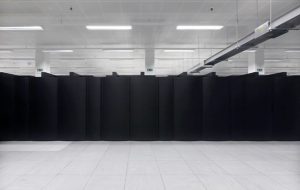
The UK Met Office’s Cray XC40 in Exeter is one of the most powerful supercomputers on the planet dedicated to weather and climate. Photo by: Tank Magazine
The buildings where we keep the world
These unremarkable streets and sprawling peripheries contain everything about who we are. Much of our dreams and fears, histories and futures are here, just behind an Oregon Thriftway, drenched in the stench of diner pancakes and simulation syrup. If we were to stroll through the screen and follow the fibre-optic tentacles across the planet, we would find ourselves in unfamiliar places like this, in the autonomous server farms, power plants, ports, factories and mines that produce the modern world.
One of these towns is Prineville, home to Facebook. This is a town that turns electricity into bits; its data centres are giant machines for organising our culture and archiving our lives. Every like, love letter, embarrassing photo and ironic update is stored in the purring technologies contained in its vast concrete boxes. This intricate portrait of human history is sitting somewhere along a winding two-lane road, near a parking lot, beside a tree, baking in the afternoon sun. We stroll through the hot aisles, breathing the air that is being warmed by our digital selves.
Facebook’s data centre, like many similar facilities, is essentially just row upon row of identical floor-to-ceiling server stacks, spinning and writing the lives of 2.27 billion global users. Each of the 4,000 servers in this hall has a blue LED that illuminates when it is accessed and a yellow flashing light that flickers with the writing of data. The server floor trembles like a forest of fireflies, a map of social-media territory, a spatialised internet, a field of flickering Facebookers all waving hello. As we exit each room on our tour, we diligently switch off the lights. There is no one left behind in the dark, it is a building of empty rooms, quietly humming away without us. Just one Facebook engineer is able to maintain 25,000 servers each day. We are surplus to the practical needs of the data centre. It is a landscape filled with our digital avatars, but strangely absent of people. Just a few wandering technicians stalk the aisles, babysitting the servers, watching the lights, waiting for something to do.
The Facebook data centre in Prineville is a prime example of one of the new typologies of the post-human: a building of extraordinary meaning that sits at the core of what it means to exist today, but turns its back on any expression of that significance. At first glance, there appears to be little architecture here, no grand monumental gesture; instead, this network of spaces so fundamental to our modern experience of the world seems to be conceived of little more than air-conditioning infrastructure. Architecture has always been defined by the prevailing means of production. Stonemasons once carved column capitals and modernist architects harnessed the prefabricated components made possible by industrialisation. These flickering buildings are more than just computational infrastructure, they are becoming the defining cultural constructions of our age. At a time when our collective history is digital, these blank forms are our generation’s great library, our cathedral, our cultural legacy.
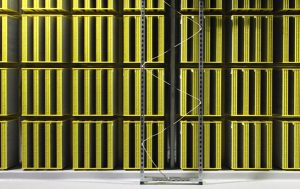
A typical server cabinet at Facebook uses 24,000 kilowatt-hours per year, four times the amount of the average family home. Thanks to the proximity of hydroelectric power plants near the Columbia River, energy is cheap in Prineville, about half the cost of elsewhere in the US. Photo by: Tank Magazine
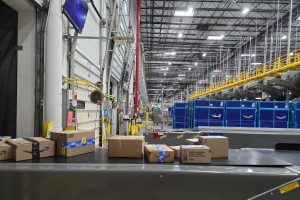
Human exclusion zones In order to understand and chronicle the emerging condition that the data centre embodies, we need to push open the pressurised doors and cross the lines of these human exclusion zones to trespass through the machine landscapes that run the world. The server farms, telecommunications networks, distribution warehouses, unmanned ports and industrialised agriculture that define the very nature of who we are today are at the same time places we can never visit. Instead they are occupied by processors and hard drives, logistics bots and mobile shelving units, autonomous cranes and container ships, robot vacuum cleaners and connected toasters, driverless tractors and taxis.
When early explorers were charting the “new world”, they would load up their ships and head off the map on expansive journeys with uncertain ends. They were pioneers plotting out uncharted lands and foreign territories, strange and unfamiliar although anything but empty. In “Machine Landscapes: Architectures of the Post Anthropocene”, the journal that I recently guest-edited, we mapped the less-trodden sites, architectures and infrastructures of a system not built for us, but whose form, materiality and purpose are configured to anticipate the logic of machine vision and habitation rather than our own. It is a compendium of conversations and encounters, travels and incursions in landscapes where we do not belong. It is a collection of spaces filled with autonomous natives, where we are each an intruder in an architecture that has left us behind.
The technological sublime We begin to make sense of a new phenomenon by naming it and framing it through mechanisms we find familiar. To assimilate the unknowns of the natural world we first understood it through mythology and folklore. Gods pulled the sun across the sky and sea monsters crashed waves across ships. Then our objective, scientific eyes categorised nature, developing classes and species, and all fell into line. Machine landscapes are typologies without history. They are sites that force us to question all we know of architecture and we must again re-evaluate our own position in relationship to the spaces and systems around us. So many of these evidentiary artefacts of this emerging era suggest new typologies or call out the inefficiencies of architectural conventions based around our own bodies that until now have seemed satisfactory. We don’t have sufficient terminology to describe these conditions; they emerged in the shadows, out of sight, in territories where we are not allowed to wander. They occur at scales where the disciplinary language of architecture breaks down, where interiors are so vast that they become microclimates, where landscapes are so engineered they become circuit boards, where robots are so ubiquitous they become nature, where aisles through the server stacks are like partitions on a hard drive and buildings are so full of machines that they are better understood as urban-scale computers.
The default position of the architecture profession seems to be to try and reclaim this lost territory, to sneak back in and parasitically occupy these landscapes with ergonomic furniture, open-plan offices, green walls and raw-juice bars. The marquee architectures of technology are the corporate headquarters of BIG and Heatherwick Studio’s Googleplex, Foster + Partners’ Apple campus and NBBJ’s Amazon Spheres. These are not the star architects of the post-Anthropocene. They are just set-dressing the waiting rooms, distracting us with expressive displays while the machines program our planet, hidden behind windowless walls and anonymous forms. In these new landscapes, the poetics of human occupation are extraneous, the scale of the body is immaterial and we must explore new forms of productive engagement with the non-human world.
Amazon warehouse in Rockford, Ilinois, USA, Photo by: Kirkam
Ideology rarely evolves at the pace of our technology. As we turn our gaze toward the machine landscapes we need to radically embrace our uncomfortable place in a world where we are no longer at its centre. These sites, structures and spaces mark an end to human-centred design as we now chart an era of hard-drive-centred design, Lidar-centred design or autonomous-car-centred design.
The founding machine landscapes of the post-Anthropocene are already here, critical and fundamental, embedded in the ground of the Earth and the fabric of the planetary city. Their cooling fans spin, the electromagnetics hum, the LEDs flicker and it smells of rare earth. Machines are making the world and we are on the outside peering in, faces pressed to the glass windows of an empty control room.
First published on TANK Magazine. An edited extract from “Neo-Machine: Architecture Without People” by Liam Young, featured in “Machine Landscapes: Architectures of the Post-Anthropocene”, Architectural Design, Vol. 89:1, January-February 2019, guest-edited by Liam Young.